
دليل لأنواع أحجيات الصور المقطوعة لتجار الجملة والعلامات التجارية
Most lists of the types of jigsaw puzzles mix shape, theme and age in one column. That is fine for a shopper and useless for a buyer. Your factory cannot quote “animal puzzle”. It can quote a 1,000-piece, random-cut puzzle on 2 mm grey board, in a panoramic format, with a linen finish.
That one sentence carries five separate decisions. This guide takes them one at a time, and shows what each one does to your tooling, your carton and your paperwork.
1. Types of Jigsaw Puzzles: The Short Answer
There are five axes, and every product sits on all five:
- Piece count — 12 to 3,000 and up.
- Cut — ribbon, random or whimsy.
- Board — grey, blue, white or black board, wood, foam.
- Format — rectangle, panorama, shaped, round, framed, floor, 3D.
- Finish — varnish, linen, spot UV, foil, lenticular, colouring.
Themes are not on the list, and that is deliberate. An animal design and a cityscape design of the same size use the same die, the same board and the same box. Theme changes the print plate, not the price. If a supplier quotes you two very different prices for two themes, ask what else changed.
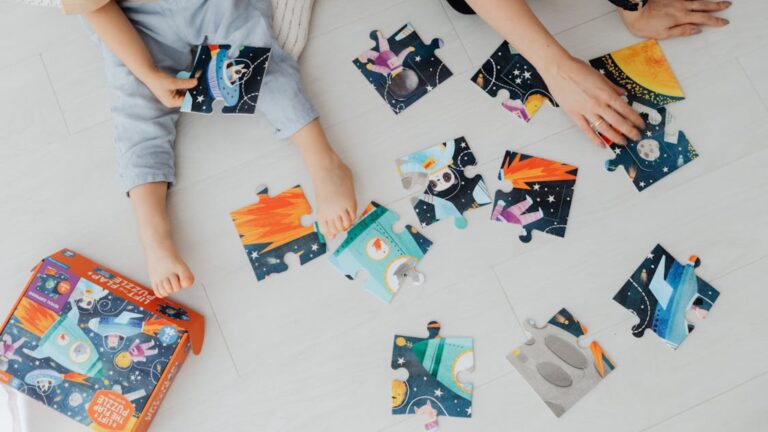
Before the axes, one definition, because the trade uses the word loosely: a jigsaw puzzle is a picture cut into interlocking pieces that the buyer reassembles. If you need the full version, our guide to what a jigsaw puzzle is covers the parts and the history. For the board, the box and the basics in one place, read jigsaw puzzles 101.

2. Axis 1: Piece Count Decides Your Paperwork
This is the axis that costs the most money, and not because of the board.
| Piece band | Typical finished size | Sold to | EU toy law | US children’s product |
|---|---|---|---|---|
| 12–48 | 20–30 cm | ages 2–4 | نعم | نعم |
| 100–300 | 36–49 cm | ages 4–8, schools | نعم | نعم |
| 500 | 49 × 36 cm | families, gifts | Yes (500 or less) | Case by case |
| 1,000 | 70 × 50 cm | adults, gifts | لا | Usually no |
| 1,500–2,000 | 80 × 60 cm to 98 × 75 cm | hobby | لا | لا |
| 3,000+ | 121 × 80 cm and up | hobby | لا | لا |
Sizes are the publisher standards we checked, not a rule. Your mould decides your size.
Why 500 Is the Most Expensive Number in This Trade
In the EU, a puzzle with more than 500 pieces is not a toy. That line is in Annex I of the toy directive you ship under today, and the replacement regulation keeps it. The customs side matches: the tariff annex to the new regulation lists puzzles with 500 pieces or less inside heading 9503.
So a single number flips your whole file:
- 500 pieces or fewer: toy rules, EN 71 tests, CE marking, and a technical file to match.
- More than 500 pieces: outside toy law, no CE toy marking, no EN 71 programme.
Most buyers hear “outside toy law” and relax. Do not. Above 500 pieces the product falls under the EU General Product Safety Regulation, which has applied since 13 December 2024. That means a risk assessment, a technical file, an EU-based responsible operator and traceability on the label. You did not lose the rules. You swapped one rulebook for another, and the second one is less familiar to most factories.
What the Same Number Does in the United States
The US draws a different line, and it is not 500. It is 12 years old. Under CPSIA, a children’s product is one designed or intended primarily for children 12 or younger. General use products skip the lead limits, the tracking label and the third-party testing.
A 1,000-piece landscape puzzle age-graded 14+ is normally a general use product. That saves real money: no CPC, no third-party lab test, no tracking label.
The saving is easy to lose. Regulators weigh four things, and one of them is how you market the product. If the box shows a family with young children, or the listing sits in a kids’ category, the claim that it is for adults gets weak. Adult artwork, an honest 14+ mark, and no children in the photos — those three keep the exemption.
The Piece Count Is Approximate, and That Is Normal
A 1,000-piece jigsaw puzzle usually holds about 1,008 pieces. The count comes from rows times columns, and the pieces have to be roughly square. Publishers round the number on the box, because shoppers buy a band, not a count.
That matters when you inspect a shipment of jigsaw puzzles. Do not reject a carton for holding 1,008 pieces. Check the finished size, the piece size and the cut instead. For the kids’ bands, our jigsaw puzzles by age guide lists what each age can actually handle.

3. Axis 2: The Cut Decides Your Tooling
Three cuts cover the market.
- Ribbon cut — a grid of rows and columns. Pieces are similar in shape, with a few peg variations. This is the default for retail puzzles.
- Random cut — irregular pieces with no visible grid. Harder to solve, and it hides a repeated image well.
- Whimsy cut — a random cut with figure pieces shaped like animals, letters or a logo.
Here is the part that hits your budget. A ribbon die is a grid, so one die can serve many designs at the same size. A random die follows the artwork, so every new image needs its own die. Whimsy pieces add hand work to the die and slow the press.
That single difference explains most of the price gap between two quotes for “the same” 1,000-piece puzzle. One factory is amortising a stock grid die across fifty designs. The other is cutting a new die for your picture.
The cut also decides returns. Loose fits come from a worn die or a board that is too thin for the blade. Ask how many cuts the die has already made. A die is a consumable, not a permanent asset. Our production steps guide shows where the die sits in the line.
The cut sets difficulty too, and difficulty sells. A random cut makes a flat sky harder without changing the picture. If you want the end user’s view of what makes a puzzle easy, our نصائح للمبتدئين في حل ألغاز الصور المقطوعة explains it in plain terms.
4. Axis 3: The Board Decides How It Feels
Board is where cheap puzzles show themselves, and where a premium line earns its shelf price.
| Board | What the core looks like | Thickness we see quoted | Used when |
|---|---|---|---|
| Grey board | grey recycled core | 1.5–3 mm | everyday adult puzzles, the default |
| Blue board | blue-grey core | 1.8–2.5 mm | mid-range, the usual step up for puzzles |
| White board | white core | 1.5–2.5 mm | pale artwork, so the edge stays clean |
| Black board | black core | 2–2.5 mm | dark artwork, no light edge line |
| Plywood / MDF | wood | 3–5 mm | wooden puzzles, keepsakes |
| Foam board | soft foam | 5–10 mm | toddler floor puzzles |
Two rules of thumb. Under 1.8 mm, a large puzzle warps in a humid warehouse or a container. The blade has to match the board. A die built for 1.6 mm board will crush 2.5 mm board, and a die built for thick board will leave tabs that tear.
Thickness is also weight, and weight is freight. A 1,000-piece puzzle on 2 mm board lands around 0.9 kg. The same jigsaw puzzle on 2.5 mm board is heavier, stiffer and more expensive on both counts.
5. Axis 4: The Format Decides Your Carton
| Format | What it is | Tooling | Carton effect |
|---|---|---|---|
| Rectangle | standard grid | قابلة لإعادة الاستخدام | best use of space |
| Panorama | long, thin ratio | own die | long box, poor pallet fit |
| Shaped | die-cut outline | own die, board waste | mid |
| Round | circular | own die | awkward, needs insert |
| Framed / tray | pieces sit in a frame | frame plus die | bulky for the piece count |
| Floor | large, thick pieces | big die | worst per unit |
| 3D wooden | plywood sheets | laser file, no die | heavy |
| Cube / block | six printed sides | own die | small, impulse price |
Panorama is the format that surprises new buyers. The picture is wide and short, the box is long, and the box sets the carton. You can lose a third of a pallet to a shape decision that looked like an art choice.
Shaped puzzles waste board by design: the outline is cut from a rectangle and the offcuts are scrap. On a 500-piece shaped jigsaw puzzle, that scrap can be a visible share of the material cost. Ask for the board sheet count per unit, not just the board price.
ملكنا puzzle catalogue shows these formats side by side with their cartons.

6. Axis 5: The Finish Decides the Shelf Price
Finish is the cheapest way to move a jigsaw puzzle up a price band, and the easiest way to make it look cheap.
- Varnish — standard, slight sheen. Fine for mass retail.
- Linen — a woven texture that scatters light. The single best upgrade for a premium line.
- Spot UV — gloss on one area only. Works on dark or photographic art.
- Foil — metallic accents. Popular on gift and licensed lines.
- Lenticular — a printed 3D or motion effect. Higher cost, higher risk of scratches.
- Double-sided — two images, twice the print plates.
- Colouring board — uncoated white surface for pencils or markers. It turns one puzzle into a craft product.
One warning on finish. Lamination and heavy varnish can dull the cut, so the die has to be set for the surface, not just the board. If you upgrade the finish, re-check the sample’s fit. Design ideas that work on a shelf are in our puzzle design list.

7. What Do the Types of Jigsaw Puzzles Cost?
Prices below come from listings we reviewed in Zhejiang and Guangdong in October 2026. They are a rough guide, not a promise.
| منتج | MOQ we saw | FOB we saw | إنتاج |
|---|---|---|---|
| 1,000-piece paper puzzle, 2 mm grey board | 300–1,000 sets | US$0.90–3.50 per set | 15–30 days |
| 500 / 1,000-piece sublimation puzzle | 100 pieces | US$2.10–2.60 per piece | 7–14 days |
| 1,000-piece wooden puzzle | 300 sets | US$1.85–4.20 per set | 3–4 weeks |
| Stock puzzle, own artwork printed | 100 pieces | Quoted per title | 2–5 days |
Three things move those numbers more than the picture does:
- Volume. One listing dropped from US$3.00 at 1,000 pieces to US$2.30 at 5,000. Another fell from US$1.50 to US$0.90 between 500 and 5,000.
- Board grade. 2 mm grey board is the baseline. Blue, white and black cores cost more, and the jump is per sheet, not per box.
- Die. A stock grid die can be free to use. A new random die is a one-off cost you pay before the first puzzle is cut.
On samples, the pattern is consistent: stock samples are free and you pay the courier; custom samples run around US$100 and are refunded on order. Ask for the refund term in writing.
Payment is usually 30% deposit with the balance before shipment, and 40/60 on custom work. Sea freight suits this product: a 1,000-piece puzzle weighs under a kilo, and one carton of ten takes about 0.06 cbm. Air freight does not suit it.
8. Which Types Should You Stock for Your Channel?
| If you sell to… | Start with | لماذا |
|---|---|---|
| Amazon and marketplaces | 1,000-piece, random cut, linen finish | High perceived value, strong photos, adult price band |
| Toy chains and supermarkets | 100–500-piece, ribbon cut, 2 mm board | Safe, stackable, easy to replenish |
| Gift and stationery | 500-piece panorama, shaped or round | Looks like a present, not a toy |
| Schools and nurseries | 12–48-piece framed or floor puzzles | Small hands, big pieces, hard-wearing |
| المشترين الترويجيين | Cube and small shaped puzzles | Low unit cost, brandable, mails flat |
| Museum and gallery shops | 1,000-piece panorama, linen, spot UV | Art first, puzzle second |
Two channel notes. Gift and museum buyers will pay for finish and packaging, and almost nothing else. Promotional buyers will not pay for either, and will ask for a printed bellyband instead of a box.
If you are new to the category, read the wholesale supplier guide before you build a range, and compare puzzle brands to see which types each one leans on.
9. What Do You Need in Writing Before You Order?
Six lines, all of them quotable.
1. Piece count and finished size, in millimetres. 2. Board grade and thickness, for example 2 mm blue board. 3. Cut type, and who owns the die. 4. Artwork files, at 300 dpi, plus a colour proof on the real board. 5. Packaging and carton, including units per carton and carton size. 6. Tests and HS code, named for each market you ship to.
On paper six, most Chinese factories quote HS 9503006000 for puzzles, and the US tariff line is 9503.00.0060, which carries a free rate today. Confirm both with your broker before you price an order. If the goods are for children, add the test list: EN 71 in Europe, ASTM F963-23 and CPSIA in the US. Our notes on toy testing labs cover who can issue the reports.
Then order a pre-production sample and keep it. That sample is your reference for board colour, cut feel, box strength and print. Everything after that is a comparison against it.
If you are comparing factories, our list of مصنعي ألغاز الصور المقطوعة و manufacturer brands is a starting point. For the wider toy factory picture, read مصنعي الألعاب في الصين و ال Chinese toy wholesale map of factory areas.
10. FAQ: Types of Jigsaw Puzzles
How many types of jigsaw puzzles are there? There is no fixed number. Five axes — piece count, cut, board, format and finish — combine into hundreds of buildable products. What matters is which axis your market cares about, and for most buyers that is piece count first.
What is the most popular type? The 1,000-piece adult puzzle is the volume seller in Europe and North America. The 500-piece is the safest gift, because it fits a normal table and a normal budget. Both sit close to a compliance line, so read the piece count before the artwork.
What is the difference between ribbon cut and random cut? Ribbon cut follows a grid, so pieces look alike and the die can be reused across designs. Random cut follows the picture, so each design needs its own die. Random is harder to solve and hides repeated textures better.
Are 1,000-piece puzzles toys in the EU? Not under toy law. Anything above 500 pieces is outside the toy directive, so no CE toy marking and no EN 71 programme. It is still a consumer product under the General Product Safety Regulation, so the safety file does not disappear.
Which type is cheapest to start with? A 500-piece ribbon-cut puzzle on 2 mm grey board in a tuck box. You use a stock die, a standard board and a small carton, and you stay inside toy rules if you sell to Europe.
Can one die be used for several designs? Yes, if the size and cut match. A stock ribbon grid can run dozens of images. Random and shaped dies cannot, because the cut follows the artwork.
Do puzzles for adults need a CPC in the US? Usually not, if the product is age-graded 14+ and marketed to adults. The decision looks at the label, the packaging images and how the product is sold, so keep children out of the photos. Marketplaces may still ask for documents.
الخلاصة
The useful way to think about types of jigsaw puzzles is not a list of themes. It is five axes, and one number that outranks them all: 500 pieces, which decides whether Europe treats your product as a toy. The second number is 12 years, which decides whether the United States treats it as a children’s product.
Get those two right, then choose the cut and the board. That is where the quote and the returns come from. If you want help mapping a range to a channel, start with our wholesale puzzle range. Send the team your piece counts, target retail prices and markets through the sourcing inquiry page. We will come back with a shortlist and real factory quotes. If you need stock rather than production, compare wholesale distributors on MOQ first, and read كيفية استيراد الألعاب من الصين before your first container.