The Evolution of Toys: 7 Stages, and What Each One Added to Your Cost
Type “evolution of toys” into Google and you get the same article twenty times. Ancient Egypt. The Industrial Revolution. Plastic. Electronics. Smart toys. It ends with a paragraph about sustainability.
That story is written for parents. It is a nice story, and it is useless when you are reading a quote.
Here is the version that matters to a buyer. Every stage in the evolution of toys added a layer of cost. None of those layers were ever removed. The FOB price on your desk today is all seven of them, stacked. Once you can see the stack, you can tell which layers you are paying for and which ones you can drop.
Why the Usual Evolution of Toys Story Is Written for Parents
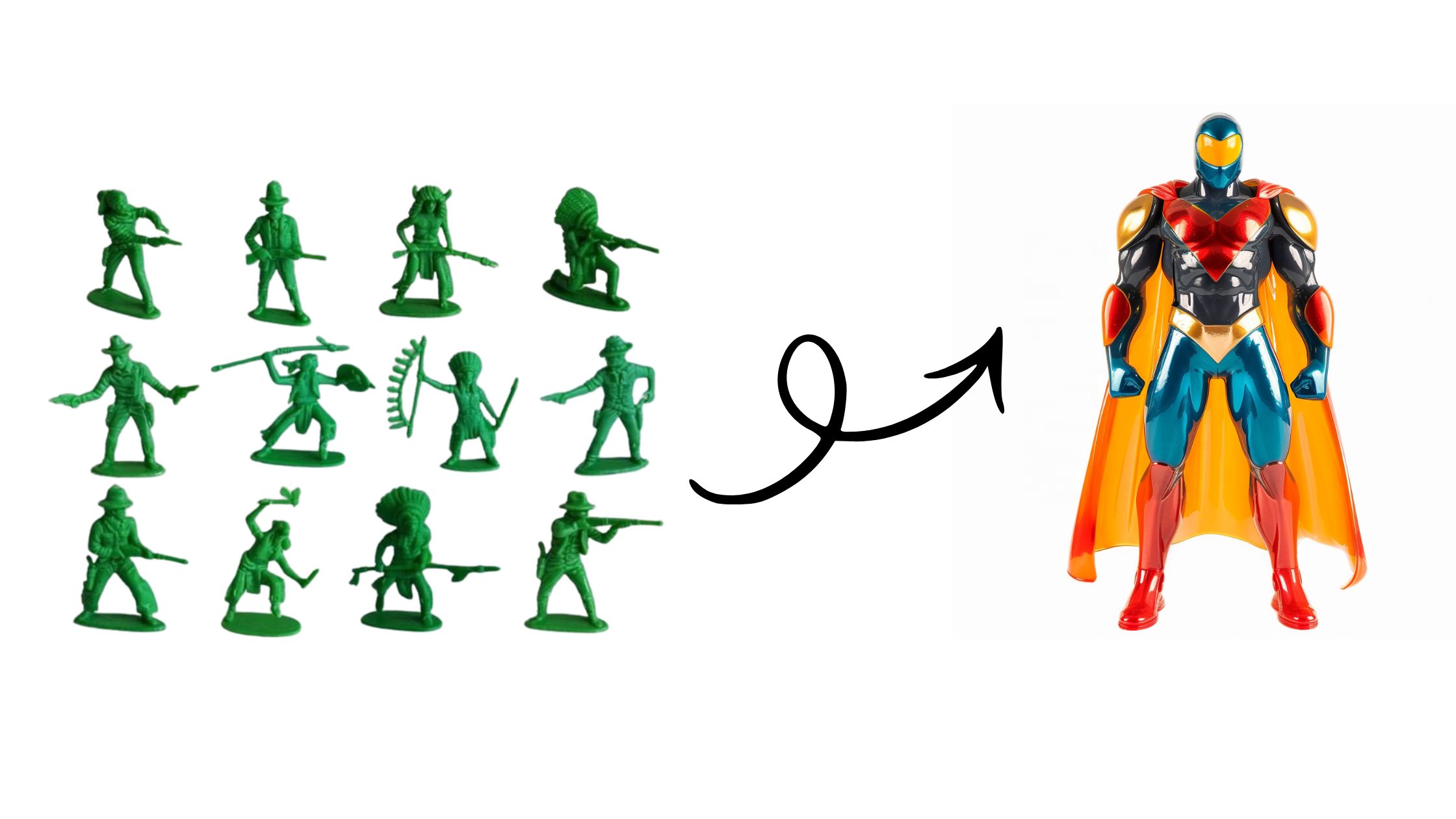
The standard history tracks cleverness. Wood got replaced by tin. Tin got replaced by plastic. Plastic learned to talk. Each step made the toy smarter, so the story goes up.
The buyer’s version tracks money. Each step added a fixed cost that does not go away. A wooden toy needs a cutter and a worker. A plastic toy needs a mould that costs thousands. An electronic toy needs three sets of approvals instead of one. The toy did not just get smarter. It got more expensive to start.
That is the difference that shows up in your order. Two toys can sit at the same retail price and carry completely different risk. One has a mould to pay off. The other has a lab bill. The guide to the different types of toys splits those costs across ten categories today. This page explains how they got there.
The Evolution of Toys in Seven Stages
| Stage | When | The layer it added | What it still costs you |
|---|---|---|---|
| 1. Wood and handwork | Before 1900 | Material plus skilled hands | Low MOQ, high unit price |
| 2. Tin and mass production | 1900–1950 | The first tooling | The idea of a minimum order |
| 3. Plastic | 1947 onward | Injection moulds | Mould cost, and tight tolerance |
| 4. Electronics | 1970s–2000s | Boards, batteries, radio | Two or three test schemes, not one |
| 5. Licensing | 1980s–now | The licence fee | A bill that never shrinks |
| 6. Compliance | 2008–now | Third-party testing | A fixed lab bill per SKU |
| 7. Adult collectors | 2020–now | Scarcity and packaging | The only stage that removed one |
Read down that last column. Six of the seven rows add cost. Only one takes it away, and it is the newest one. That is the part of the evolution of toys nobody writes about.
1. Wood and Handwork: The Only Stage With No Mould
For most of human history, a toy was what a carpenter could cut or a mother could sew. That is not nostalgia. It is a production fact, and it shaped the economics.
No mould means no minimum. A workshop can cut fifty units as easily as five thousand. The cost per unit barely moves, because there is nothing to pay off up front. What you pay for is hands.
That is still true. Wooden toys carry a higher unit price than plastic equivalents, and the reason is labour, not material. They also carry a lower entry cost, because nobody has to build a tool first. If you are testing a market with a small first order, wood is one of the few categories where that is honest. Start with the types de jouets en bois if you want to see what sits in this group, and the wooden toys wholesale page for buying terms.
Plush works the same way. A soft toy is cut and sewn, not moulded. That is why plush MOQs sit lower than most of the market. See plush toys in bulk for how those orders are built, and what to know about plush toys before you brief a factory.
The trade-off: no tooling means no barrier. Anyone can copy a sewn product in a week. A moulded product takes a competitor months.
2. Tin and Mass Production: Where the Minimum Order Was Born
The factory changed one thing. It moved the cost from the worker to the tool.
Stamping dies and presses let one worker make what a hundred used to. But the die had to be cut first, and it cost real money. So a factory could not make fifty. It had to make enough to spread the cost of the die across the run.
That is the origin of the minimum order quantity. It is not a policy someone invented to annoy small buyers. It is arithmetic. The tool has to be paid for, and the only way to pay for it is volume.
Toy cars came out of this stage, and they still carry its economics today. Look at jouets de voiture en gros and you will see the same pattern: a tooling cost up front, then a price that falls as the run gets longer.
Board games and printed products came through a similar door. The plate had to be made before the first sheet was printed. The board games buying page covers how print runs set the price on that side.
What this stage left you with: every tooling-based category now carries a question you have to answer early. Who owns the mould, and what happens if you move factory?
3. Plastic: One Machine Changed Everything
Here is the number that explains the whole stage.
In 1947, a Danish carpenter named Ole Kirk Christiansen bought a plastic injection moulding machine from England. It cost 30,000 Danish kroner. That was one fifth of his company’s annual earnings. Four years later, half of everything his firm made was plastic. On 28 January 1958, his company filed the patent for the brick we still know today. In 1960, a fire burned the wooden toy warehouse, and the company decided not to rebuild it.
That company was LEGO. Its own history page still tells that story, and the detail worth keeping is the price of the machine. A single asset, worth a fifth of a year’s revenue, changed the industry.
That is what plastic bought: the ability to make the same shape a million times, at a tolerance of two thousandths of a millimetre, cheaply enough to sell it in a box of five hundred. It also created the single biggest entry cost in the toy business.
A mould is a bet. It costs thousands, sometimes tens of thousands, and it is worthless if the product fails. It also locks your design. Changing a curve after the steel is cut means cutting new steel.
And it is paid up front. Most factories want the tooling money before they cut anything. The usual split is half when you place the order, and half when samples are ready. No factory takes that cost onto its own books for a new customer.
This is the stage that made building bricks a specialist business rather than a general one, and it is why the LEGO-alternative brands guide spends so long on tolerance. Fit is not a decoration. It is the product. The same logic runs through connector toys et OEM block toys.
If you want to see what a mould-led category looks like end to end, the OEM diecast car page walks through tooling, sampling and production in that order. And if you are sourcing this kind of product, the Shantou import guide covers the cluster where most of it is made, while the China toy wholesale market roundup gives you the wider map.
Plush moved into this world too, later. Modern soft toys use moulded parts, printed fabric and embroidered faces. The custom plush manufacturer page shows where the tooling shows up in an otherwise sewn product.
What this stage left you with: the largest single up-front cost in your order, and the longest lead time before you see a finished sample.
4. Electronics: One Toy, Three Sets of Rules
Adding a circuit board did more than add parts. It added a second regulator.
A plain plastic toy answers to one scheme: toy safety. Add a motor, and you are still mostly in toy safety. Add a radio, a Bluetooth chip or a Wi-Fi module, and you now answer to two more. The radio has to be approved. The battery has to be tested for transport. The charger, if there is one, has its own rules.
The bill did not double. It changed shape. Toy safety testing scales with the product. Radio approval does not care how many you ordered.
Remote control products sit at the centre of this. The RC toys page covers the category, and jouets drones sit at the strictest end of it, because a flying product gets looked at twice. Learning products went the same way. Once a teaching toy has a screen and a speaker, it is an electronic product that happens to teach. See STEM educational toys wholesale and the educational toys wholesale page for where that line falls, and the interactive toys roundup for what is shipping now.
The buying consequence: electronics raise your sample cost and your failure risk at the same time. A board that works in one unit can fail in one in fifty. Test at volume, not on a golden sample.
5. Licensing: The Cost That Never Shrinks
A licence fee behaves like nothing else on your cost sheet.
Mould cost falls per unit as you make more. Fabric gets cheaper at volume. A licence fee does not. It is usually a percentage of sales or a fixed minimum, agreed before you make anything. Order ten thousand or a hundred thousand, and the IP owner still takes their share.
So a licensed product has a floor under its price that an unlicensed one does not. That floor is real money, and it is the reason licensed goods need volume to work at all.
How big is this layer now? Circana reported that licensed products reached 37% of all US toy sales in the first half of 2025, up 18% on the year before. Roughly one in three dollars spent on toys in America now carries a licence fee inside it. The properties doing the work were Pokémon, NFL, Marvel, Squishmallows, Star Wars, Hot Wheels, LEGO Botanical Collection, Barbie, MLB and LEGO Star Wars. Nine of those ten are entertainment or sport.
That tells you where the demand sits, and also where the barrier sits. If you cannot get the licence, you compete on the other 63%. The toy brands page is a starting point on who owns what, and doll brands plus fashion doll brands show how concentrated that side is. Building brick brands show the same pattern in construction.
If you want your own product rather than someone else’s character, the route is OEM. Factory OEM covers how that works, and custom doll design shows it in a category where the tooling is expensive. Doll sizes matter more here than buyers expect, because a size change means a new mould.
What this stage left you with: a permanent percentage on your top line, and a contract you cannot renegotiate once the run starts.
6. Compliance: The Bill That Arrived in 2008
This is the layer most new importers miss, because it is invisible until it arrives.
Before 2008, a factory’s own test report was usually enough. Then the Consumer Product Safety Improvement Act was signed on 14 August 2008, and the rules changed for good. Under CPSIA, a children’s product has to be tested by a lab the CPSC accepts, and the importer has to issue a Children’s Product Certificate based on that testing. The product and its packaging also need permanent tracking information.
Two details matter more than the rest.
First, the line is drawn at twelve. A “children’s product” is one designed or intended mainly for children 12 years of age or younger. Everything in this section applies below that line.
Second, the bill is fixed. The lab charges by the sample and the test, not by your order size. A test that costs a few hundred dollars spread over fifty thousand units is nothing. Spread over five hundred units, it is a real share of your landed cost. This is why small first orders hurt more than buyers expect.
The route is laid out in the toy certification guide. For the US paperwork, the Children’s Product Certificate page covers what goes on the document, and the CE, EN71, ASTM and CPSIA page compares the schemes side by side. If you need a lab, the testing lab roundup is the shortlist.
Then the marketplaces added their own layer. Amazon wants the certificate uploaded before the listing goes live, and it asks for it again when a detail changes. See Amazon compliance for kids’ items et toy sourcing for Amazon sellers. Baby products sit in the strictest band of all, so start with baby toys if that is your category.
What this stage left you with: a fixed cost per SKU, before a single unit sells.
7. Adult Collectors: The Only Stage That Removed a Cost
Now the part nobody puts in a toy history.
For the first time in the evolution of toys, the newest generation is cheaper to comply with than the one before it. Not cheaper to make. Cheaper to approve.
Here is the data behind it. Circana’s 2025 numbers, reported by Kidscreen and The Toy Book, show US toy sales up 6% in the first half of the year, with the average price up 3% to USD 11.11. Sales to buyers aged 18 and over rose 18% in that window. Across the rolling year to September 2025, US spending by the over-12 group reached USD 13.4 billion, up 12%, or 30.2% of the whole US toy market. In Europe the same group reached EUR 5.7 billion, up 14%, and 32% of the market.
In the same report, the other side of the ledger: infant, toddler and preschool toys were flat. Plush fell 4%. Dolls fell 6%. Outdoor and sports toys fell 6%.
That is the turn. The fastest-growing buyer in toys is not a child. And that buyer sits above the line drawn in 2008.
Think what that means. A display piece made for an adult shelf is not designed or intended mainly for a child of 12 or younger. So it is not a children’s product. It does not need testing by a CPSC-accepted lab. The heaviest fixed cost in stage six simply does not apply.
That is why this generation looks different on a cost sheet. The money moved out of compliance and into other things: better packaging, tighter quality control, and scarcity. A blind box works because of what is inside the ratio, not because of what the lab found. The blind box business page breaks that down, and jouets capsules et jouets en bonbons are the older versions of the same idea.
Designer figures are the purest form of it. The art toy market guide covers how that business is priced, and how art toy figures are made shows the production route. Pop Mart is the name most buyers now know from this side of the industry. Novelty sits partly in both worlds, so novelty toys wholesale and the 2026 novelty roundup are worth reading together.
Do Not Assume “14+” Gets You Out of It
This is where buyers lose money, so read it slowly.
Printing 14+ on the box does not decide anything on its own. Under 16 CFR Part 1200, the CPSC weighs four factors:
1. What the maker says the product is for, including a label, as long as that claim is reasonable 2. Whether the packaging, display, promotion or advertising presents it as suited to children 12 or under 3. Whether consumers generally see it as something for a child 12 or under 4. The CPSC’s age determination guidelines, and any later version of them
A plush bear labelled 14+ can still land on the children’s side of the line. Soft toy, rounded shape, bright colour, sold next to the teddy bears. Factor three does the work, and the label loses.
The CPSC’s own guidance gives both edges. It says a piece of adult jewellery does not become children’s jewellery just because children find it attractive. It also says chess, checkers and playing cards are usually general-use products, because a hard game is hard. But add junior rules or childish artwork, and the same game moves across the line.
⚠️ One more trap. The age guidelines were revised in 2020. The 2020 edition replaced the 2002 one. A lot of secondary writing still quotes 2002, and the two do not agree on every category.
The CPSC’s rules also age-grade by test, not by label. Use and abuse testing is split into bands: 18 months and under, over 18 months up to 36 months, and over 36 months up to 96 months. The band you land in sets how hard the lab hits your sample. Getting the age wrong is not a paperwork problem. It means the wrong test.
So the honest version is this: adult-targeted products can carry a much lighter compliance load, and that is a real advantage. But the age grade has to survive all four factors, not just the one you printed on the carton.
What the Stack Tells You About Your Next Order
The evolution of toys is not a story about things getting cleverer. It is a story about fixed costs piling up. Here is how to use it.
Count the layers before you commit. A wooden puzzle carries layers one and six. An RC car carries three, four and six. A licensed electronic toy carries four, five and six. Each layer is a cost that arrives before you sell anything.
More layers means you need more volume. Fixed costs only behave if there is volume to spread them across. A two-layer product can work at 500 units. A five-layer one rarely can.
The newest layer is the cheapest one. If your product can honestly be sold to adults, the compliance load drops. Just make sure the age grade survives the four-factor test, not only the label.
Watch how the money is staged. Tooling is paid first, before production starts. Then comes a deposit, usually around 30%, with the balance paid against the shipping documents. A factory that wants 100% up front on a first order is telling you something.
Ask who owns the tooling. Layer three is the biggest cheque you will write. Know what happens to the mould if you change factory, and get it in writing before you pay.
Then check what the tariff does on top. The import tax guide covers that. And if you want to see the whole market before you pick, how to find toy manufacturers in China and the China toy suppliers page are the two places to start. Fairs are still the fastest way to read a year ahead, so the China toy fair page is worth a look as well.
FAQ
What is the evolution of toys, in one line? Seven stages, and each one added a layer of cost that never went away: handwork, tooling, moulds, electronics, licensing, compliance, and adult collectibles. Only the last one removed a layer.
Which stage matters most to a buyer? Stage three, plastic. The injection mould is usually the biggest single up-front cost in an order, and it locks your design before you have sold anything.
Did toys actually get more expensive? The average US toy price rose 3% to USD 11.11 in the first half of 2025, per Circana. But the bigger change is in fixed costs, not unit price. Testing and licences arrive before the first sale.
Why is compliance such a large share on small orders? Because the lab bills by the sample, not by your order size. A few hundred dollars of testing spread over 500 units is a large share of landed cost. Spread over 50,000 it disappears.
Are toys for adults really easier to import? Often yes, on paperwork. Products aimed above age 12 are not children’s products under US rules, so third-party testing and the Children’s Product Certificate do not apply. But the age grade has to hold up across all four CPSC factors, not just the label on the box.
Which categories are shrinking? Per Circana’s first-half 2025 figures: dolls down 6%, plush down 4%, outdoor and sports down 6%. Infant, toddler and preschool were flat.
Which categories are growing? Games and puzzles were up 39%, explorative toys up 19%, youth electronics up 9%, action figures up 8%, building sets up 7%. Licensed goods were up 18% and reached 37% of US toy sales.
Is the 12-year line the same in the EU? No. The EU works from the toy directive and its own age framework, and the two systems do not line up exactly. Compare them on the CE, EN71, ASTM and CPSIA page before you assume one report covers both markets.
Can I use one test report for several SKUs? Rarely. A report covers the sample tested. Change a material, a colourant or a supplier, and you are usually looking at a new test.
What is the cheapest way to test a new category? Pick a category with fewer layers. Wood and plush have no mould cost, so a small first run is honest. Save mould-led categories for when you know the market.
Next Step
Tell us which stage your product sits in, and how many you plan to order. You get back a per-layer breakdown: tooling, unit price, testing, certificate and freight, on one sheet you can compare.
Most quotes show one number. We show you which of the seven layers is driving it, because that is usually where the saving is.
Request a quote or email info@tonysourcing.com.
Before you commit, the toy certification guide covers the EU route, the Children’s Product Certificate page covers the US route, and the import tax guide covers what the tariff adds on top.