Custom Toy Packaging: Materials, Costs, and Ordering from China
Custom toy packaging should fit your product, sales channel, and order quantity. When sourcing toys from China, plan the box, insert, labeling, and assembly together. This guide helps you choose a suitable structure, compare complete quotations, and approve packaging before committing to production.
#1 What Does Custom Toy Packaging Include?
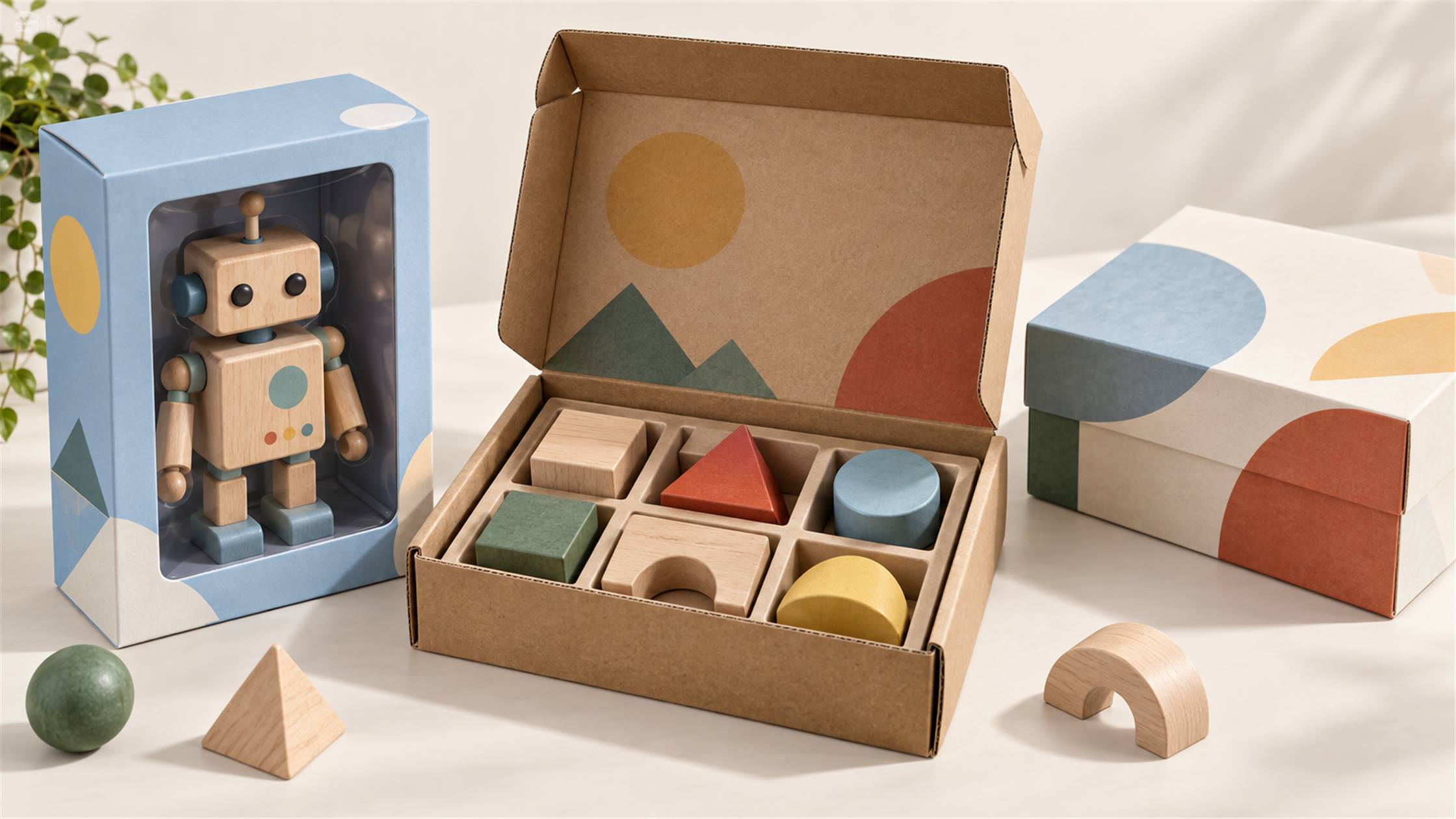
Custom toy packaging is packaging adapted to your toy or brand through its dimensions, artwork, structure, or internal supports. A printed sleeve around an existing box and a new box with a molded tray represent different levels of customization.
Define which parts your order includes:
- The sales package: the box, card, sleeve, or other presentation the customer receives.
- Internal packaging: inserts, dividers, restraints, and compartments that hold the toy and accessories.
- Shipping packaging: the outer carton and protective materials used for distribution.
These parts must work together. A display box may hold a figure upright on a shelf yet need a separate shipping carton. When you request “custom packaging,” specify whether you want empty printed boxes or toys fully packed and ready for dispatch. That distinction affects the quotation and who performs the work.
#2 Choose the Structure Around Your Sales Channel
Start with the toy’s weight, shape, fragile areas, and accessories. Then decide whether customers need to see it, whether the box must hang or stack, and how orders will be delivered.
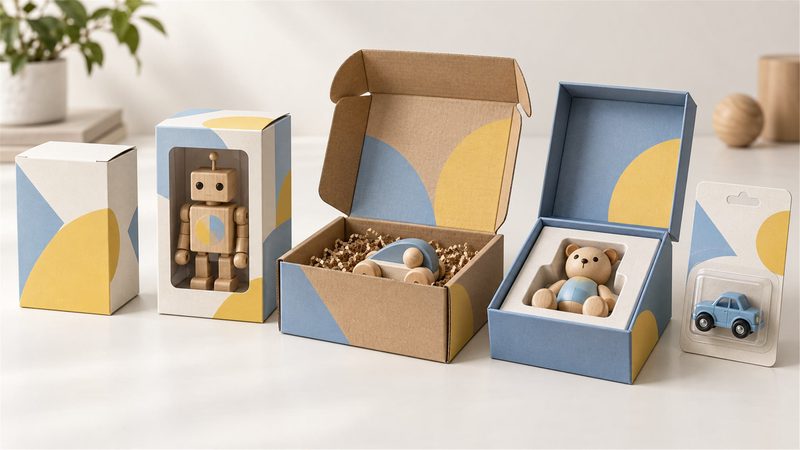
Packaging manufacturers offer folding cartons, corrugated boxes, rigid boxes, and several insert materials. These are available construction options, not interchangeable performance grades. See this manufacturer’s toy packaging specifications.
| Structure | When to consider it | What to check before approval |
|---|---|---|
| Folding paperboard carton | Lightweight toys and compact sets with printed instructions or graphics | Bottom closure, panel stiffness, accessory containment, and loaded fit |
| Window box | Figures, dolls, or other toys where seeing the actual product helps selection | Product restraint, window attachment, and support around the opening |
| Corrugated box or mailer | Activity kits, larger products, or a proposed direct-shipping format | Performance with the complete contents and intended shipping arrangement |
| Rigid box with a fitted insert | Collector products or gift sets where presentation justifies the extra expense | Assembly cost, storage space, corner condition, and shipping protection |
| Blister with a backing card | Small toys intended for visible hanging display | Blister fit, card attachment, hanging strength, and opening method |
For blister packaging, the shaped plastic and printed card need to be developed as a pair. A vacuum-forming example from equipment supplier MY YARD shows a PET front formed over a mold and attached to a backing card. This illustrates the construction process; it does not establish the performance of your proposed package. MY YARD’s toy packaging example.
Match the Insert to the Toy’s Vulnerable Areas
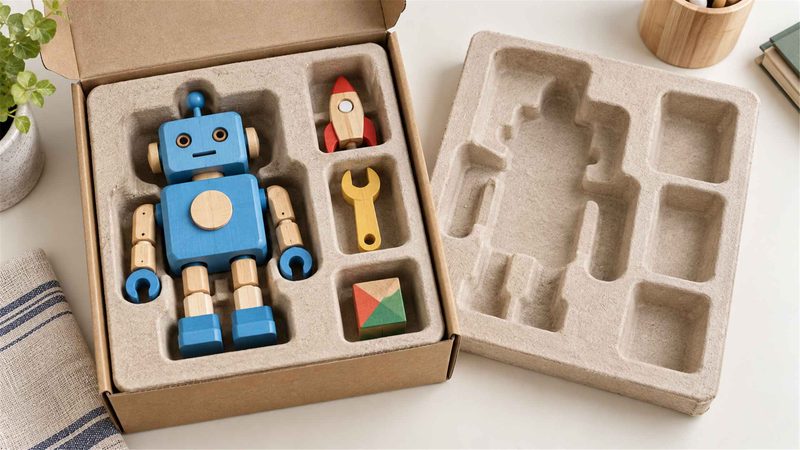
Ask your supplier to show where the insert supports the product. A fragile antenna, wheel, or painted face should not become an unintended pressure point. For a set, check that accessories cannot migrate into another compartment during handling.
Request a loaded prototype before adding decorative finishes. If the contents move or the closure struggles, revise the structure first. Upgrading the surface finish will not correct those problems.
#3 Compare MOQ and Total Cost Together
There is no universal minimum order quantity for custom toy packaging. For example, Mei Packaging publishes different minimums for rigid boxes and folding or corrugated boxes, while also asking buyers to confirm project-specific requirements. Treat a supplier’s advertised MOQ as a starting point for discussion. Mei Packaging’s FAQ.
Ask whether the minimum applies per size, structure, printed design, or combined order. Also confirm whether the insert has a separate minimum.
Illustrative example: you order 1,000 toys across four designs, with 250 of each. If the packaging supplier requires 500 boxes per printed design, four different artworks would mean purchasing 2,000 boxes. Your total toy quantity does not automatically satisfy each packaging minimum.
You could ask about a shared box with correctly differentiated labels, a short-run printing option, or storing spare packaging. Compare the cash commitment and future usability of each choice before accepting surplus stock.
Ask for a Complete Packaging Cost
A useful comparison includes the printed box, insert, setup or tooling, samples, assembly, delivery to the packing location, and any additional shipping materials. Confirm which charges are one-time and which recur.
For a first order, compare:
Packaging cash outlay per packed toy = total packaging-related outlay for the order ÷ toys packed in that order.
Include surplus boxes in the cash-outlay calculation, but record their remaining inventory value separately. This prevents a low box price from hiding a larger upfront purchase.
Compare packed dimensions as well as unit prices. FedEx explains that dimensional weight can determine shipping charges when it exceeds actual weight. The applicable calculation depends on the service and terms. Ask your logistics provider to assess the proposed shipping carton before you finalize an oversized retail box. FedEx’s dimensional-weight guidance.
#4 Decide Who Will Supply and Pack the Boxes
You can ask the toy supplier to coordinate packaging, manage a separate packaging supplier, or use a sourcing team to coordinate both. The right arrangement depends on the work each party can actually perform.
Using the toy supplier as the main contact can simplify communication, provided it can obtain the required structure and manage packing. A separate packaging specialist may be worth considering for a more demanding design, but you must arrange delivery, fit checks, assembly, and responsibility for rejected materials.
Before ordering, record who will:
- Measure the final toy and approve the structural drawing.
- Supply and check the artwork, labels, and instructions.
- Receive and inspect empty packaging.
- Pack the toys and check accessory counts.
- Resolve shortages, damaged boxes, or fit problems.
Name the packing location in the quotation. A supplier offering empty boxes delivered to your warehouse is quoting a different job from one supplying packed toys at the factory.
#5 Send a Packaging Brief Suppliers Can Quote Consistently
Give each supplier the same requirements. If a material is undecided, ask for clearly identified alternatives rather than allowing unrecorded substitutions.
| Information to provide | What to specify |
|---|---|
| Product | Photos, dimensions, weight, accessories, and preferably a physical sample |
| Order breakdown | Quantity per SKU, artwork version, and language version |
| Market and channel | Destination country, retail display or e-commerce route, retailer requirements |
| Box and insert | Preferred structure, internal dimensions, support points, and closure |
| Materials | Board type and proposed thickness or grammage, insert material, window material if used |
| Printing | Artwork status, printed sides, color references, and required finishes |
| Labeling | Approved text, barcode data, variable batch information, and placement |
| Delivery | Packing location, required arrival date, units per outer carton, and delivery terms |
| Commercial terms | Separate sample, tooling, assembly, transport, and repeat-order charges |
Keep structure and material descriptions separate. “Kraft,” for example, is not enough to describe a finished box’s construction. Chinese packaging specifications commonly list board, surface treatment, and insert as separate fields; use that level of detail when confirming your order. Example specification from Bolin Printing.
Also request a schedule with separate dates for structural approval, artwork approval, packaging production, packing, and dispatch. “Production time” alone does not tell you when the finished toys will arrive.
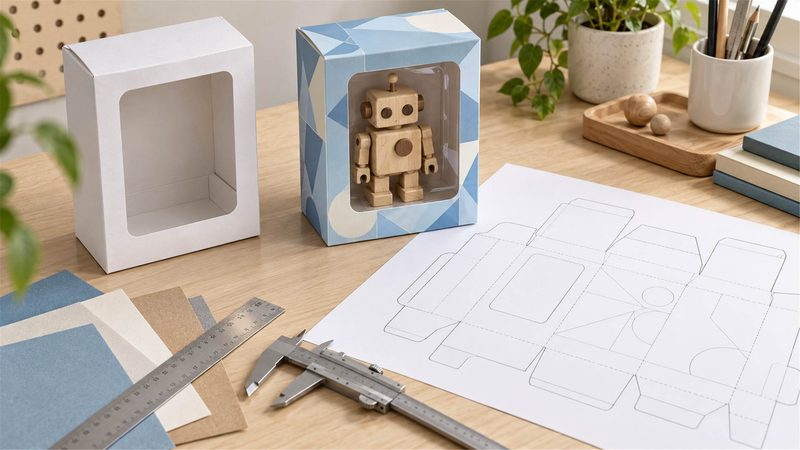
#6 Approve Samples in Stages
A generic sample kit helps you inspect available materials and printing, but it does not prove your toy will fit. Packlane, for example, distinguishes its non-customizable sample kit from a test order made in the buyer’s design or dimensions. Packlane’s sample guidance.
For your own order, use these approval stages:
- Structural sample: pack the actual toy and accessories. Check fit, support, closure, and removal.
- Artwork proof: review every panel against the current dieline—the drawing showing cuts and folds. Confirm text, orientation, product images, and version details.
- Production-representative sample: confirm which materials, printing processes, finishes, and assembly methods match the bulk order. Record any differences.
- Packed shipping sample: evaluate the finished toy, sales package, and outer shipping arrangement together.
For transport testing, select a procedure appropriate to the distribution route. ISTA describes Procedure 3A as a simulation for individual packaged products moving through parcel delivery systems; it is not a universal specification for every shipment. Agree on the appropriate procedure and acceptance criteria with your testing provider. ISTA’s official 3A overview.
Keep an approved reference sample and a dated specification. Define acceptable cosmetic condition as well as product protection: for a collectible, a functioning toy inside a visibly damaged retail box may still fail your sales requirements.
#7 Check Labels and Claims Before Printing
Reserve space for required information early. Otherwise, a late label change can obscure artwork, force a box redesign, or require rework after printing.
For U.S. children’s products, tracking information generally belongs on both the product and packaging, subject to practicability and specific exceptions. Packaging artwork should therefore be coordinated with the product’s marking plan. CPSC tracking-label guidance.
The requirements for the toy itself also depend on the product and applicable rules. A packaging supplier’s material certificate does not establish that the finished toy meets all relevant requirements. Have the responsible compliance reviewer confirm the labeling and documentation for your SKU and destination before artwork approval. CPSC toy-safety guidance.
Check barcodes on printed samples, including the encoded data and required clear space. Where your retailer requires formal print-quality verification, a successful phone scan is not a substitute. GS1’s guidance explains the roles of placement, contrast, quiet zones, and verification. GS1 retail barcode guidance.
Make Environmental Claims Specific
Ask for the composition of the whole package, including windows, coatings, and inserts. A paper exterior alone does not establish the recyclability of every component.
For U.S. marketing, the FTC advises against broad, unqualified claims such as “eco-friendly” and explains that recycling availability affects recyclable claims. Use wording supported by the actual materials and intended market, with clear qualifications where needed. FTC Green Guides summary.
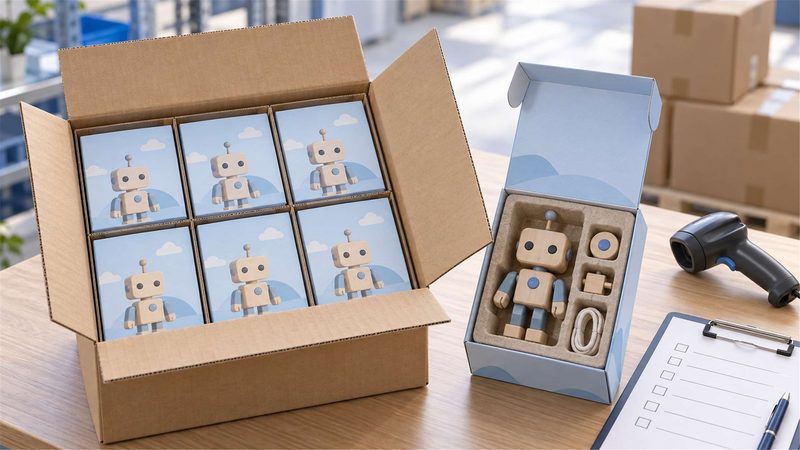
#8 Inspect the Finished Packing Before Shipment
Turn the approved specification into inspection checks. Include correct toy-to-box matching, artwork version, accessory count, insert position, closure, visible damage, barcode data, and outer-carton quantity.
For mixed orders, verify the assortment inside cartons against the packing list. Checking a carton label alone cannot confirm its contents.
Agree in advance on how failed checks will be handled and rechecked. This gives the supplier a defined correction process instead of leaving you to negotiate one when dispatch is due.
#9 Plan Packaging as Part of Your Toy Order
Choose the simplest structure that meets your display, protection, and labeling needs. Compare the cost of fully packed toys, then confirm the physical result before bulk production. That sequence makes packaging decisions easier to control across suppliers.
If you are sourcing toys from China, send TonySourcing your product photos or samples, quantities per SKU, destination market, sales channel, and packaging references. Its published services include private-label packaging, instruction manuals, barcodes, and carton coordination, providing a relevant starting point for discussing your toy order. Discuss your sourcing requirements with TonySourcing.
#10 Frequently Asked Questions
Can I customize packaging without changing the toy?
Often, packaging and product customization can be quoted separately. Ask the supplier to distinguish existing-toy packaging work from changes to the toy’s color, components, or tooling. Confirm brand and artwork permissions for the proposed product.
Do I need to own the packaging tooling?
Clarify ownership and future use before paying for custom tooling. Ask who keeps it, whether storage or replacement fees apply, and whether you can obtain the structural files. Do not assume that a setup charge includes transferable tooling rights.
Can I reuse the same box for a repeat order?
You may be able to reuse the structure, but check whether the toy, accessories, artwork, or required information has changed. Keep batch-specific information controlled separately so you do not reuse an outdated production code.