Types of RC Trucks: 8 Kinds, What Each One Costs to Import
Every guide to the types of RC trucks sorts them by terrain. Monster trucks for grass, crawlers for rocks, short course trucks for dirt tracks. That sorting is right if you are buying one truck for yourself. It is nearly useless if you are buying 500.
A buyer needs a different split. What decides your landed cost is not the shape of the body. It is the motor, the speed controller, the battery and the radio set. Those four parts also decide which lab tests you pay for, and how many units come back to you. This page sorts the eight main types of RC trucks by those things, and gives you one number per type.
What Counts as a Type When You Buy RC Trucks, Not Drive Them
Here is the thing most first-time buyers miss. A truck body is the cheapest part on the bill. One 1:10 chassis can wear a monster body, a short course body or a desert body. The factory swaps a shell and calls it a new model. The frame, the motor and the radio underneath stay the same.
So when you compare the types of RC trucks below, read the spec row, not the photo. Two trucks that look nothing alike can share a bill of materials. Two trucks that look identical can differ by USD 40 because one ships with a brushless motor and a 3S pack.
If you want the car-level split first, the types of remote control cars page covers touring, drift, buggy and truck side by side. For what sits inside any of them, what an RC car is breaks down the parts. And if RC is only one line on your plan, the 10 different types of toys shows where it sits against everything else you could be buying.
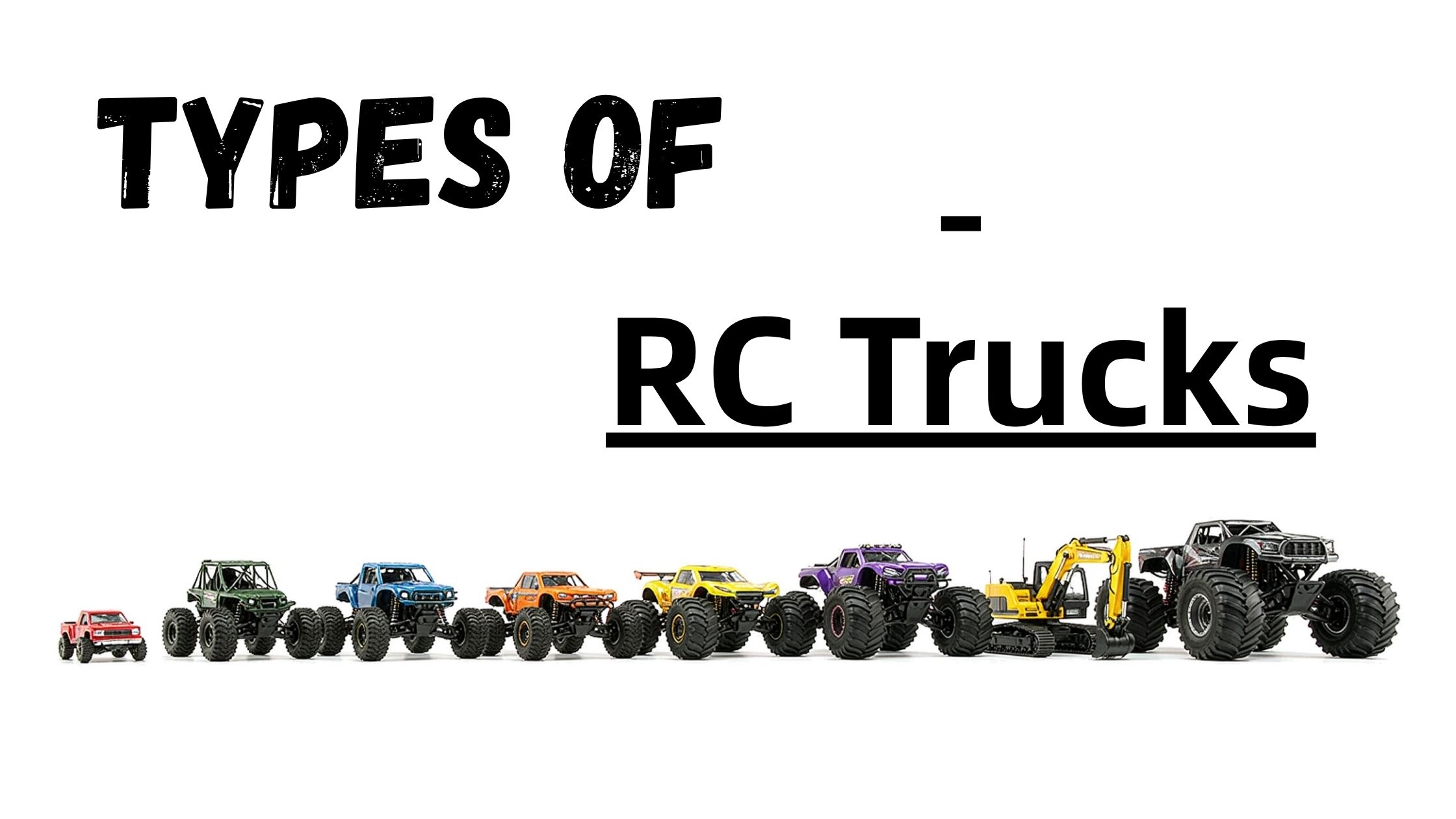
The 8 Types of RC Trucks at a Glance
| Tipo | Escala | Top speed | Motor and battery | Cantidad mínima de pedido | FOB per unit | Watch out for |
|---|---|---|---|---|---|---|
| Toy-grade mini truck | 1:24–1:32 | 8–15 km/h | Brushed, 3.7V or AA | 500–1,000 | USD 3.50–8.00 | Thinnest margin, price war |
| Entry hobby off-road | 1:16–1:10 | 25–35 km/h | Brushed, 7.4V | 300–500 | USD 12–22 | Battery run time claims |
| Monster truck | 1:10–1:8 | 30–50 km/h | Brushed or brushless, 7.4–11.1V | 200–500 | USD 18–32 | Broken suspension arms |
| Rock crawler / trail truck | 1:10–1:18 | 10–20 km/h | High-torque brushed, 7.4–11.1V | 200–300 | USD 28–55 | Portal axles cost real money |
| Short course truck | 1:10 | 45–55 km/h | Brushed or brushless, 7.4–11.1V | 200–500 | USD 20–38 | Body shells get crushed |
| Stadium / desert truck | 1:10–1:8 | 45–65 km/h | Brushed or brushless, 7.4–14.8V | 200–300 | USD 25–45 | Tyre wear, rim cracks |
| Speed monster / basher | 1:8–1:5 | 80–95+ km/h | Brushless, 4S–6S | 100–200 | USD 85–180 | Highest claim rate in RC |
| Construction / haulage | 1:14–1:20 | 5–12 km/h | Brushed, 7.4V, 6–22 channels | 100–300 | USD 22–60 | Channel count drives cost |
Prices are rough 2026 factory ranges, not a quote. The last column is the one worth reading twice, because that is where the money goes after the sale.
Eight rows, and every one of them can be built in Shantou. Which of the types of RC trucks you pick is a question about your channel, not about the truck.

1. Toy-Grade Mini Trucks: Cheapest Unit, Tightest Margin
These are the 1:24 and 1:32 trucks you see in a supermarket aisle. They run on a small brushed motor and a 3.7V pack, or on AA cells. Speed is 8 to 15 km/h. Many still ship on 27 MHz or 40 MHz rather than 2.4 GHz.
The unit price looks great. The margin does not. At USD 3.50 to 8.00 FOB you are competing with every other importer on the same shelf, and there is no spec story to tell. Freight also hurts: a truck this small still needs a printed box, and the box is a large share of the cost.
There is one real reason to order them. They fill a container. If you are already shipping wholesale RC toys and want to top up the cartons, these are the cheap filler.
Scale matters more here than anywhere else, because the smaller you go the less the truck can carry in electronics. The RC car scale guide shows what each scale actually measures.
2. Entry Hobby Off-Road Trucks: The Volume Driver
This is the type that moves. A 1:16 or 1:10 truck, four-wheel drive, 2.4 GHz with proportional steering, 25 to 35 km/h, a 7.4V 1,200 mAh pack, 18 to 22 minutes of run time, and 40 to 50 m of range.
Buyers do not compete on top speed in this band. They compete on whether the thing climbs stairs. That is the demo that sells it on a listing, and it is a suspension and torque question, not a motor question. Ask the factory for a stair-climb video before you ask for a price.
MOQ sits at 300 to 500 and FOB runs USD 12 to 22. It is the widest band of any truck type, and the easiest to get wrong. Two trucks at USD 14 and USD 21 can look the same on a sample table. The gap is usually in the ESC and the servo, not in the shell. Our RC toy buying page lists the spec set we hold factories to.
Run time is the claim that gets challenged. A 22-minute claim tested on a flat floor is a 14-minute claim in grass. Put the surface in your inspection report.
3. Monster Trucks: Big Wheels, Bigger Spare-Parts Business
Big tyres, long travel, high ground clearance. A 1:10 monster truck runs 30 to 50 km/h on a brushed motor, and crosses USD 30 once you move to brushless.
The cost driver is the suspension. Long travel means long arms, and long arms are the part that snaps. A truck that lands badly at 45 km/h breaks an A-arm or a shock cap. That is the single most common warranty claim on this type.
That is also the business case. Broken parts mean repeat orders. A buyer who stocks arms, shock towers and body mounts can run a parts line at a better margin than the truck it came from. Just plan the stock from day one, or the first 200 returns will eat your profit.
MOQ runs 200 to 500. If you want the factory-side view of what a real MOQ means, the diecast MOQ and pricing page explains the same logic for a different category.
4. Rock Crawlers and Trail Trucks: Slowest Seller, Lowest Returns
Crawlers are built for control, not speed. A 1:10 example like the Traxxas TRX-4 measures 523 mm long, rides on a 312 mm wheelbase, clears 80 mm, and weighs 2.91 kg. It runs a 21-turn brushed motor through a two-speed gearbox, with portal axles and remote-locking diffs. Top speed is under 20 km/h.
Slow is the whole point. At walking pace, a crawler almost never breaks. That makes it the lowest-return type in RC, and the easiest one to sell to a parent.
It is also one of the dearest to make. Portal axles, a two-speed box and locking diffs are real metal parts, not moulded plastic. FOB runs USD 28 to 55 and MOQ sits at 200 to 300. Two-speed gearboxes also add a build step, so it is worth asking whether the line is made by a factory that handles this class of work.
The 1:18 micro crawler is the cheap way into this type. It keeps the look and the slow-speed appeal at half the weight, and it ships well because the box is small.
5. Short Course Trucks: The Racing Look
Short course trucks copy the real off-road race trucks. They sit lower and wider than a monster truck, and they are the most “racing” shape in the type list.
A 1:10 two-wheel-drive short course truck runs about 568 mm long on a 335 mm wheelbase, weighs around 2.16 kg, and hits 30+ mph on a 12-turn brushed motor. Swap in a brushless motor and you pass 35 mph.
Two-wheel drive is the decision here. It is cheaper, lighter and easier to fix than 4WD. It is also harder to drive, which means more complaints from a customer who expected it to climb. Four-wheel drive adds cost and grip. For a general retail line, 4WD is the safer call.
The body shell is the weak point. A short course body is wide and flat, and it takes the hit on every rollover. Order spare shells with the first container. MOQ is 200 to 500, FOB USD 20 to 38.
For who makes these and which names carry weight with buyers, see the remote control car brands page.

6. Stadium and Desert Trucks: Where the Body Does the Selling
Stadium trucks are lighter and lower than monster trucks, and they handle both pavement and dirt. Desert or trophy trucks copy the long-travel Baja racers, with a long body and big rear tyres.
In both cases the body sells the unit and the chassis decides whether it survives. A desert truck shell looks expensive and photographs well, which is why this type does better in gift and hobby channels than in a general toy aisle.
Speeds run 45 to 65 km/h. Tyres are the running cost: soft compound grips well and wears fast, and a set of four is not a cheap replacement. FOB is USD 25 to 45 at 200 to 300 units.
Scale choice matters less here than in any other type, because the body shape already tells the customer what it is. The scale size guide is still worth a read before you fix the carton.
7. Speed Monsters and Bashers: Highest FOB, Highest Claim Rate
This is the top of the type list. Manufacturers call it a speed monster truck. A 1:8 example runs 594 mm long on a 377 mm wheelbase, weighs 4.85 kg without the battery, and is rated past 96 km/h on a brushless motor and a 6S pack.
At that speed, everything becomes a wear part. Bearings, diffs, driveshafts and tyres all have a service life measured in runs, not years. The claim rate on this type is the highest in RC, and it is not a quality defect. It is physics.
That makes this a type for a buyer who already has a hobby channel and a parts counter. It is the wrong first order for a general importer. MOQ is 100 to 200 and FOB runs USD 85 to 180, with the battery as the biggest single line on the bill.
The battery is also the shipping problem, which we come to below. If you are selling into the US or UK hobby trade, the distributor list for RC hobby items shows who already moves this class of stock.
8. Construction and Haulage Trucks: Multi-Channel, Steady Demand
Excavators, dump trucks, semi trucks with trailers, cranes. This type barely appears on hobby sites, and it is one of the steadiest sellers in the whole category.
A 1:14 RC excavator like the Huina 1592 runs 22 channels on 2.4 GHz, on a 7.4V 1,200 mAh pack, for about 30 minutes per charge. It measures roughly 560 mm long. The bucket is alloy, the gears are metal, and the cab swings 680 degrees.
Channel count is the cost switch in this type. A basic 6-channel dumper is a toy. A 22-channel excavator is a different product with a different remote, a different main board and a different radio approval. Every channel you add costs money in three places at once.
The advantage is that this type does not follow a film or a trend. A child who wants a digger this year wants one next year. That makes it the only type on this list you can schedule production for twelve months out. MOQ is 100 to 300, FOB USD 22 to 60.
Shantou is where most of it is made. The Chenghai toy city guide covers the cluster, and the engineering toy sourcing page covers the wider construction range.
That completes the eight types of RC trucks. Two of them carry most of the volume, and two of them carry most of the risk. The rest of this page is about telling those apart before you order.
Which Specs Move the Price on an RC Truck Order
Four parts decide the number. Everything else is a rounding error.
The motor. A brushed motor is cheap and wears out. A brushless motor costs more, lasts longer, and needs a matching ESC. Moving a line from brushed to brushless is not a small step. It changes the price of three parts at once.
The ESC. It must match the motor and the battery voltage. An ESC paired to the wrong motor overheats, and that shows up as returns in month three, not as a fault on the inspection table.
The battery. Voltage and capacity drive both cost and freight. A 7.4V 1,200 mAh pack and a 6S 5,000 mAh pack are not the same product to ship, and they do not sit in the same carton count.
The radio set. A 2-channel set is cheap. A 4-channel set with a screen costs more. A 22-channel set for a construction truck is a different product class again.
Channels are the one buyers forget to ask about. Ask, because it is also what your quotation list should show as a separate line. Getting it listed separately is how you find out what a shell change really costs.
Packaging is the fifth cost and the one people skip. A printed window box on a 1:8 truck is a real line item. The custom toy packaging page covers what to specify.
What Certificates Does Each RC Truck Type Need
Every type on this list carries a radio, so every type needs radio approval on top of toy safety. That is the part that catches buyers out. It is also the part that separates the cheap types of RC trucks from the ones that actually clear customs.
| Mercado | Toy safety | Radio | Extra |
|---|---|---|---|
| UE | EN 71-1/2/3, plus EN 62115 for anything electric | RED 2014/53/EU, tested to EN 300 328 at 2.4 GHz | Battery: UN38.3 + MSDS |
| A NOSOTROS | ASTM F963, plus a CPC signed by you | FCC Part 15, FCC ID on the transmitter | Amazon may ask for a UL report |
| Ambos | Age grading and tracking labels | An ID that actually matches the public database | RoHS / REACH for the EU |
A factory that only holds an EN 71 report cannot ship you a compliant RC truck. The radio is a separate approval under the Radio Equipment Directive, which has applied in full since June 2017. Our toy certification page lists what we collect before a shipment leaves.
One rule surprises people. Under the EU Toy Safety Directive, Article 2(2)(c) leaves out toy vehicles fitted with a combustion engine. A nitro truck therefore sits outside EN 71 in Europe. It does not sit outside RED, and it does not sit outside ASTM F963 or CPSC rules in the US. You save one test, not the whole bill.
The US side has its own trap. The FCC ID printed on the transmitter must match the entry in the FCC database. Fake IDs are common. Check the number yourself before you pay. The CPC page for Amazon sellers covers who signs what, and the CPSC eFiling page covers the newer filing step.
If you are listing on Amazon, read the Amazon compliance page for kids’ items before you book production. Getting the lab test set wrong is the most common reason a container clears customs and still cannot go on sale.
The Battery Rule That Changed in 2026
This one is new, and it hits RC harder than most toy lines.
Every lithium cell has to pass the UN 38.3 test series. That part is old news. What changed is the state of charge. From 1 January 2026, lithium batteries packed in the same box as the product they power must ship at no more than 30% charge. Before that, the 30% cap only applied to batteries shipped on their own.
A ready-to-run truck with a spare battery in the box is exactly that case. So the “two batteries included” line that sells well on a listing is now a compliance step, not just a spec. Ask the factory how they set and record the shipping charge. If they cannot answer, the freight forwarder will.
For batteries already fitted inside the truck, the 30% level is strongly advised rather than forced. Our battery shipping page carries the MSDS side, and the freight forwarder guide covers what to hand over at booking.
Why Carton Volume Beats Unit Price
A 1:8 truck is roughly 594 mm long. Two of them side by side is over a metre. You are not buying a toy, you are buying air.
That is why the small types still matter. A 1:24 mini truck at USD 5 costs almost nothing to ship. A 1:8 basher at USD 120 might cost USD 25 to put on the water. Run the cube before you compare FOB prices, or the cheap truck will not look cheap at all.
Construction trucks are the worst shape on the list. An excavator with a boom does not pack flat, and the carton is sized by the boom, not the hull. The container shipping page shows how the cube math works.
How to Match an RC Truck Type to Your Channel
Amazon or marketplace. Start with entry hobby off-road at 1:16 to 1:10. It demos well in video, ships in a sane carton, and sits at a price that still leaves room for ads. Add construction trucks once you know your review rate.
Hobby shop or specialist retail. Crawlers and short course trucks. These customers know what they want, they buy parts, and they come back. Margin beats volume here.
General retail or supermarket. Toy-grade minis and construction trucks. Keep the unit price low, keep the box loud, and do not try to explain brushless motors to a shopper in an aisle.
Gift and promotional. Stadium and desert trucks. The body does the selling and nobody asks about the ESC. If you are weighing this against other channels, the Amazon sourcing page y el wholesale distributor page cover the two ends of that decision.
Whatever you pick, do not order eight types on the first run. Pick two, ship them, read the returns, then add. The 2025 toy industry analysis has the demand background if you need to brief a partner.
Where These Trucks Actually Get Made
Almost all of it comes out of two places: Shantou Chenghai in Guangdong, and Yiwu in Zhejiang.
Shantou is the manufacturing cluster. Chenghai holds thousands of toy factories, and the RC and electronics lines sit there. A crawler, a basher or an excavator that looks complex is usually made within a few kilometres of the showrooms. The Shantou toy factory page covers how those factories are set up, and the sourcing page for Shantou covers how to work with them.
Yiwu is the trading market. It is faster for small mixed orders and for filling a container across many categories, but you are usually buying from a trader rather than a line. The Yiwu toy market guide lays out that difference.
Either way, the inspection happens before the balance payment. Ask for a sample first, and drive it. A crawler that will not hold a line on a slope, or a monster truck whose arms flex under load, tells you more in ten minutes than any report. Most factories will send one in about seven days. Hold the balance until that sample has come back and you have signed it off.
The payment pattern on a first order is a deposit to book the line, then the balance against a passed inspection. The how to buy toys from China page walks the full route.
Preguntas frecuentes
Which type of RC truck has the steadiest demand? Construction trucks. An excavator or a dump truck does not depend on a film, a season or a trend. You can plan production a year ahead, which no other type on this list lets you do.
Which type has the fewest returns? Rock crawlers. They move slowly, so they rarely break. The trade-off is a higher unit cost, because portal axles and two-speed gearboxes are real metal parts.
Which type should I avoid on a first order? Speed monsters and bashers at 1:8 and above. The claim rate is the highest in RC, and it comes from speed, not from bad quality. Take them once you have a parts line to support them.
Do nitro trucks need fewer certificates? In the EU, yes for toy safety. Article 2(2)(c) of the Toy Safety Directive leaves out vehicles with a combustion engine, so EN 71 does not apply. Radio approval still does, and US rules still do. You save one test.
¿Qué cantidad mínima de pedido debo esperar? From 80 units on a standard model, up to 500 on a tooled one. Our RC toy page lists the real minimums by category, and the OEM page for custom diecast cars covers how a made-to-order project is built.
Which scale should I start with? 1:10 for a hobby line, 1:16 for marketplace volume, 1:24 or smaller for shelf price. The scale size guide has the measurements, and the car toy wholesale page covers the wider vehicle range.
How many types of RC trucks should a first order cover? Two. Pick one for volume and one for margin. Ship them, read the returns for a season, then add a third. Buyers who start with five types almost always end up with dead stock in three of them.
Does the type change the customs code? Usually not. Remote control toy trucks sit under HS 9503.00 in most markets. There is one edge case: a racing set sold with track and timing gear can be classed as a game rather than a toy. Ask your broker before you book.
Next Step
Pick two types from the table and send us the spec. We will pull factory quotes from Shantou, check the radio approval on the actual module in the truck, and tell you what the carton cube works out to before you commit.
Request a quote or send the consulta de abastecimiento de productos form. Samples run about seven days, and production is 25 to 35 days once the sample is signed off.