Les 9 meilleures marques de jouets éducatifs pour les grossistes en jouets
Every list of educational toy brands says the same thing. Nine names. Nine paragraphs of praise. No answer to the only question a buyer has: can I actually buy any of this?
Usually the answer is no. These names belong to a handful of groups, and those groups sell through channels you are not in. That is not a reason to ignore them. It is a reason to read them correctly.
A brand list is not a shopping list. It is two things: a map of who controls supply, et a price benchmark for what you should build.
This guide does both. First comes the ownership map, with the nine brands most lists repeat. Then the three routes to brand-level goods, and the risk signals that come with a change of owner. Last, the maths that turns a shelf price into your target cost.
1. What Are Educational Toy Brands? The Short Answer
An educational toy brand is a trademark plus a channel. It is not a product category, and it is not a safety class.
That distinction matters more than it sounds. Two toys can be identical in wood, paint and box. One carries a brand and sells for US$29.99. The other carries your name and sells for US$12.99. The difference is not the toy. It is who is allowed to sell it, and where.
The brand side of the market is large and getting larger. Licensed toys reached 39% of total US toy sales in 2025, growing 14% while the rest of the market grew 2%, according to Circana. Adults now buy more toys than any other group, at about US$9 billion a year.
So brand demand is real. But it is concentrated. Nine famous educational toy brands sit with eight owners, and one owner holds two of them. That is the first thing most lists get wrong.
2. Who Owns the Educational Toy Brands on Every List?
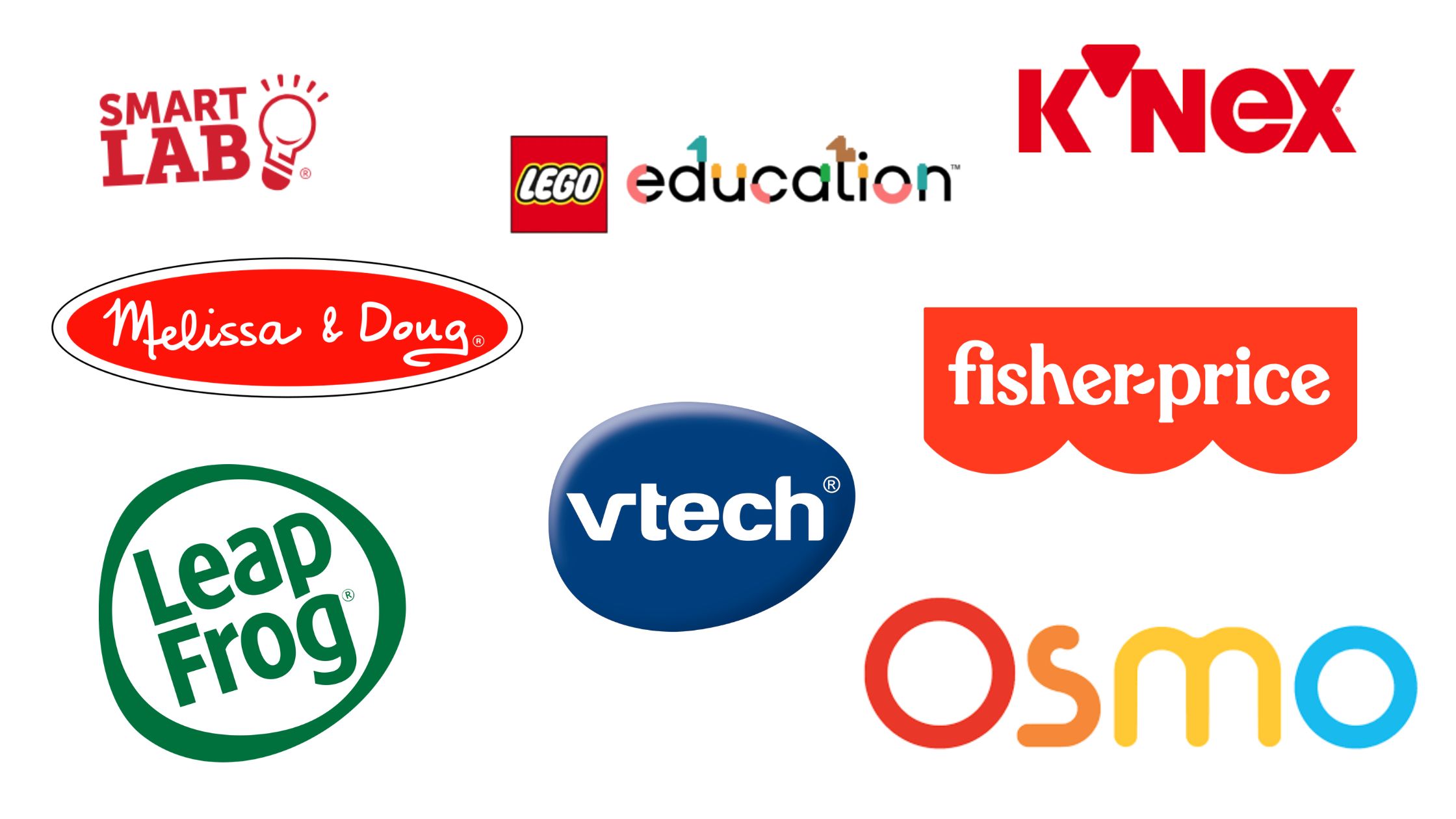
Here are the nine names that appear in almost every article on this topic, with the owner behind each one.
| Brand | Owner | Listed? | How it reaches shops | Can a wholesaler buy it? |
|---|---|---|---|---|
| LEGO Education | The LEGO Group (Denmark) | Private, family owned | LEGO Education resellers, direct to schools | No. Authorised education channel only |
| Fisher-Price | Mattel | NASDAQ: MAT | Mass retail and national distributors | No. National distributors only |
| Melissa & Doug | Spin Master, since Jan 2024 | TSX: TOY | Specialty, mass and e-commerce | No. Brand-owner accounts only |
| VTech | VTech Holdings (Hong Kong) | HKSE: 303 | Mass retail, own factories | No. Regional distributors |
| LeapFrog | VTech, since Apr 2016 | Part of HKSE: 303 | Same channel as VTech | No. Same owner as VTech |
| Osmo | Independent again, sold late 2025 | Private | Own site, Amazon, some retail | Unclear. Ownership just changed |
| SmartLab Toys | Educational Development Corp. | NASDAQ: EDUC | EDC wholesale division | Yes. EDC sells wholesale |
| K’NEX | Basic Fun!, since 2018 | Private | Mass and specialty | No. Brand-owner accounts only |
| Makeblock | Makeblock (Shenzhen) | Private | Distributors and education | Yes. Distributor programme |
Read the last column first. One row says yes without a caveat. One more says yes with a programme. The rest are closed, and no amount of email will open them for a buyer ordering 2,000 units.
That is the honest answer to “where do I buy educational toy brands”. You mostly don’t. You buy from an owner, or you build your own.
That second option is what a wholesale supplier sells: a factory’s own range, under your name. A brand owner sells permission. A supplier sells product. Only one of those fits a buyer starting at 2,000 units.
Two details are worth pausing on, because they show how fast this map moves.
VTech and LeapFrog are the same company. VTech bought LeapFrog at US$1.00 a share in 2016. Since 4 April 2016, LeapFrog has been an indirect wholly-owned subsidiary of VTech. A list that ranks them as #4 and #5 is ranking one supplier twice.
Melissa & Doug is no longer independent. Spin Master closed the US$950 million deal on 2 January 2024. Melissa & Doug had revenue of US$489 million in 2022. When a brand that size is absorbed, channel policy usually tightens, not loosens.
3. Why Do Brand Owners Refuse to Sell to Most Wholesalers?
Because a brand is a price, not a product. Break the price once and the shelf collapses.
A brand owner makes money on repeated sales at a stable shelf price. An importer who dumps 5,000 units on a marketplace at 30% off damages that price for every other account. So owners control the channel before they control the product.
Here is what a distribution agreement usually contains. It is worth reading even if you never sign one, because it explains why the answer is no.
| Clause | What it usually says | Why the owner wants it |
|---|---|---|
| Territory | One country or region, exclusive or not | Stops two partners undercutting each other |
| Minimum purchase | A number per year, often reviewed quarterly | Pays for the channel support you get |
| MAP | Minimum advertised price | Protects the shelf price |
| Marketplace ban | No Amazon, eBay, sometimes no own web shop | Keeps the price clean |
| Customer approval | Owner approves who you may sell to | Protects brand image |
| Term and renewal | One to three years, renewed on performance | Easy exit if you underperform |
| Parts and service | You stock spares and handle returns | Cuts the owner’s after-sales load |
None of this is unreasonable. It is just expensive, and it is designed for a distributor with an existing retail base. If you are starting from zero, the door is not locked. It was never built for you.
One warning. Buyers who cannot get an account sometimes buy from a reseller instead. That stock is grey market, and the owner can refuse warranty and recall support on it. If a shelf price looks 25% under the official one, ask why before you wire money. Our notes on wholesale toy distributors show how the legitimate ones describe their territory.
4. What Are Your Three Routes to Brand-Level Goods?
There are only three, and they cost very different amounts.
| Route | What you sign | Typical cost | Time to first shipment | Who it suits |
|---|---|---|---|---|
| Brand distribution | Distribution agreement plus purchase orders | Stock at brand price, plus channel support | 4–10 weeks from stock | Importers with a retail base |
| Licensed IP | Licence with royalty and guarantee | 5–15% royalty, upfront guarantee, approvals | 4–7 months | Factories and brands with design teams |
| Private label | Nothing but your own purchase orders | Tooling, testing, your own stock | 3–5 months | Most importers at 500–2,000 units |
Route one, brand distribution, is the one people ask about and the one least available. You are buying finished goods at a set price. You do not own the mould, the artwork or the customer list. If the owner changes channel strategy, you lose the line.
Route two, licensed IP, means you make the goods and pay for the name. Royalties in toy licences usually run 5–15% of net wholesale, plus an upfront minimum guarantee. The guarantee is the part that hurts. You pay it whether you sell the stock or not. Add two to four rounds of sample approval, and a one to three year term.
Route three, private label, means the brand is yours. No royalty, no approval, no territory limit. You pay for tooling and testing instead, and you carry the inventory risk. For most readers of this page, it is the only route with a real margin at the end.
One clause decides everything in route three: who owns the mould. Pay for it yourself and it is yours, so a second factory can quote later. Let the factory absorb the cost and it stays theirs, which locks you in for the life of the product. Ask on day one. Our educational toy manufacturer notes explain how Chinese factories usually split this.
The three routes are not equal in status. They are equal in one way: each one has a cost you cannot argue away.
5. How Do You Read a Brand’s Ownership Before You Commit?
Ownership changes are normal. What is not normal is how fast they can strand your stock.
Osmo is the case to study. Osmo was acquired by BYJU’S in 2019 for about US$120 million. BYJU’S collapsed, and in 2024 the Osmo apps stopped working. In late 2025 a small group of former employees bought the brand out of bankruptcy. The price was US$825,000. They are bringing the apps back one at a time. Some titles will never return, because the licences are gone.
Most brand lists call Osmo’s expansion packs and app updates a strength. For a wholesaler holding kits, the app is not a feature. It is a dependency you do not control. A dead app turns working hardware into shelf stock nobody can use.
K’NEX is the second case. Basic Fun! bought the brand in 2018. In July 2024 the company filed for Chapter 11, and it emerged on 1 November 2024 with US$65 million in new financing. Production continued. But for five months, a buyer’s main question was not price. It was whether the line would exist next season.
Here is the short list I use before committing to any brand line.
| Signal | What it means | What to do |
|---|---|---|
| Owner changed in the last 18 months | Channel policy may be reset | Ask who signs the invoice this quarter |
| Revenue fell before the sale | New owner will cut SKUs | Confirm spares and app support in writing |
| Product needs an app | You inherit a software risk | Ask for offline mode and an update policy |
| One factory, one mould | Capacity is a single point of failure | Ask for a second source |
| Design is licensed in | Copying invites a claim | Check design registrations first |
A brand with a stable owner and no app is boring. Boring is what you want in a stock line.
6. How Do You Turn a Brand’s Shelf Price into a Target Cost?
You buy one unit at retail. That is the whole trick.
Then measure six things, because each one maps to a cost line a factory will quote you. Every list of educational toy brands hides these numbers behind a photograph.
1. Weight. Grams per unit drive material cost and freight. 2. Unique part count. Ten shapes means ten mould cavities. Five shapes can halve tooling. 3. Board or wall thickness. Under 1.8 mm, a large wooden panel warps. 4. Box volume. Length times width times height in metres gives CBM. This decides your container maths. 5. Finish. Paint, print, varnish or bare wood. This is where cheap sets get expensive. 6. Content. Cards, workbook, instructions. Someone had to write and translate them.
Now work backwards from the shelf price. The ladder below is a rough model, not a promise. It assumes a 40–50% retail margin, a 30% importer margin, and freight plus duty at 20–30% of landed cost.
| Retail price | Wholesale to retailer | Landed cost target | FOB target |
|---|---|---|---|
| US$9.99 | US$5.00–6.00 | US$3.85–4.60 | US$3.00–3.70 |
| US$19.99 | US$10.00–12.00 | US$7.70–9.20 | US$6.00–7.40 |
| US$29.99 | US$15.00–18.00 | US$11.50–13.80 | US$9.00–11.00 |
| US$49.99 | US$25.00–30.00 | US$19.20–23.00 | US$15.00–18.50 |
| US$79.99 | US$40.00–48.00 | US$30.80–36.90 | US$24.00–29.50 |
A quote above the top of the band means one of two things. You are paying for a spec you do not need, or the product cannot carry that shelf price. Both are useful to know before you order.
Landed cost is not FOB plus freight. It also carries duty, broker fees, inland haulage and the cost of money while the container is at sea. Most buyers forget the last one. Our China toy wholesale guide breaks the landed figure into its parts.
This is a benchmark, not a blueprint. Which brings up the next question.
7. Where Does Copying an Educational Toy Brand Become Illegal?
Sooner than most buyers think, and the line is not “did I use their logo”.
Four rights can bite you.
- Design patents. In the US, a design patent runs 15 years from grant. A distinctive shape can be protected even with no logo on it.
- Registered designs. In the EU, a registered design lasts five years and can be renewed up to 25. An unregistered design right lasts three years from first disclosure.
- Trade dress. Box layout, colour scheme, mascot, even the shelf look can be protected if buyers recognise it.
- Copyright and trademarks. Characters, artwork and names. This is where most claims start.
The practical rule is simple. Copy the function. Change the look. A stacking ring is a stacking ring. A stacking ring in the same colours, in the same box, with the same font, is a claim waiting to happen.
Customs is the part people forget. A container held for infringement is not a discount. It is a total loss plus storage. Check the design registration before you approve artwork, not after.
Checking is free. Search the US design patent database and the EU design register by shape keywords and by the brand owner’s name. If nothing shows up, you still need your own test file before shipment. A toy testing lab can confirm the scope of the reports you already hold.
8. What Do Private-Label Educational Toys Cost?
Here is the cost stack for a private-label line, at the volumes most importers start with. Every figure is a rough guide, not a promise.
| Cost line | Typical range | When you pay it | Note |
|---|---|---|---|
| Tooling | US$1,500–8,000 per mould | Before production | One per unique part |
| Sample | Free to US$300 | Before the order | Custom fee often credited later |
| Testing (CE, ASTM) | US$600–2,500 per SKU | Before shipment | A battery adds a second bill |
| Conditionnement | US$0.15–1.20 per unit | With production | A rigid box can cost more than the toy |
| MOQ | 500–1,000 units | At order | 300 is possible on simple wood |
| FOB | US$0.50–30 per unit | 30% deposit, 70% before the bill of lading | Moves with part count |
| Lead time | 25–45 days | After deposit and artwork sign-off | 45+ with new tooling |
Payment is usually 30% deposit, 70% before the bill of lading, with LC at sight for larger orders. Fix the Incoterm in writing at the same time. Stock samples are often free, with you paying the courier. Custom samples are charged, and usually credited against the order.
Three things move these numbers more than the rest. Part count sets the tooling. Packaging sets the unit price on cheap items. Order timing sets both, because factory capacity tightens before peak export months.
The full cost picture by product type sits in types de jouets éducatifs, and the price-band detail is in the Guide des prix de gros des jouets pour bébés. If you are comparing factories rather than products, start with toy manufacturers in China.
9. Which Educational Toy Brand Should You Use as a Benchmark?
Match the benchmark to your channel, not to your taste.
| If you sell to | Benchmark this brand | Because |
|---|---|---|
| Mass retail and discount | Fisher-Price | The price ladder is public and stable |
| Specialty toy shops | Melissa & Doug | Wood and finish set the perceived value |
| Schools and nurseries | LEGO Education | Kit structure and spares model |
| STEM hobby and gift | K’NEX, Makeblock | Part count and build complexity |
| Tablet-based learning | Osmo | Shows the app risk clearly |
Take one product from that brand and tear it down with the six checks in section 6. You end up with a spec, a target FOB and a realistic shelf price. That is a brief a factory can quote in days instead of weeks.
The same method works for narrower categories. A Montessori range benchmarks against open-ended wood, where the finish carries the price. A STEM range benchmarks against part count and build time, where the manual is half the product. For worked examples from the Shantou showrooms, see best STEM toys et new wholesale educational toys.
If you want the range mapped by category first, start with types de jouets éducatifs and our educational toys wholesale overview. For the definition and claim side of the same topic, read what are educational toys.
10. FAQ: Educational Toy Brands
These are the questions buyers ask most often about educational toy brands.
Can I buy LEGO Education wholesale? No. LEGO Education reaches schools through its own authorised reseller channel. There is no open wholesale account for a new importer.
Is Melissa & Doug still an independent company? No. Spin Master completed the acquisition on 2 January 2024 for US$950 million. Melissa & Doug is now part of a listed group, and channel policy follows the group.
Are VTech and LeapFrog different companies? No. LeapFrog has been an indirect wholly-owned subsidiary of VTech since 4 April 2016. Treat them as one owner when you plan a range.
What royalty should I expect on a licensed toy? Usually 5–15% of net wholesale, plus an upfront minimum guarantee. The guarantee is paid whether the stock sells or not, and approval rounds add two to four months.
Which is cheaper, a brand or a private label? Private label, at 500 units and above. You pay tooling and testing once, then keep the margin. A brand line costs more per unit and gives you no control over supply.
Do I need a licence to make a wooden puzzle like a famous brand’s? Not for the function. A puzzle that stacks and fits is a puzzle. You need one if you copy the shape, the artwork, the box or the name.
Which educational toy brands can a new importer actually buy? Very few. SmartLab Toys sells through its owner’s wholesale division, and Makeblock runs a distributor programme. The realistic route for most buyers is a private label built against a brand benchmark.
Réflexion finale
Nine educational toy brands, eight owners, one open wholesale door. That ratio is the whole story.
Read the list for what it tells you about price and channel, not for what it promises about supply. Then take one benchmark product, measure it, price its parts, and build your own version with a different look and your own name on the box.
If you want help turning a benchmark into a quote, send three things through the sourcing inquiry page: the product you are benchmarking, your target shelf price and your market. We will come back with a shortlist, factory quotes and the test list you actually need. If you are still choosing a partner, compare China toy sourcing companies before you commit volume, and check how to import toys from China for the paperwork.