Types of Dinosaur Toys: 6 Groups and What Each Costs to Make
Most guides to the types of dinosaur toys sort them by dinosaur. T-Rex, Triceratops, Velociraptor, Brachiosaurus. That is a nice list for a parent. It tells a buyer almost nothing.
Here is why. A toy dinosaur is a body with a head on top. Change the head and the paint, and the same mould gives you a new species. So the species is not a product category. It is a decoration.
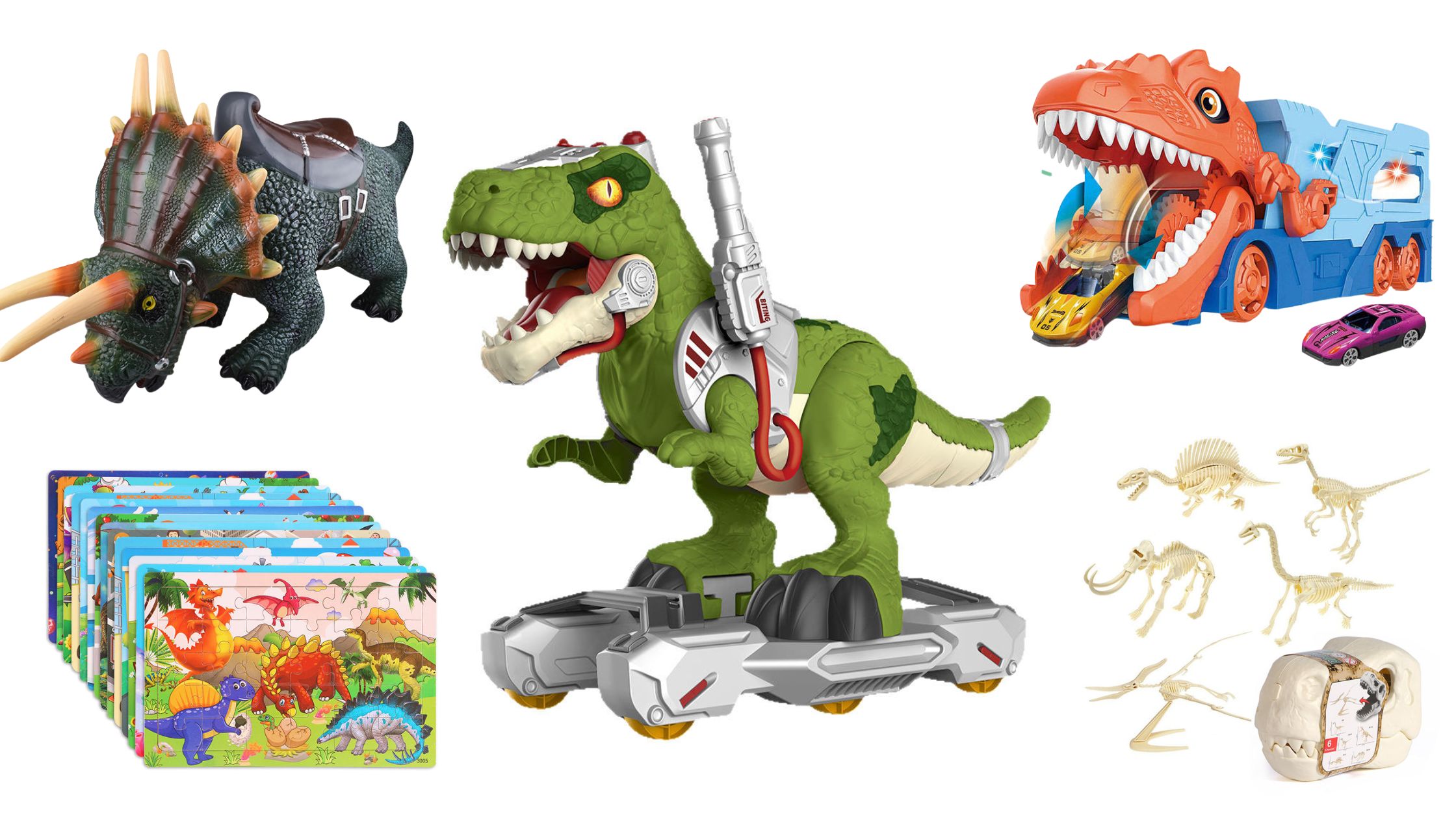
What actually separates one dinosaur toy from another is how it moves. A static figure, a wind-up walker and a remote-control rex are three different factories, three different moulds and three different rule books. That is the split this guide uses. Six groups, one table each, and the paperwork that comes with them.
Prices below are rough FOB guides at 1,000–3,000 pieces. They are not a quote. Your number depends on size, mould ownership and paint work.
1. The Types of Dinosaur Toys Have Nothing to Do With Dinosaurs
Ask a factory for a T-Rex and a Triceratops. You will often get two quotes that differ by 10%. Same body blank, different head tool, different paint mask. The mould is the product. The species is the skin.
This matters for two reasons.
First, it makes a dinosaur range cheap to extend. Once a body mould exists, a second species costs a new head tool and a new paint stencil. That is why factories can offer 40 species from six moulds, and why a “12-piece dinosaur set” often contains 12 paint variants of four bodies.
Second, it makes the category easy to copy. Every factory in Chenghai can sell you a green T-Rex at the same price. Your edge will not come from the species list. It will come from size, paint quality, packaging and the mechanism inside.
So the useful question is not “which dinosaur”. It is “what makes it move?”
For the buying side, the dinosaur toys in bulk page covers the product lines, current MOQ and freight. This page covers how each type is built. If you want to see which factories in this space are worth a visit, our dinosaur toy manufacturer supply list is a starting point.
2. The 6 Types of Dinosaur Toys, Sorted by How They Move
| Group | How it moves | Main process | Typical FOB | Tooling |
|---|---|---|---|---|
| 1. Static figures | It doesn’t | Injection or rotocast | $0.30–12.00 | Mould only |
| 2. Hand-powered sets | The child moves it | Assembly, digging, magnets | $1.00–4.00 | Low |
| 3. Wind-up and friction | A spring or a flywheel | Injection plus gear parts | $0.80–2.50 | Mid |
| 4. Battery and RC | A motor | Injection plus electronics | $3.00–15.00 | High |
| 5. Grow and hatch | Water | Chemical, no mould | $0.50–2.00 | Almost none |
| 6. Soft, wearable, ride-on | The child wears or rides it | Sewing, blow mould, frame | $1.00–30.00 | High |
The spread is not a markup story. Group 1 and group 5 use almost no tooling. Group 4 and group 6 use a lot, and group 4 also carries an electronics file that the others never touch.
3. Type 1: Static Figures — The Cheapest Type, and the Easiest to Get Wrong
This is the biggest group by volume and the one most buyers start with. A solid or hollow dinosaur, painted, in a polybag or a window box. No battery, no moving part.
There are two ways to make it, and the choice sets everything else.
Injection moulding fills a steel cavity with PVC, ABS or TPR. It gives crisp detail, tight tolerances and a hard, solid part. Tooling is a steel mould cut by CNC, usually 25 to 30 days.
Rotocasting pours liquid vinyl into a heated mould and spins it. The plastic coats the inside wall and you get a hollow, soft-touch figure. Tooling starts from a wax pattern, then a master, then the production mould. Same 25 to 30 days, but less steel and less money.
Both then go through the same finishing line: trim, prime, mask spray, pad print, assemble, pack. And both live or die on that line. A cheap figure is cheap because the paint is one or two spray passes and no hand work. A good figure has four or five passes, a dark wash in the crevices, and eyes done by pad print.
The trap is size without weight. A 30 cm hollow figure feels like a toy. A 30 cm solid figure feels like a model, and sells for more. But solid costs more in material and freight, and it breaks a child’s toe when dropped. Decide which one you are selling before you approve the sample.
For a wider range of realistic and cartoon figures, our dinosaur toys catalogue lists the current stock designs. If you want to know which styles actually move at retail, the meilleurs jouets de dinosaures page tracks the ones that keep reordering.
4. Types 2 and 3: Hand-Powered and Wind-Up — The Middle Ground
These two groups sit between a statue and a robot, and they are where most of the profit sits for small importers.
Hand-powered sets need the child to do something. Snap-together skeletons, dig-out fossil kits, magnetic build sets, dinosaur puzzles. There is little or no tooling, because the product is card, plaster or a simple plastic frame. Your cost is in content and assembly: a plaster block, a plastic chisel, a brush, a fact card, a box.
The compliance load is higher than it looks. A dig kit contains small parts, dust and sometimes a real stone. Under-3s cannot have it, so the age mark and the small-parts warning have to be right. Get that wrong and the kit fails at retail, not at customs.
This group also overlaps with two categories we cover separately. A dinosaur dig kit is sold as an educational toy, and a wooden dinosaur skeleton puzzle follows the wood rules in our types de jouets en bois guide. Same shelf, different factory.
Wind-up and friction toys add a mechanism. A spring motor, a flywheel, or a pull-back gearbox. The body is still injection moulded, but now you have a gearbox supplier, an assembly step and a failure mode. If the gearbox is cheap, the toy walks in a circle and comes back as a return.
Our advice on this group is simple. Buy the mechanism from a factory that already makes it, not from a factory that makes dinosaurs. A dinosaur factory can mould a body. It usually cannot make a reliable gearbox, and the ones it buys in are the cheapest on the market.
5. Type 4: Battery-Powered — Highest Price, Highest Return Rate
Remote-control rexes, roaring walkers, light-up robots. This is the group with the best margin per unit and the worst margin after returns.
Three things drive the cost: the motor and gearbox, the sound module, and the battery compartment. A basic RC dinosaur runs US$3 to US$6 FOB. Add 2.4 GHz control, a rechargeable pack and a demo mode, and you are at US$10 to US$15.
The compliance file is the real cost. A powered toy needs the toy standard plus an electronics standard. In Europe that means EN 71 et EN IEC 62115, plus EMC. In the US it means ASTM F963-23 and, if the battery is replaceable, the battery compartment rules under 16 CFR 1263.
Sound is the part most buyers miss. EN 71-1 caps a close-to-ear toy at 80 dB(A) and a hand-held noise-making toy at 85 dB(A), with a peak limit above that. A sound module that tests at 78 dB in the sample can hit 88 dB in mass production when the speaker batch changes. Then the whole container fails.
Notre Jouets radiocommandés page covers the radio and motor side in more detail.
If this is your first dinosaur order, do not start here. Start with group 1, learn the paint and packing line, then move up.
6. Type 5: Grow and Hatch — The One US Customs Watches Closest
Water-growing dinosaurs, hatching eggs, dinosaur-egg blind boxes. The product looks simple: a polymer bead or a compressed sponge, a capsule, a colour box. No mould, almost no tooling, a unit cost under US$1.
It is also the most regulated group in this article, and most suppliers still quote it as if nothing changed.
Since 12 March 2026, the US has a standalone federal standard for water beads: 16 CFR 1250.4. It applies to water bead toys and to any toy that contains water beads. A water bead is defined as a liquid-absorbent polymer that expands when soaked. A toy dinosaur that grows in a glass of water is in scope.
The rule has three parts, and each one kills a common product:
- Size. A bead that fits in the small-parts cylinder when dry must pass through a 5.0 mm funnel or sieve gauge once fully expanded. A bead that grows to 12 mm fails. This is the rule that ended the “grow 10x” novelty.
- Chemistry. No more than 325 micrograms of extractable acrylamide per 100 small beads, or per one large bead. Cheap polymer fails this regularly.
- Labels. The toy, the packaging and the container all need the warning. A hangtag or sticker is allowed only when there is no packaging. Multi-packs need every unit marked.
And the certificate has to name it. Your CPC must list “16 C.F.R. § 1250.4” as one of the rules certified.
This is not a detail you can leave to the factory. Ask for the acrylamide test report and the expanded-size test before you approve artwork. If the supplier says “we have EN 71”, that answers a different question.
7. Type 6: Soft, Wearable and Ride-On — Three Products With One Problem
Plush dinosaurs, costumes and tails, ride-on dinosaurs. Three different production lines, one shared issue: volume, not weight.
Plush is a sewing job, not a moulding job. A 30 cm plush dinosaur is cut, sewn, stuffed and finished by hand. There is no steel mould, so tooling is near zero and MOQ can drop to 300–500. The cost is in fabric, filling and sewing time, and the risk is in seam strength and eye safety. Embroidered eyes pass; cheap plastic eyes pop off and become a small part. Our custom plush toys page covers the fabric and filling side, and the plush toys in bulk range shows current styles.
Ride-on dinosaurs are blow moulded on a steel frame, with wheels and a handle. They are light for their size, which is exactly what makes them expensive to ship. You pay for the cubic metre, not the kilo. A 60 cm tall ride-on can fill a carton that holds two units and weighs 8 kg. That carton is the product.
Two checks before you order a ride-on:
- Load test. Sit a 30 kg weight on it for an hour. If the shell flexes and cracks at the seam, the mould is too thin.
- Carton maths. Get the carton dimensions and the units per carton before you compare FOB. A cheaper unit in a bigger carton can cost more landed.
Costumes have the opposite profile. Small, light, cheap to ship, but bound by flammability and labelling rules that most dinosaur suppliers do not handle. If the product is worn on the body, treat it as apparel, not as a toy, and check which standard your market applies. Our jeu de rôle range shows how these sell next to figures.
8. Why Two Look-Alike Figures Cost 3x Apart
Two 25 cm dinosaurs, same pose, same green. One quotes US$1.80, the other US$5.40. Buyers assume one factory is cheating. Usually both are honest.
| Injection moulded | Rotocast vinyl | |
|---|---|---|
| Body | Solid or split parts | Hollow shell |
| Matériel | PVC, ABS, TPR, PP | PVC only |
| Mould | Steel, CNC cut | Copper or aluminium, from a wax pattern |
| Tooling | Higher | Lower |
| Material per unit | Higher | Lower |
| Labour per unit | Lower | Higher |
| Best for | Small to mid figures, volume | Large figures, soft skin, collector pieces |
Three things explain the gap.
One: the mould. A steel cavity for a 25 cm body is a real investment. A rotocast tool is cheaper but wears faster and cannot hold sharp detail.
Two: the finish. A cheap figure gets two spray passes. An expensive one gets a base coat, two or three colour passes through a copper mask, a dark wash, pad-printed eyes and a matte topcoat. That is four to six hand touches per unit, and hand touches do not get cheaper with volume.
Three: the seams. A rotocast shell comes out of the mould in one piece, with a visible seam line that has to be trimmed by hand. An injection figure is assembled from parts, so the seams are designed in, but the assembly is a line item.
This is why the same drawing can produce a US$1.80 toy and a US$5.40 model. If you want the cheap one, accept fewer paint passes. If you want the expensive one, pay for the hand work and say so in the spec.
9. Which Types of Dinosaur Toys Need Toy Certification?
Almost all of them, but not for the same reasons. A quick map:
| Market | Rule | What it means |
|---|---|---|
| NOUS | ASTM F963-23 (16 CFR 1250) | Mandatory toy standard |
| NOUS | CPC | Certificate signed by importer or maker |
| NOUS | CPSIA | Lead 90 ppm in surface coating, 8 phthalates at 0.1% |
| NOUS | 16 CFR 1250.4 | Water beads, effective 12 March 2026 |
| UE | EN 71-1 / 2 / 3 | Mechanical, flammability, migration |
| UE | CE marking | Self-declared, with a technical file |
| UE | EN IEC 62115 | Electric toys |
| Les deux | Battery rules | 16 CFR 1263 in the US, battery and EMC rules in the EU |
Two dates matter. In the US, a produit pour enfants is one aimed mainly at children 12 or younger. In the EU, a toy is for children under 14. So a collector figure marked 14+ can sit outside EU toy law. In the US, the same figure can still count as a children’s product, if the art and the channel say so.
Le CPC is signed by the importer, not the factory. The factory supplies test reports from an accepted lab. If a supplier offers to “give you a certificate”, ask who signs it.
Our guide to toy testing labs for CE and ASTM covers how to check a report before you pay a deposit.
10. “Dinosaur” Is Public Domain. “Jurassic” Is Not.
This is the single most expensive misunderstanding in the category.
A real dinosaur species cannot be copyrighted. T-Rex, Triceratops and Stegosaurus are scientific names, and a scientifically accurate reconstruction is not owned by anyone. You can make a green T-Rex and sell it.
A film design can be. The dinosaurs in Jurassic Park and Jurassic World are Universal and Amblin properties. So is the look of a specific character, down to the scar pattern and the colour break. Copy that silhouette and you are not selling a dinosaur. You are selling their dinosaur.
And the word is a trademark. “Jurassic Park” and “Jurassic World” are registered marks. Putting “Jurassic” in a title, a listing or a box is high risk even if the model is your own sculpt.
The licensing chain shows how tightly this is held. Kenner made the first films’ toys, Hasbro took over after buying Kenner, and Mattel has held the master licence since Fallen Kingdom. In September 2026, Spin Master signed a preschool line with Universal for launch in 2028, with rights everywhere except China and Japan. That last clause tells you how the licensor treats this manufacturing base.
So what do you do? Three things:
- Work from scientific reconstruction, not from a film still.
- Keep the words Jurassic, Park and World out of the artwork, the listing and the box copy.
- If a buyer sends you a reference image, ask for the licence before you cut steel. A purchase order is not a licence.
11. How Much Do They Cost, and What Is the MOQ?
Rough FOB bands at 1,000–3,000 pieces. Treat them as a planning tool, not a price list.
| Type | Size / format | FOB guide |
|---|---|---|
| Static figure | 10–15 cm, polybag | $0.30–1.20 |
| Static figure | 25–35 cm, window box | $1.50–4.00 |
| Static figure | 40 cm and up | $4.00–12.00 |
| Hand-powered set | Dig kit, assembly set | $1.00–4.00 |
| Wind-up / friction | 15–25 cm | $0.80–2.50 |
| Battery / RC | Basic to 2.4 GHz | $3.00–15.00 |
| Grow and hatch | Egg, capsule, blind box | $0.50–2.00 |
| Wearable / ride-on | Costume to 60 cm ride-on | $8.00–30.00 |
| Plush | 20–40 cm | $1.00–5.00 |
MOQ has three tiers, and the difference confuses almost every first-time buyer.
- 300–500 pieces per design. This is what a sourcing agent quotes, because the agent is buying from a factory that already owns the mould. You are picking from an existing range.
- 1,000–2,000 pieces. Custom paint and custom packaging on an existing mould. You pay for print plates, a colour match and a new box die.
- 3,000–5,000 pieces. A new mould. Small PVC figures often start at 5,000 because the tooling has to be paid back inside the first run.
So when one supplier says 300 and another says 5,000, they are usually not competing. One is selling a stock design, the other is selling your design. Ask which one you are being quoted.
Most dinosaur moulding capacity sits in Chenghai, Dongguan and Shenzhen. Our Shantou toys factory guide explains how that cluster is organised, and the top 21 toy manufacturers list is useful when you are shortlisting.
Tooling, if you go custom: US$800–3,000 per design for a simple single-cavity mould, more for a multi-part body with an articulated jaw. Hand samples take 5–7 days; a new mould takes 25–30 days; mass production runs 15–45 days after sample approval. Plan 8 to 12 weeks from artwork to warehouse.
On payment, the normal term is 30% T/T deposit and 70% against the bill of lading copy. Larger programmes can use a letter of credit at sight. For a first order, keep the deposit small and put the balance against a passed inspection.
12. Frequently Asked Questions
What are the main types of dinosaur toys?
By mechanism: static figures, hand-powered sets, wind-up and friction, battery and RC, water-growing toys, and wearable or ride-on. By species is not a useful split, because one body mould can carry many species.
Which type is cheapest to start with?
A static figure in the 10–15 cm range, packed in a polybag. Stock moulds, no electronics, low unit cost. Our stock lines start around US$0.30–1.20 at 1,000 pieces.
Do I need a new mould to add a species?
Often no. A new head tool and a new paint mask on an existing body is the cheap route. A new body costs US$800–3,000 and 25–30 days.
Are water-growing dinosaur toys still allowed in the US?
Yes, but only if they meet 16 CFR 1250.4, effective 12 March 2026. That means a 5.0 mm expanded-size limit, an acrylamide limit and specific warnings. Many older designs no longer pass.
Can I sell a Jurassic Park style dinosaur without a licence?
No. The species is public domain, the film design and the “Jurassic” name are not. Work from scientific references and keep the film words off the box.
What is the HS code for a toy dinosaur?
9503, toys. Do not let a supplier declare it under 3926 as a plastic article. That is a classification error, and it changes your duty and your admissibility.
How much does a sample cost?
Around US$20–50 for a stock item, credited against the order. A custom painted sample with new artwork costs more, because the mask and the proof are one-off.
Can I mix types in one container?
Yes, and it is common. Figures, plush and dig kits ship together without a problem. Keep the electronic items out of the same inner carton as a plain figure, though, because the battery rules follow the whole package.
13. Pick the Mechanism Before You Pick the Dinosaur
Le types of dinosaur toys split six ways, and the split is about movement, not species. A static figure, a wind-up walker and a water-growing egg are three different businesses with three different rule books.
Get the mechanism right and the rest gets simple. You will know your mould cost, your test file and your freight profile before you see a single sample. Get it wrong and you will spend a month comparing two quotes that were never for the same product.
Start with one question. What makes it move? Everything else — species, colour, box art — is skin.
If you already have a reference sample or a component list, send it over. We will tell you which group it lands in, what the mould will cost, and which test report you need. Our China factory network covers injection, rotocast, plush and electronics under one order, so a mixed dinosaur range does not need five suppliers. For the buying side, start with wholesale dinosaur toys or the full stock catalogue. And if the range sits next to a school or nursery buyer, our educational toys wholesale page covers the age-graded side.
We handle sampling, factory checks, inspection and shipping as one job. The service page explains what is included and what is not.