China Toys Wholesale Market: Where and How to Source
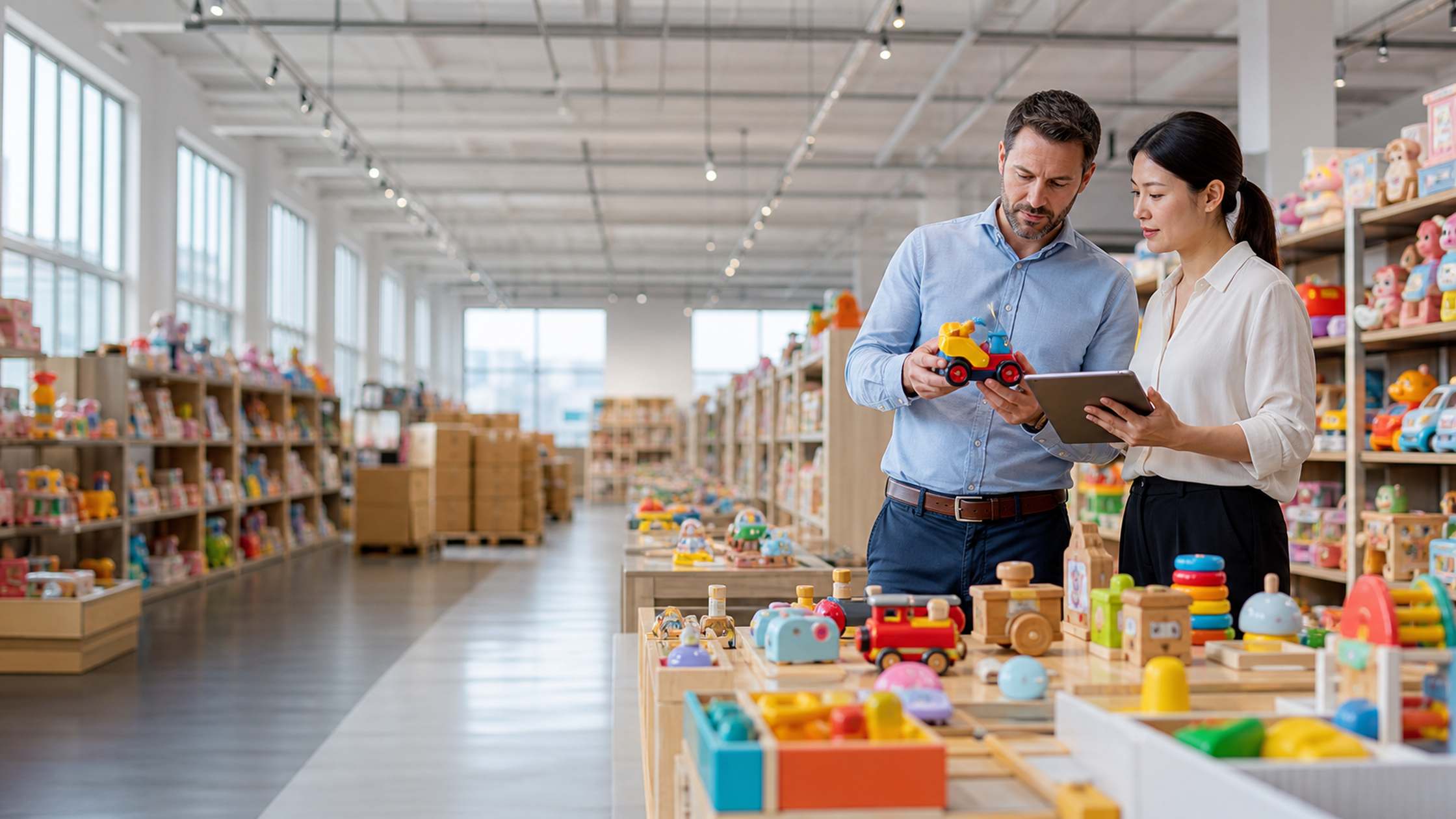
A China toys wholesale market can help you compare hundreds of products quickly, but the right destination depends on your buying plan. Yiwu is strong for variety and mixed orders, while Shantou’s Chenghai district is better for factory-linked toy sourcing and product development. This guide shows you how to choose a market and buy with fewer surprises.
China Toy Sourcing Options at a Glance
“Wholesale market” can describe several very different sourcing channels. Choosing the channel before choosing the supplier prevents wasted travel and quotations that cannot be compared.
| Sourcing channel | Ideal para | Main advantage | Main limitation |
|---|---|---|---|
| Yiwu International Trade Market | Broad assortments, mixed categories, smaller trial quantities | Many products can be compared in one location | A booth may be a factory, trader, or sales office |
| Shantou/Chenghai | Plastic, electronic, RC, building, pretend-play, and OEM/ODM toys | Close connection to a specialized manufacturing cluster | Less efficient if your order includes many non-toy categories |
| Guangzhou wholesale area | Buyers combining toys, gifts, stationery, and other South China sourcing | Convenient as part of a wider Guangzhou trip | More distributor-oriented; factory identity still needs verification |
| Online B2B marketplace | Remote product discovery and initial supplier contact | Fast search and easy first comparison | Listings do not replace audits, samples, or product-specific compliance checks |
| Direct factory sourcing | Larger, repeatable orders and customization | Better control over engineering and production | Higher coordination burden and often less flexibility for mixed SKUs |
| Sourcing company or buying agent | Multi-supplier orders, consolidation, inspection, and local follow-up | One workflow across suppliers and shipments | Service scope, fees, and accountability must be agreed in writing |
The best channel is often a combination. You might discover products in Yiwu, compare factory alternatives in Chenghai, approve samples remotely, and consolidate several orders into one shipment.
1. Yiwu International Trade Market
Yiwu is the practical first stop when range breadth matters more than deep specialization. The toy section is on the first floor of International Trade City District 1. The official Yiwu government market guide lists stuffed, inflatable, electrical, and general toys there (Distrito 1 da Cidade Internacional de Comércio de Yiwu).

When Yiwu is the better choice
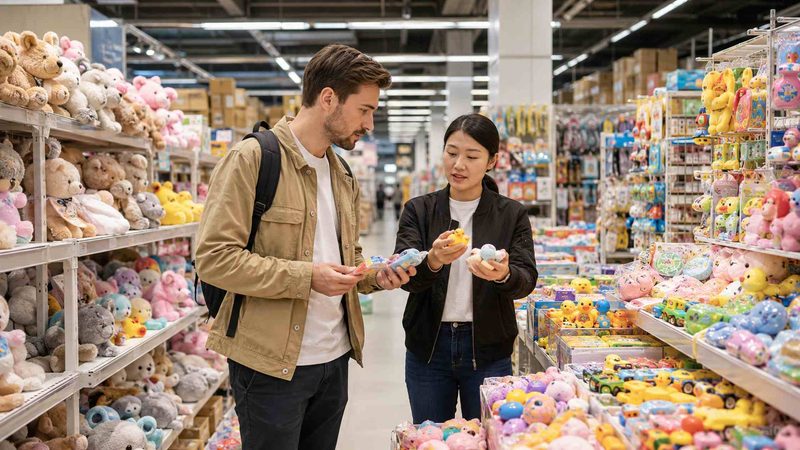
Yiwu suits importers, variety stores, promotional-product buyers, party-goods wholesalers, and newer retailers building a mixed assortment. You can compare packaging, colors, price positions, and adjacent categories within a concentrated area. It is also useful when your container will include toys alongside stationery, gifts, decorations, or household products.
The main tradeoff is supply-chain visibility. A booth is a sales channel, not proof that the seller owns a factory. Some vendors produce one range, some outsource part of it, and others are traders representing several factories. This is not automatically a problem: a capable trader can make low-volume assortment buying easier. The risk appears when you price the order as factory-direct or approve compliance documents without identifying the actual manufacturer.
For each shortlisted item, record the booth, company legal name, product code, manufacturer name, unit specification, packaging, carton data, quantity, price basis, lead time, and available reports. Photographs without a matching product code are rarely enough to reconstruct a quotation after a long market visit.
2. Shantou and the Chenghai Toy Cluster
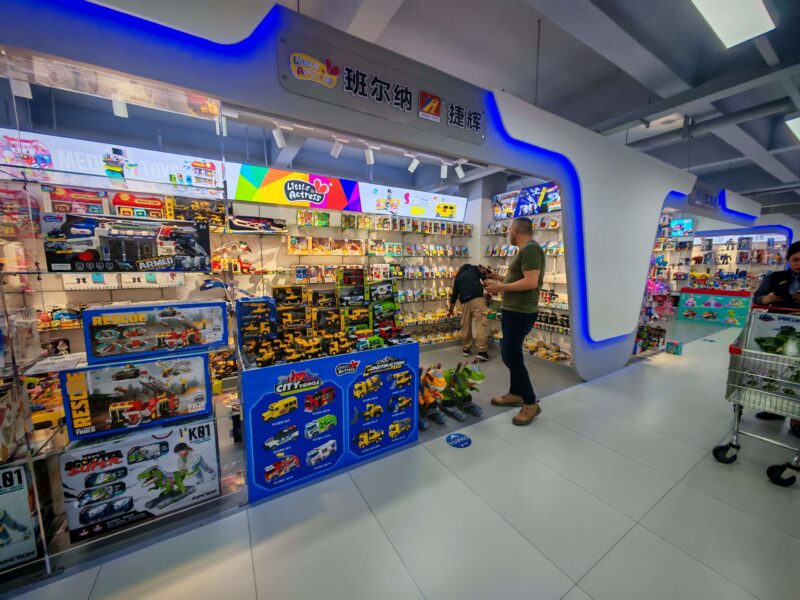
Chenghai, a district of Shantou in Guangdong, is a specialized toy manufacturing cluster. Unlike a single market building, the sourcing experience may involve showrooms, trading companies, factories, and supplier offices spread through the industrial area.
When Chenghai is the better choice
Choose Chenghai when toys are the core of your business and you need deeper supplier comparison. The cluster is particularly relevant to plastic toys, remote-control products, electronic toys, building sets, pretend-play items, outdoor toys, and OEM/ODM projects. Proximity to mold making, plastics processing, electronics, printing, packaging, and assembly can make product changes easier to discuss.
Chenghai is usually more valuable for a buyer who already has a category brief. If you arrive asking only for “new toys,” a large showroom can produce hundreds of attractive options but little basis for selection. Start with target age, retail channel, price position, functions, packaging size, compliance market, expected quantity, and whether you need an existing item or a custom product.
A showroom model also needs verification. Ask which factory makes the exact SKU, whether the displayed sample represents current production, who owns the tooling, what customization is available, and whether the quotation comes from the manufacturer or an intermediary. For a custom item, discuss tooling ownership, engineering changes, sample stages, color tolerances, packaging artwork, spare parts, and change-control procedures before paying a deposit.
3. Guangzhou Toy Wholesale Areas
Guangzhou can be useful when toys are one part of a wider South China buying trip. Wholesale areas around Yide Road and large gift and commodity centers provide access to toys, gifts, seasonal products, stationery, and related merchandise.
The city’s transport connections and proximity to other Pearl River Delta manufacturing centers are convenient, but the toy offer is generally less concentrated around manufacturing depth than Chenghai. Treat Guangzhou primarily as a discovery and distribution channel unless a seller can demonstrate the factory relationship for your product.
Before planning a visit, verify the current building, opening schedule, category location, and appointment requirements directly. Wholesale tenants and market layouts can change, and an old online guide is not a reliable travel plan.
Yiwu vs. Shantou: Which Market Should You Choose?
The choice becomes clearer when you compare the structure of your order.
| Your buying situation | Better starting point | Why |
|---|---|---|
| Many toy styles in relatively small quantities | Yiwu | Efficient assortment building and supplier comparison |
| Toys plus gifts, party goods, or stationery | Yiwu | More adjacent categories in the same trading ecosystem |
| One toy category with repeat orders | Chenghai | Better access to specialized manufacturers and variations |
| OEM/ODM, tooling, electronics, or packaging development | Chenghai | Closer engineering and production coordination |
| A short South China trip covering multiple industries | Guangzhou, then Chenghai if toys are important | Guangzhou supports broad discovery; Chenghai adds toy depth |
| You cannot travel to China | Online search plus local verification | Remote shortlist, samples, audit, inspection, and consolidation |
Neither destination is automatically cheaper. A low unit quote can hide thinner materials, smaller dimensions, weaker packaging, missing accessories, inferior electronic components, non-comparable Incoterms, or testing that is not included. Compare landed value under one written specification, not the first price stated in a showroom.
Physical Markets vs. Alibaba, 1688, and Direct Factories
Physical markets are strongest at visual discovery. You can handle samples, compare adjacent products, see packaging options, and learn the vocabulary suppliers use. Online marketplaces are better for broad remote searches and initial communication. Direct factories are strongest when the product is stable enough to justify deeper engineering and production control.
Alibaba.com is designed for international B2B communication, while 1688 primarily serves China’s domestic trade. A low 1688 listing price may assume domestic packaging, local payment, China delivery, or a quantity that differs from your export order. You may still need export-ready labeling, product testing, stronger cartons, consolidation, and international logistics.
Do not treat platform badges, marketplace tenure, or a polished product page as final verification. Confirm the legal entity receiving payment, business scope, factory relationship, production address, export experience, and ownership of the reports supplied. A video call, third-party audit, sample order, and pre-shipment inspection answer different questions; one does not replace all the others.
What to Prepare Before Visiting a China Toys Wholesale Market
A short buying brief makes market time far more productive. Prepare:
- destination country and sales channel;
- intended age grade and customer profile;
- target retail and landed-cost range;
- categories and approximate SKU count;
- quantity per SKU and total order volume;
- existing design versus OEM/ODM requirement;
- packaging type, language, barcode, and carton constraints;
- required functions, materials, colors, and accessories;
- destination-market compliance requirements;
- delivery window and preferred shipping method.
Use one RFQ sheet for every supplier. If one quotation includes retail packaging and testing while another is for a bare product with domestic delivery, the prices are not comparable.
Questions to ask at every booth or showroom
- Are you the manufacturer, a trading company, or an authorized sales office for this SKU?
- What is the exact legal name of the manufacturer and payment recipient?
- What quantity, packaging, Incoterm, and validity period does the price assume?
- Is the sample an existing production item, and can it be reordered unchanged?
- Which parts, colors, artwork, and packaging can be customized?
- Which test reports apply to this exact model, material, age grade, and destination market?
- What are the sample, production, and packaging lead times?
- Can production be inspected before the balance is paid?
How to Verify a Toy Supplier
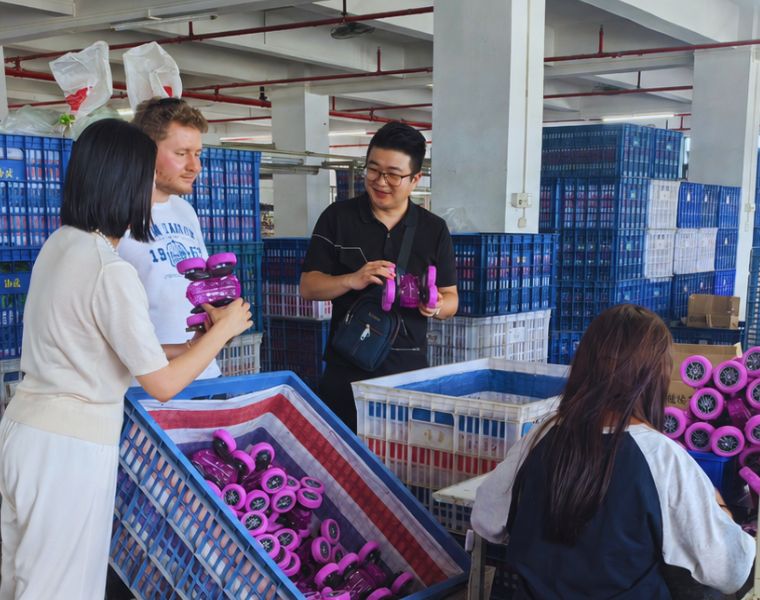
Supplier verification should match the risk and value of the order. Begin with business registration and payment identity. Then confirm whether the supplier manufactures the product, subcontracts it, or buys it from another producer. For higher-risk or custom orders, an on-site audit should examine relevant processes, capacity, incoming-material control, production records, quality procedures, and subcontracting.
Samples answer whether a proposed product can meet your expectations; they do not prove that mass production will match. Create a signed or sealed approval sample and a written specification covering dimensions, weight, materials, components, colors, functions, packaging, artwork, warnings, carton strength, and acceptable workmanship. Your purchase order and inspection checklist should refer to the same version.
Avoid sending a large deposit solely because a product is trending or a market visit feels time-sensitive. Confirm the contracting entity, bank account, sample, specification, compliance path, production schedule, inspection right, defect remedy, and shipping terms first.
Toy Compliance Is the Importer’s Responsibility Too
A supplier’s statement that a toy is “CE,” “ASTM,” or “EN71 approved” is not enough. Compliance depends on the exact product, age grading, materials, functions, warnings, market, and current legal requirements. A report for a similar model or different material may not support your SKU.
For the United States, children’s toys intended primarily for children 12 and under generally require third-party testing by a CPSC-accepted laboratory to applicable rules, followed by a Children’s Product Certificate. The applicable sections vary by toy (CPSC Toy Safety Business Guidance).
For the EU, importers must ensure that the manufacturer completed the appropriate conformity assessment and technical documentation, and must check CE marking, traceability, instructions, and warnings. The European Commission’s guidance also makes clear that importers have their own obligations (Placing toys on the EU market).
Before ordering, send the product specification and intended market to a qualified test laboratory or compliance professional. Confirm what must be tested, which entity appears on the documents, what labeling is required, and whether a design or material change triggers reassessment.
Quality Control Before Shipment
Do not make inspection a generic “check quality” instruction. Convert the product’s selling points and failure risks into checks. Depending on the toy, these may include:
- product dimensions, weight, color, and assortment ratio;
- part count, accessory completeness, and assembly;
- sharp edges, small parts, accessible fasteners, and battery access;
- pull, torque, drop, seam, wheel, switch, sound, light, charging, or leakage checks;
- printed artwork, warnings, age grade, barcode, and traceability details;
- retail package condition and carton dimensions;
- function cycling on a defined sample size;
- comparison with the approved sample and signed specification.
The inspection plan must not be used as a substitute for laboratory testing. Inspection checks workmanship and order conformity; accredited testing addresses applicable safety requirements.
Calculate Landed Cost, Not Just Unit Price
The cheapest showroom quote may not produce the lowest final cost. Build a landed-cost model that includes product price, packaging, tooling, samples, testing, domestic transport, consolidation, inspection, export handling, freight, insurance, duties, taxes, marketplace preparation, and an allowance for defects or returns.
Packaging size can change the decision. A slightly cheaper bulky toy may use so much carton volume that freight removes the saving. For e-commerce, dimensional weight, parcel limits, damage rates, barcode placement, and fulfillment preparation can matter more than a small difference in factory price.
Common China Toy Market Sourcing Mistakes
- Assuming every booth is a factory. Verify the actual producer and decide whether the intermediary adds useful service.
- Comparing only unit prices. Normalize specification, packaging, quantity, Incoterm, testing, and payment terms.
- Buying too many untested SKUs. Start with a range sized to your channel and reorder data, not showroom excitement.
- Accepting a generic test report. Match the report to the exact model, materials, age grade, manufacturer, and market.
- Approving only a visual sample. Document function, components, packaging, tolerances, and workmanship.
- Leaving inspection until after the balance payment. Agree inspection rights, acceptance criteria, and remedies in advance.
- Ignoring intellectual property. Avoid unauthorized characters, logos, packaging, molds, and copied designs.
- Planning travel from old directory pages. Verify market locations, schedules, and appointments before booking.
Perguntas frequentes
What is the biggest toy wholesale market in China?
There is no single answer for every buyer. Yiwu International Trade Market offers exceptional breadth and is the most practical large physical market for mixed assortments. Chenghai in Shantou is more important when you want access to a specialized toy manufacturing cluster. “Biggest” matters less than fit with your category and order structure.
Is Yiwu or Shantou cheaper for toys?
Neither is always cheaper. Yiwu can be efficient for mixed, lower-volume buying, while Chenghai may offer a shorter route to specialized factories for repeat or custom orders. Compare identical specifications and full landed cost before deciding.
Can I buy small quantities at a China toy market?
Often, but quantity depends on the item, packaging, stock status, customization, and seller. Ready-stock products may allow smaller trial orders; custom colors, printed packaging, or production runs usually require higher quantities. Request the MOQ for each exact SKU and configuration.
Do I need a sourcing agent to visit Yiwu or Shantou?
Not necessarily. An experienced buyer with Chinese-language support and a clear logistics setup can buy directly. A sourcing company becomes more useful when you need translation, supplier verification, multi-supplier payments, samples, order follow-up, consolidation, inspection, or export coordination. Define the fee and responsibility for each service before appointing one.
Can suppliers arrange toy certificates for my market?
They may provide existing reports or coordinate new testing, but you must verify that the documents apply to your exact product and destination. The importer retains important legal responsibilities in markets such as the US and EU. Confirm requirements with a qualified laboratory or compliance adviser before production.
Choose the Market Around Your Order
Start with Yiwu for a broad mixed range, Chenghai for specialized factory-linked sourcing and product development, or Guangzhou as part of a wider South China trip. Then support discovery with written specifications, product-specific compliance review, approval samples, supplier verification, pre-shipment inspection, and a landed-cost comparison.
If you want to compare brinquedos por atacado da China or plan a market visit, TonySourcing’s China toy sourcing service can coordinate supplier shortlisting, translation, quotations, samples, order follow-up, inspection, consolidation, and shipping. Send your destination market, product categories, expected quantities, packaging plan, and compliance requirements to build a comparable sourcing brief before you buy.