What Are Diecast Cars?
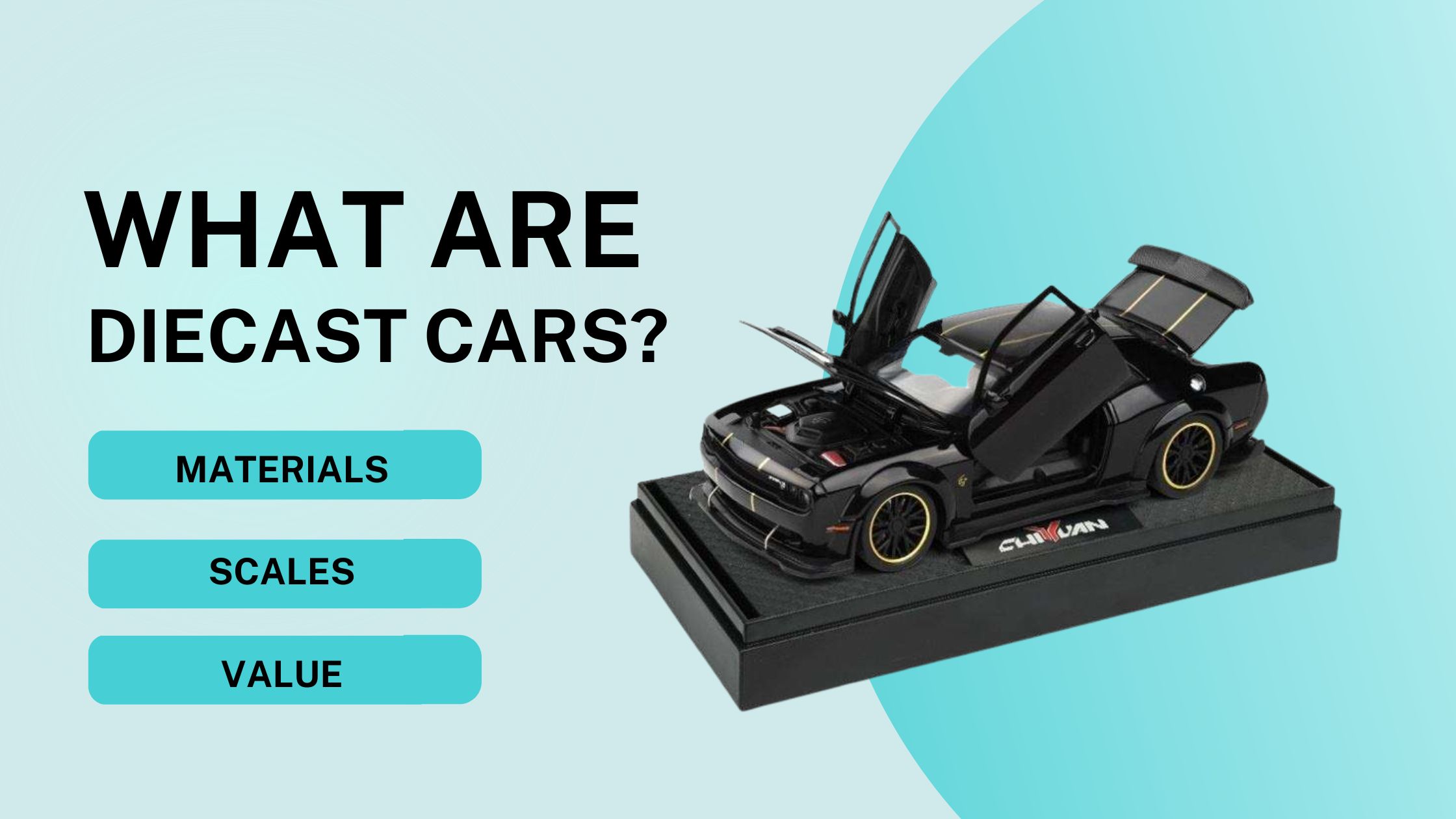
A diecast car is a scale model whose body is cast from molten metal inside a steel die. That is the whole definition, and almost everything a buyer cares about follows from it: the weight in your hand, the panel gaps, the tooling bill, the age label on the box, and the number of units in a carton. The short answer to the question “what are diecast cars” is that sentence; the rest of this page unpacks it.
Search what are diecast cars and you get a wall of collector blogs. Most of them answer the question for collectors. This one answers it for the person placing the order. You will see what the metal really is, how a model gets built, and what each scale does to your freight maths. You will also get the eight lines to put in your first RFQ.
One warning before we start. The word “diecast” names a process, not a promise about materials. Keep that in mind and half the confusing quotes you get will make sense.
Índice
AlternarWhat Are Diecast Cars Made Of?
The body is a zinc alloy called Zamak. It is about 96% zinc, with small amounts of aluminium, copper and magnesium. It melts at 380–420 °C, which is low for a metal. That low melt is the reason the whole industry uses it.
The metal is only part of the car. A typical model is a mix of materials, and each one is chosen for a reason.
| Part | Material | Why this material |
|---|---|---|
| Body shell | Zinc alloy (Zamak 3) | Holds fine detail, takes paint and plating |
| Base plate | ABS plastic | Cheap, stiff, holds the axles straight |
| Interior tub | ABS plastic | Deep shapes are easier to mould in plastic |
| Windows | Clear PC or PVC | One cheap stamping, no polishing |
| Tyres | Rubber or TPR | Grip without scratching a shelf |
| Badges, stripes | Pad print or water-slide decal | No extra tooling needed |
A 1:64 usually has four parts: body, windows, base and interior. Only the body is metal. Collectors call this “metal body, plastic base”, and it is normal rather than a shortcut. A whole 1:64 car leaves the carton at about 40 g, and only part of that is zinc. If a supplier claims his 1:64 is all metal, ask him to put the unit weight on the invoice. That is the honest answer to what are diecast cars made of: a zinc shell wrapped around a plastic frame.
Why Do Factories Use Zinc Instead of Aluminium?
Three reasons, and none of them is “zinc is better metal”.
Zinc flows. At 380–420 °C it fills thin slots in the die before it freezes, so you get grille slats, door handles and shut lines that read as sharp. Aluminium needs about 660 °C, which is harder on the die and coarser in fine detail.
Zinc is heavy. Its density is 6.6–7.0 g/cm³, roughly 2.5 times aluminium. That weight is the “heft” buyers judge quality by, whether or not the judgement is fair.
Zinc is kind to tooling. A good zinc die runs 200,000 shots or more. At that life the die cost per car becomes small, which is what makes a $1 model possible.
Aluminium still shows up in cheap large shells and in models where the brand wants a lighter feel. If a quote says “aluminium alloy body”, nothing is wrong. It will simply feel different in the hand.
What Is Zinc Pest, and Should You Worry About It?
Zinc pest is the old failure that gives diecast a bad name. Lead or iron left in the alloy reacts with moisture, and the casting swells, cracks and grows white powder. Pre-war toy cars crumble for this reason.
Modern Zamak 3 with clean feed does not do this. So the risk today is not the material. It is the supplier.
Two cheap checks protect you. Ask for the alloy grade in writing, and ask for a spectro report with the batch. Then look at the goods on arrival. White powder on a new shipment means scrap metal went into the furnace, and that is a supplier problem, not a storage problem.
When Did Diecast Cars First Appear?
The first diecast toy cars came out of England in the 1930s. Meccano launched Dinky Toys in 1934, and those small models set the pattern the industry still follows: one metal body, a base plate, and a set of rubber tyres.
Matchbox arrived in 1953 in a box small enough for a schoolboy’s pocket. Hot Wheels followed in 1968 with low-friction wheels and loud paint. Between them they fixed what are diecast cars mean to most people: small, metal, cheap and collectable.
That history still shows up in quotes. Collectors pay real money for early Dinky castings, and the factors behind those prices are covered in our guide to what makes diecast cars valuable. Factories still reissue the same shapes today, using dies that are older than most of the people running them.
How Is a Diecast Car Made?
Eight steps. The days column is what a normal factory quotes for one model, not a promise.
| Step | What happens | Days | Where the money goes |
|---|---|---|---|
| 1. Master model | CAD from blueprints and scans, 3D print for sign-off | 10–20 | design labour |
| 2. Tooling | Steel die cut on CNC, two or three trial shots | 15–25 | the big bill |
| 3. Casting | Molten zinc injected at 100–200 MPa, seconds per shot | — | machine time, cheap |
| 4. Trim and tumble | Flash cut off, bodies polished in a vibrating tub | 1–2 | low labour |
| 5. Paint | Primer, two or three colour coats, clear coat | 1–3 | paint and oven time |
| 6. Decoration | Pad print, one pass per colour | 1–2 | each colour is a pass |
| 7. Assembly | Glass, interior, wheels and doors fitted by hand | 1–2 | skilled labour |
| 8. QC and pack | Wheel spin, door gap, paint chip check, carton | 1 | labour plus carton |
Read the last column again. Steps 3 and 4 are the cheapest part of the whole job. The money sits in step 2 and step 7, and that is why a simple repaint is cheap while a new casting is not.
A full-detail 1:18 usually needs four dies or more, not one. The zinc body needs a die. The plastic base, interior and glass each need their own, because every material needs its own tool. This is why one new model can cost more than a whole year of repaints.
Why Does an Opening Door Add So Much Cost?
Because a door is not a hole. It is a separate casting with its own die, two tiny hinges, and a hand-fitting step where a worker sets the gap by eye and by feel.
Look at what that does to the price ladder.
| Scale | Typical MOQ | FOB per unit | What the money buys |
|---|---|---|---|
| 1:64 | 500–1,000 pcs | $0.90–1.50 | Metal body, plastic base, free wheel |
| 1:32 | 360 pcs | $2.80–4.50 | Pull-back motor, or sound and light |
| 1:24 | 240–300 pcs | $4.50–6.80 | Opening doors, rubber tyres |
| 1:18 | 120–200 pcs | $9.00–15.00 | Full opening, detailed interior, display base |
| Custom box | 500 pcs+ | Add $0.30–0.80 | Printed box, blister or window box |
These are 2026 FOB China bands, not quotes. They move with the zinc price, the order size and the number of colours. For the full breakdown by quantity tier, our MOQ and pricing breakdown goes deeper than this one.
You are not paying ten times more for ten times more metal at 1:18. You are paying for fitting time and for four dies spread over 120 units instead of 500.
What Does Each Scale Do to Your Freight?
This is the table most buyers never see before they quote a landed cost. Duty is a separate line. In the US a diecast car falls under 9503.00.0073, which is duty free on its own, but the Chapter 99 add-ons for China still stack on top. The import duty and tax guide walks through that stack.
| Scale | Model length | Pcs per carton | Carton size | CBM per carton | Units per CBM | 40HQ at 68 CBM |
|---|---|---|---|---|---|---|
| 1:64 | 8.2 cm | 240 | 41.5 × 28 × 44 cm | 0.051 | 4,700 | ~319,000 |
| 1:43 | 9.5 cm | 240 | 40 × 25 × 48 cm | 0.048 | 5,000 | ~340,000 |
| 1:24 | 17.3 cm | 48 | 41 × 34 × 34 cm | 0.047 | 1,010 | ~68,900 |
| 1:18 | 25 cm | 12 | 44 × 30 × 32 cm | 0.042 | 284 | ~18,900 |
Look at the last two columns. A 1:18 carton is smaller than a 1:64 carton, yet it holds twenty times fewer cars.
At 1:18 the container runs out of weight before it runs out of space. Fill 68 CBM with 1:18 cartons and you would load 19,300 cars at 22.6 t. That is past the payload most carriers accept on a 40HQ, so in practice you stop nearer 18,900 units. So 1:18 is a weight product. 1:64 is a volume product, and it is why a 1:64 line only makes money at scale.
Carton figures above come from factory spec sheets for one moulding each. Your supplier will differ by a few percent. Ask for the carton spec with the quote, never after. For the full tamanhos em escala de carros de metal fundido chart, including 1:12 and 1:87, that page lists every common ratio. If you are still choosing between the big three, 1:18 vs 1:24 vs 1:64 compared walks through what each one buys you.
How Much Does the Tooling Cost?
Tooling is the one line item that decides whether a project is viable. For model cars in China it falls into three bands.
| Die type | Cost (RMB) | Typical use |
|---|---|---|
| Simple single-cavity | 5,000–20,000 | 1:64 body, one colour, no opening parts |
| Precision steel die | 20,000+ | Sharp shut lines, 1:43 and up |
| Complex multi-cavity | 100,000–500,000 | 1:18 full-open, several castings per shot |
On a normal run, tooling sits at 8–12% of unit cost. On a 500-piece trial order the same die can be 40% of unit cost. That is why small orders look expensive, and why factories push you toward 1,000 or 3,000.
Three clauses belong in the tooling contract, and they cost nothing to ask for:
- Who owns the die? You do, if you paid for it. Say so in writing.
- What is the die life, and who pays for a replacement after it wears?
- Can you take the die at the end of the relationship?
Skip those and you are renting a die you thought you bought. A custom diecast car maker will normally sign those clauses. A trading company will not.
Is a Diecast Car a Toy or a Model? The Age Label Decides
Ask what are diecast cars in customs terms and you get a different answer than the toy catalogue gives. This is the single biggest cost switch on the whole product, and most first-time buyers miss it.
In the EU, a product designed for play by children under 14 is a toy. It needs EN 71-1/2/3 tests, a CE mark, a technical file kept ten years, and a notified body if you use certain chemicals. Our EN 71 and CE certification guide covers that paperwork step by step. Mark the same casting as a 14+ display model and the toy directive no longer applies. You still fall under the General Product Safety Regulation (EU) 2023/988, which has applied since 13 December 2024.
In the US, a children’s product is one designed for ages 12 and under. That means a CPC, ASTM F963 testing, and a tracking label on the box. The CPC process for Amazon sellers is the one most first orders need. A 14+ collectible is not a children’s product, so those rules drop away.
| Mercado | Sold as a 3+ toy | Sold as a 14+ model |
|---|---|---|
| UE | EN 71 + CE + technical file | GPSR only, no toy tests |
| NÓS | CPC + ASTM F963 + tracking label | general safety only |
| Test cost per SKU | $400–1,200, rough guide | close to zero |
| Retail reach | Toy aisles, Amazon Toys | Hobby, gift, online |
If you sell on Amazon, the toy certificates for FBA list is what the platform will actually ask for. Any accredited testing lab can run the same tests, so the lab matters less than the sample you send.
Two limits do not move with the label. Lead in paint stays at 90 ppm and lead in the substrate at 100 ppm. Small parts still need a warning if the model is sold for under-threes.
The same car, same die, same paint, can be a $6 toy or a $40 collectible. The label, the box and the channel decide, not the metal. The box has rules of its own now. PPWR packaging rules have applied to EU shipments since 12 August 2026.
Do You Need a Licence to Sell a Replica?
Sometimes. The answer depends on what is printed on the car, not on how accurate the shape is.
Chinese customs does enforce this. Jiuzhou Customs, under Gongbei, detained 662 model cars out of an 8,796-set shipment declared at USD 29,600. The detained units carried Ferrari, Ford, Honda and Jaguar marks.
In Europe the shape is more defensible. The Hamburg Higher Regional Court ruled on 8 May 2025 in case 5 U 61/21 that Volkswagen’s claims against a maker of accurate unlicensed Bulli replicas failed. The court held that model cars are a separate market, and that a replica does not infringe simply because it is accurate. What it must not do is suggest a licence it does not have.
US Customs treats “certain replicas, models, toy cars” as a special category under 19 CFR 133.21. That means a confusingly similar mark can be detained even where the shape is fine.
The practical rule is short. No badge, no “officially licensed”, no model name on the box, and you are usually safe. Print the badge and you need a licence, because the badge is the trademark and the shape is not.
What Are Diecast Cars Compared With Plastic and Resin?
Every first order runs into the same question: what are diecast cars giving you that a plastic model does not?
| Fundido em metal | Plastic (injection) | Resina | |
|---|---|---|---|
| Tooling | High | Médio | Low, silicone moulds |
| Unit cost at 1,000 pcs | Mid | Lowest | High |
| Sensible volume | 1,000+ | 3,000+ | 50–300 |
| Opening parts | Yes, and they hold | Yes, but weaker | Rarely |
| Feel | Heavy | Light | Light, very sharp shape |
Plastic wins on cost per unit once you pass a few thousand pieces, and it takes colour through the material. Resin wins when you need a rare subject in a short run and no opening parts. Diecast wins when weight and shut lines are part of the sell. If you are building a range rather than a single SKU, our notes on marcas de carros de metal fundido show which names still move at retail.
What Should You Put in the First RFQ?
Send eight lines and you will get comparable quotes back. Send a photo and you will get guesses. If you have no supplier yet, start with how to find a toy factory in China before you compare prices.
| Line | What to write |
|---|---|
| 1 | Scale and length in mm, not just “1:24” |
| 2 | Metal body, plastic base — ask them to confirm the split |
| 3 | Opening parts: which ones, and how many |
| 4 | Carton: pcs per carton, CBM, gross weight |
| 5 | Age label and target market, EU or US |
| 6 | Badge: licensed subject, or generic design |
| 7 | MOQ, sample fee, sample lead time |
| 8 | Payment terms and production lead time |
On a normal custom order, expect 30% deposit and 70% against the bill of lading. Expect 5–7 days for a stock sample and 15–20 days for a new tool. Expect 30–45 days of production after sample approval, so eight to twelve weeks from artwork to container. Anything much faster than that on a new casting is a reused die.
Perguntas frequentes
What are diecast cars sold as on Amazon, toys or models? Both are listed. A 1:64 in a blister pack sells as a toy and needs a CPC. A 1:18 in a window box sells as a collectible and skips that test. Pick one lane per listing.
Is diecast one word or two? Both are used. “Die-cast” is the process, “diecast” is the product name. No buyer will care which you write in an email.
Why does my 1:64 feel lighter than expected? Because the base is plastic. That is the standard build, not a defect. Ask for the unit weight before you order and compare it with the sample.
Can I order 500 pieces of my own design? Yes, if you reuse an existing die and change paint, decals and box. A brand new casting usually needs 1,000–3,000 pieces to be worth tooling.
How long does a new model take from sketch to container? Tooling 15–25 days, sample approval a week, production 30–45 days. Plan on eight to twelve weeks.
What does a sample cost? A stock sample is free or $20–50 plus freight. A custom sample is charged and normally credited back against the order.
Which scale should I start with? 1:64 for volume and multipacks, because freight per unit is tiny. 1:24 for gift and mid-market. 1:18 only if you have a collector channel.
Can one carton mix scales? Yes, and it usually costs more per unit. Mixed cartons slow the packing line. Keep one scale per carton where you can.
Where are most diecast cars made? Guangdong. Dongguan and Shenzhen handle most collector-grade work, while Shantou and Chenghai dominate mass-market 1:64. Ask which cluster your quote comes from before you compare prices.
What damages a shipment most often? Humidity, not handling. A container that sweats will bloom white corrosion on zinc. Ask for desiccant and a moisture-barrier bag inside the carton. Our freight and consolidation service can add that at the loading end.
Conclusão
So what are diecast cars, in one line? A zinc shell cast in a steel die, dressed with plastic and paint, and priced by the fitting time you ask for.
Four things decide your cost: the scale, the number of opening parts, the tooling you amortise, and the age label you choose. Get those four right and the rest is negotiation.
If you are sourcing carros de metal fundido por atacado from China, we can quote against a real factory spec instead of a catalogue photo. Send the scale, the quantity and the market you sell into, and we will come back with FOB, carton data and a sample plan. If you already have a design, the OEM diecast car process starts one step further along. If this is your first container in the category, a Agente de compras na China is cheaper than a bad first shipment.