Types of Rubik’s Cube: A Wholesale Buyer’s Guide to Every Puzzle Category
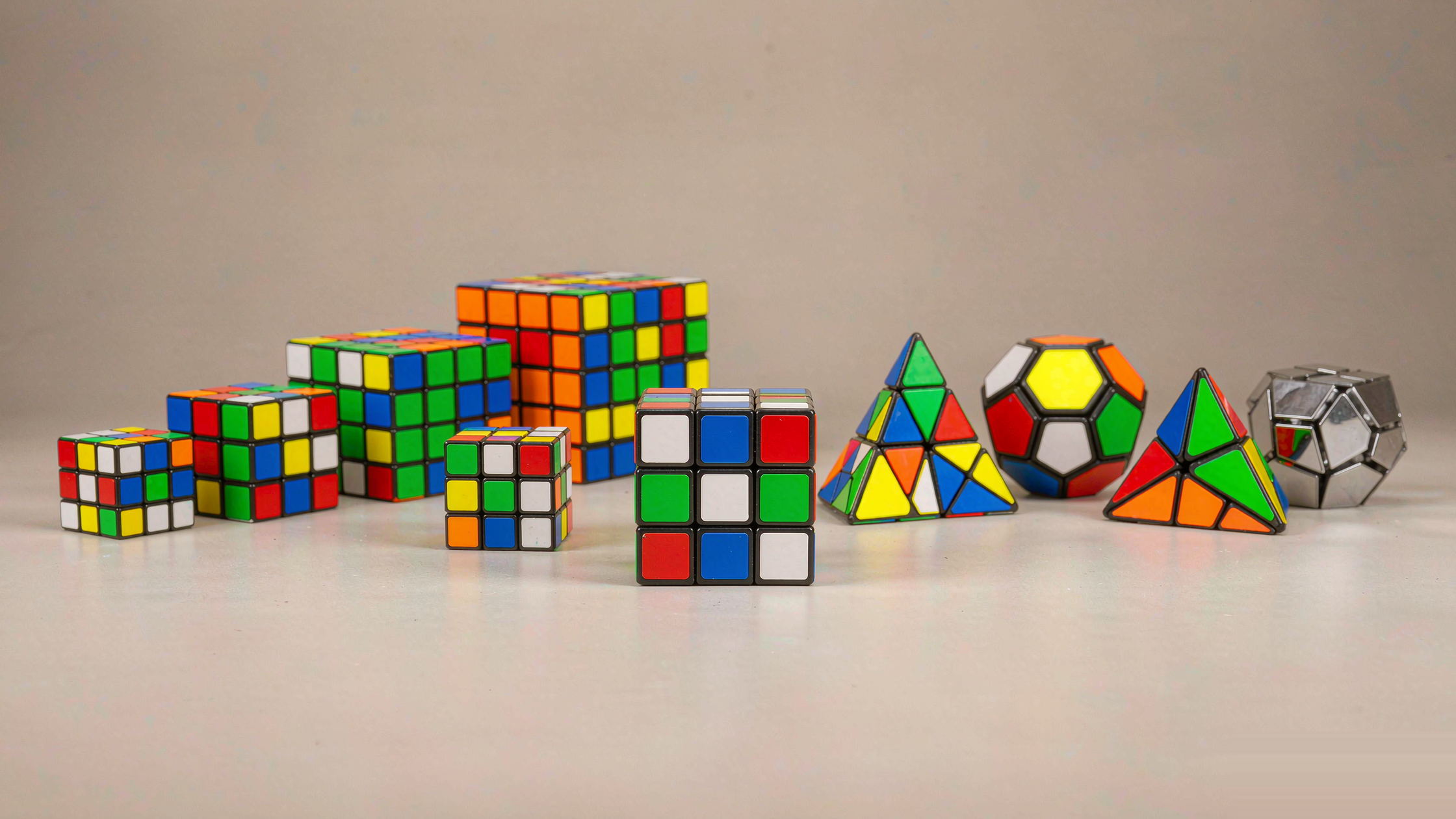
There are far more types of Rubik’s Cube than the 3×3 you remember from childhood. For a buyer, that is the problem: the names are messy, the same puzzle is sold under five different names, and picking the wrong mix leaves you with slow stock and returns. This guide splits the whole category into six clear groups, tells you who actually buys each one, and shows you how to match cube types to your channel and price point.
1. Why the Type of Cube Decides How Well It Sells
A cube is not one product — it is a whole shelf. Each type brings a different buyer, a different price band, and a different repeat-order pattern. The 3×3 is your volume item at a low unit price. Magnetic competition cubes carry a much higher ticket and get re-bought every time a new model comes out. Shape mods like the Mirror Cube sell on looks, so they work best in gift and display settings.
So the question is never “which cube is the most fun”. The question is which cube turns over fastest in your channel with the fewest complaints. A school buyer and a speedcubing shop want two completely different cubes, and both of them are right.
One more thing worth knowing: this is a real, still-growing market, not a fad. The World Cube Association (WCA) has registered over 280,000 competitors and more than 16,000 competitions worldwide, and it currently runs 17 official events across more than 100 countries. For you, that means the competition side of the category has a stable, predictable demand base — it is worth a place in your line, not a one-off test.
The split inside the category is just as useful. Retail data from a major Chinese e-commerce platform covering March to July 2026 showed that 3×3 speed cubes accounted for 62% of all cube sales value, while shape puzzles grew 41% year on year. Read that as a stocking plan, not as trivia: the 3×3 funds your shelf, and the shapes are where the growth is. If your range is all 3×3, you are holding the stable half and missing the growing half.
2. Types of Rubik’s Cube by Layer Count (the NxN Family)
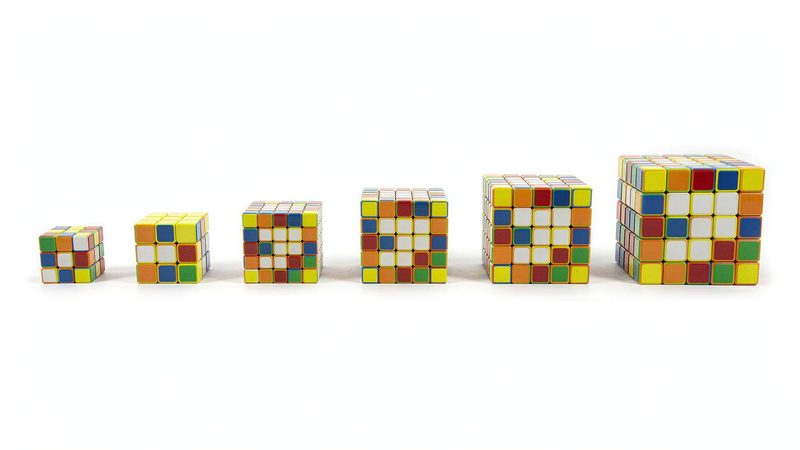
This is the group most buyers mean when they say “Rubik’s Cube sizes”. The number tells you how many pieces sit along one edge.
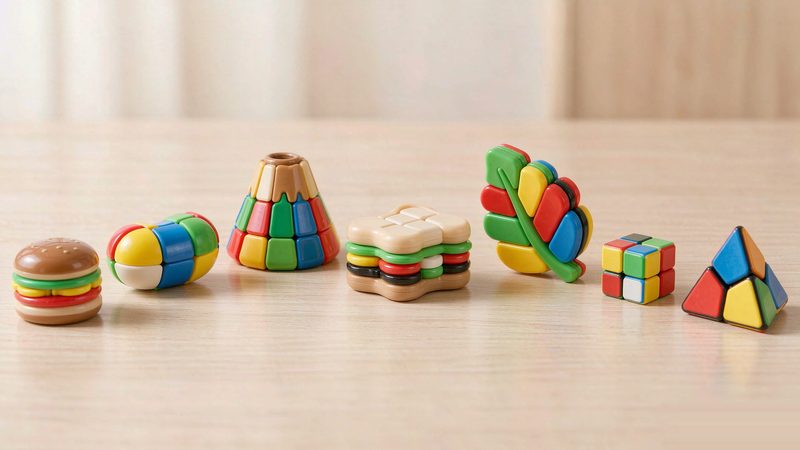
One step comes before all of it, though. In the Chinese supply chain you will meet a whole entry ladder that sits below the 2×2 — puzzles sold as hamburger, magic bean, volcano and sandwich shapes, plus the leaf cube (枫叶魔方), which many teaching clubs use as a child’s very first puzzle. They have no algorithms at all: the player just matches one color per layer, so a five-year-old can finish one in a minute. These are the items that decide whether a young child becomes a cube buyer at all, and they are cheap to make. If you sell into early education, preschool or family channels, this is where your range should start — not at the 3×3.
2.1 2×2 — the Pocket Cube
Only 8 corner pieces, no centers and no edges, and around 3.6 million possible positions. It is the easiest cube to learn and the cheapest to buy, which makes it a strong first item for school packs, party favors and keychain versions.
For your business: the 2×2 is a low-risk add-on SKU. Unit cost is low, shipping is cheap because it is small and light, and it rounds out a “starter set” without pushing your price up much.
2.2 3×3 — the Classic Cube
27 pieces, 54 colored faces, and over 43 quintillion positions. The 3×3 is the standard every solving method is built on, and it is still the single biggest seller in the category by volume.
Для вашего бизнеса: the 3×3 is your cash-flow item. Nearly every buyer you meet will order it, and it is the one SKU you should always keep in stock. It is also the cube your customers judge you on — if your 3×3 turns badly, they assume the rest of your range is the same.
2.3 4×4 — Rubik’s Revenge
No fixed center pieces, so the solver has to build the centers and pair the edges first. It also introduces parity errors — cases that cannot happen on a 3×3 and need extra algorithms.
For your business: the 4×4 is where a beginner becomes a real hobbyist. That makes it a natural second purchase, so it belongs in any set aimed at people who already own a 3×3.
2.4 5×5 — the Professor’s Cube
Fixed centers come back, but there are many more edges to pair and the solve runs much longer. Most people find it more patient work than the 4×4, rather than harder logic.
For your business: the 5×5 sits at a comfortable mid price and looks impressive on a shelf. It is a good step-up SKU for gift sets — big enough to feel like an upgrade, still easy to pack and ship.
2.5 6×6 and 7×7
Same idea again, just bigger. These cubes are more prone to popping and corner twists, especially when they arrive dry or badly tensioned.
For your business: treat big cubes as a quality-control risk. Ask your supplier how they are lubricated and tensioned before packing, ship them in a rigid box rather than a soft bag, and expect a slightly higher complaint rate. They are worth carrying, but they are not where your volume should come from.
2.6 Big Cubes (8×8 and up, up to 21×21)
These exist and they look incredible in videos. But they are slow to solve, heavy, expensive, and bought almost only by collectors.
Для вашего бизнеса: big cubes are a display item, not a volume item. Only stock them if your customers already have cubing traffic — otherwise they will sit in your warehouse.
3. Types of Rubik’s Cube That Are Not Cubes at All
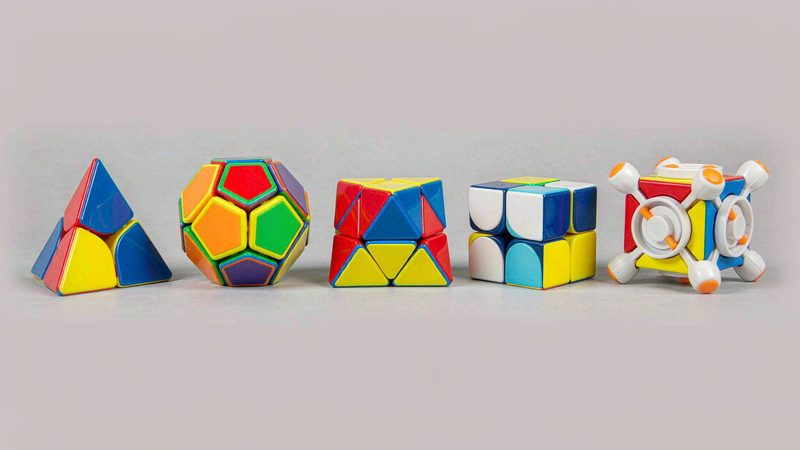
This is the group that surprises new buyers most. Several of these are official WCA competition events, so demand for them is steady and predictable rather than seasonal.
3.1 Pyraminx
A four-sided tetrahedron that turns around its tips. It is easier than a 3×3 and can be solved in seconds, which is exactly why it is so popular as a first “different” puzzle.
3.2 Megaminx
A twelve-sided dodecahedron with 50 moving pieces. It looks scary, but the last stage uses the same ideas as a 3×3. It is a long solve, not a hard one — good for the end users who enjoy the process rather than the speed.
3.3 Skewb
Turns around its corners instead of its faces. It is a deep-cut puzzle, so it feels completely different from anything else on the shelf even though it is quick to learn.
3.4 Square-1
The middle layer moves independently, so the puzzle loses its cube shape completely while scrambled. The solver has to rebuild the shape before solving colors.
For your business: the Square-1 has the most complex mechanism in this group, so mechanism quality is the main risk. Ask for a sample and turn it hard before you place a bulk order.
3.5 Clock
Two faces of nine dials each. Important timing note: the WCA has announced that Clock will be removed after the 2027 World Championship. Plan your long-term stock and any tooling around it accordingly — do not build a multi-year program on a puzzle that is losing official status.
For your business: the five puzzles above are the backbone of a “WCA set”. Bundling a Pyraminx, Megaminx, Skewb and Square-1 together gives schools, clubs and resellers one easy purchase instead of four, and it lifts your average order value.
4. Shape Mods: A 3×3 Inside, A Different Puzzle Outside
Shape mods use a familiar mechanism but change what the solver sees. They sell on sight — even a shopper who has never solved a cube will pick one up off the shelf because it looks strange.
- Mirror Cube (Mirror Blocks) — one color, every piece a different size. You solve by shape instead of color. It is the best-known mod and the safest one to stock.
- Ghost Cube — asymmetric cuts, and it stops looking like a cube the moment it is scrambled. Genuinely hard, aimed at experienced solvers.
- Fisher Cube, Axis Cube, Windmill Cube — standard internals with rotated or rearranged cuts.
- Void Cube — the centers are removed, so you can see straight through it.
- Gear Cube and cuboids — gear-linked turns, or rectangular shapes like 2x3x3 and the 2x2x4 “Tower”.
5. Types by Build: Toy-Grade, Speedcube, Magnetic and Smart
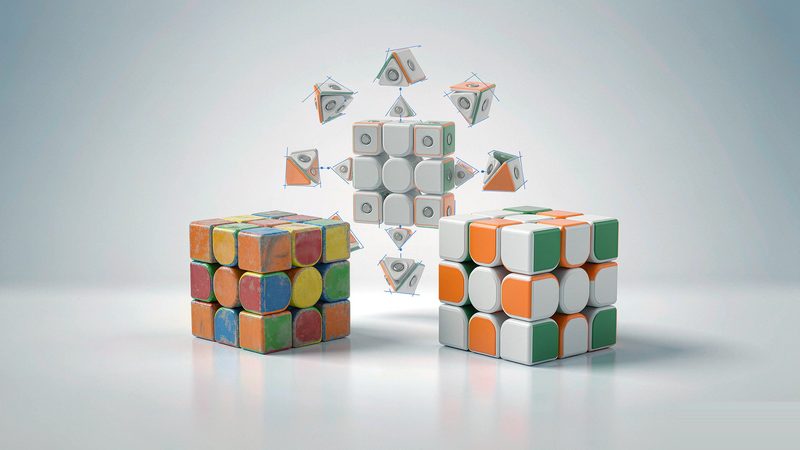
Even inside the same 3×3, there are two very different products. Knowing the difference protects you from ordering the wrong one.
5.1 Toy-Grade Cubes
Basic mechanism, often stickered, stiff out of the box. These are fine for giveaways and party bags, and risky for anything else. A bad cube makes people think they dislike cubing when they actually just dislike that cube.
That last point is not a figure of speech, and it is the single most useful thing you can tell a customer who only looks at unit price. In buyer reports from Chinese parenting and review communities, the same story repeats: a child gets a cheap cube, it jams, sheds stickers and pops apart, the child gives up in tears, and the parent concludes the kid has no talent for it. One widely shared account describes a beginner stuck at around 70 seconds after a month on a budget cube, then dropping under 50 seconds within a week of switching to an entry-level magnetic cube. The tool was the problem, not the child. For your business, that cuts both ways: a cheap cube does not just get returned, it kills the repeat purchase that would have followed. Sell the magnetic entry model and you protect the customer’s next order instead.
5.2 Speedcubes
Better plastics, rounded internals, adjustable tension, and strong corner cutting so the cube still turns when a layer is not perfectly lined up. This is the level most of your buyers now expect, even at entry prices.
5.3 Magnetic Cubes
Small magnets inside the pieces give a light click when a layer lands. Magnets stop overshooting and make the cube feel stable, which is why they help beginners learn faster. There are two main systems:
- Piece magnets — usually one per edge and corner, around 48 in total. This is the standard now.
- Ball-core / core magnets — magnets in the core itself, pulling layers into place from the center out. More stable, higher cost.
There is also MagLev, which replaces springs with repelling magnets. It is not automatically better — buy the whole package, not the buzzword on the box.
Для вашего бизнеса: magnetic is no longer a premium feature, it is close to the default. If a supplier is still quoting you non-magnetic mid-range cubes at the same price as magnetic ones, that is a warning sign about how current their tooling is.
5.4 Stickerless vs Stickered, and UV Coating
Stickerless cubes are molded in colored plastic, so the color cannot peel or fade. Stickered cubes look sharper when new but need replacement stickers later. A UV coating adds a glossy, grippy finish and a more premium look.
Для вашего бизнеса: stickerless directly removes your most common complaint. Peeling stickers are the number-one reason a cheap cube gets returned, and stickerless costs very little more per unit.
5.5 Smart / Bluetooth Cubes
Built-in sensors connect to an app for tutorials, timing and online battles. Retail prices run roughly $35 to $80, far above a normal cube, and the segment is growing fast.
For your business: smart cubes are a high-ticket, high-responsibility SKU. They contain a battery, so they add shipping restrictions and extra electrical and wireless approvals on top of toy safety testing. Do not make them your first order — add them once your range is established and you can support the app side.
6. Which Types of Rubik’s Cube Sell Best in Each Channel
There is no single best type. There is only the best type for the channel you sell into.
| Your channel | Types to lead with | Why |
| Schools, clubs, training centers | 3×3 and 2×2, bulk packed | Price-sensitive, high volume, needs durability |
| Amazon and cross-border e-commerce | Magnetic 3×3, shape mods, mixed sets | Good margins, strong photo appeal, reviews drive ranking |
| Promotional gifts and corporate orders | 2×2 and 3×3 with printed logo | Low unit cost, long desk time, high brand exposure |
| Specialist cubing shops and clubs | Flagship magnetic models, big cubes, WCA shapes | Buyers know exactly what they want and re-buy often |
| Supermarkets, discount chains | Entry 3×3, keychain cubes, puzzle sets | Impulse price point, needs eye-catching packaging |
| Preschools, early learning, family channels | Bean, hamburger, volcano and leaf puzzles, then 2×2 | No algorithms needed, so young children finish them and stay interested |
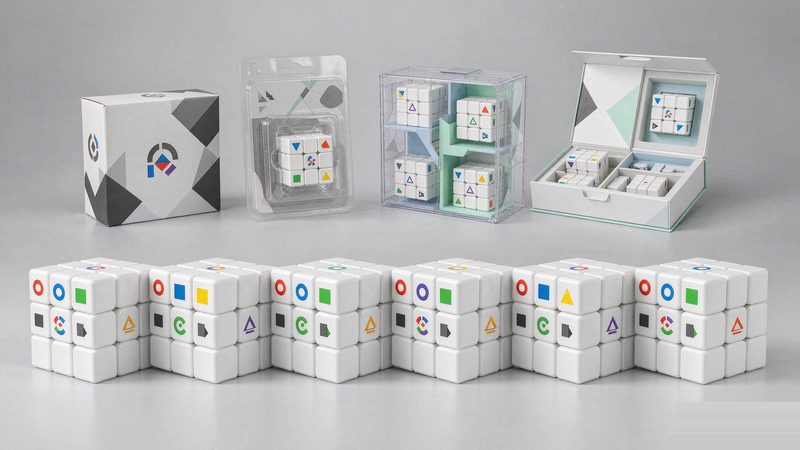
Two practical notes. First, sets are the easiest way to raise order value — a 3×3 plus a Pyraminx plus a Mirror Cube feels like a real gift for very little extra cost. Second, watch the brand name: “Rubik’s” is a registered trademark owned by Rubik’s Brand / Spin Master. Use it only for genuine licensed goods, and describe your generic range as magic cube, puzzle cube, speed cube or twisty puzzle. Your listings still need the search term people type, but the product description should not claim a brand you are not licensed to sell.
7. What to Check Before You Order: Quality, Safety and Customization
Buying cubes is easy. Buying cubes that pass inspection and sell through is the actual work.
Material and build. ABS plastic is the standard. Ask for non-toxic material documentation, and check for smell, color consistency between batches, and turning feel across a random sample — not one hand-picked piece.
Safety certification depends on your market:
- European Union — CE marking based on the full EN 71 series (parts 1, 2 and 3), plus REACH and a Declaration of Conformity. Partial test reports are often rejected.
- United States — ASTM F963 testing plus CPSIA compliance, and a CPC certificate issued against a third-party lab report. Amazon and US customs both check this.
- Smart cubes and anything with electronics — expect extra electrical, EMC and wireless approvals, plus battery transport documentation. Budget more time for these.
Common defects to inspect: loose or misaligned stickers, popping under hard turns, inconsistent tension between units, sharp edges on the internal pieces, and color mismatch across a batch. Agree an AQL level before production, not after.
Customization options usually cover pad printing or full-color UV printing of your logo, custom color schemes, and packaging — printed color box, blister, display box or a multi-piece set box. MOQs for stock items often start in the hundreds, while custom printing and custom packaging push higher, because artwork setup and tooling have to be paid for. Always get a printed sample before you commit to a bulk run.
Two supplier checks save you more time than any price negotiation. First, ask whether the factory actually takes export orders — a surprising number of small cube workshops on domestic B2B platforms sell well at home but cannot handle export paperwork, testing or English specifications, and you only find out after the sample is approved. Second, pin down the real MOQ by service, not by product: in the Shantou Chenghai cluster, custom logo work and private labelling commonly start around 1,000 pieces, while gift-oriented factories in Yiwu often ask for 5,000, and mixing several types into one assortment is usually negotiable even when a single SKU is not.
8. Frequently Asked Questions
What are the main types of Rubik’s Cube?
They fall into six groups: NxN cubes by layer count (2×2, 3×3, 4×4, 5×5, 6×6, 7×7 and bigger), non-cubic WCA puzzles (Pyraminx, Megaminx, Skewb, Square-1, Clock), shape mods (Mirror, Ghost, Fisher, Void, Gear), build levels (toy-grade, speedcube, magnetic, smart), brand versus generic, и packaging formats (single cube, set, promotional item).
What is the easiest type of Rubik’s Cube for beginners?
The Pyraminx and the 2×2 are the easiest, followed by the 3×3. The Pyraminx can often be solved without memorized algorithms, which is why schools and clubs start with it.
What is the best first puzzle for a young child?
Start below the 2×2. Bean, hamburger, volcano and leaf-style puzzles need no algorithms at all — the child just matches one color per layer — so a five-year-old can finish one in about a minute. That first finished puzzle is what keeps them buying the next one.
What is the hardest type of Rubik’s Cube?
Among common puzzles, the Square-1, the Ghost Cube and big cubes above 7×7 are the hardest. The Square-1 is hardest to learn, the Ghost Cube is hardest to read, and big cubes are hardest to finish.
What is the difference between a Rubik’s Cube and a speedcube?
A standard Rubik’s Cube is built for casual play, while a speedcube is built for fast, smooth turning with better corner cutting, adjustable tension and usually magnets. Most buyers now expect speedcube-level performance even at entry prices.
What sizes do Rubik’s Cubes come in?
The common sizes are 2×2, 3×3, 4×4, 5×5, 6×6 and 7×7, with cubes up to 21×21 made for collectors. Physical size is usually around 56–57 mm for a standard 3×3; smaller keychain versions also exist.
Is a 4×4 harder than a 5×5?
The 4×4 is harder to learn because it has no fixed centers and creates parity errors. The 5×5 has fixed centers and more predictable logic, but takes much longer to finish.
What is a magnetic cube, and do I need one?
Magnets help the layers snap into place, which reduces mis-turns and makes the cube feel stable. For most buyers today, yes — magnetic models are available at entry-level prices and they cut down on frustration and returns.
What is the difference between stickerless and stickered cubes?
Stickerless cubes are molded in colored plastic, so the color cannot peel. Stickered cubes look slightly sharper when new but need replacement stickers over time. For resale, stickerless is the safer choice.
Are Pyraminx, Megaminx and Skewb types of Rubik’s Cube?
Not strictly — they are twisty puzzles with different shapes and mechanisms. They are grouped with Rubik’s Cubes because buyers search them the same way and they are official WCA competition events.
Can I put my logo on a Rubik’s Cube?
Да. Pad printing and full-color UV printing on all six faces are both common, along with custom color schemes and printed packaging. Minimums for printed cubes are higher than for plain stock because of setup costs.
Which safety certifications do puzzle cubes need?
EN 71 plus CE and a Declaration of Conformity for the EU, and ASTM F963 with CPSIA and a CPC certificate for the US. EN 71 and ASTM do not replace each other, so if you sell into both markets you need both test reports.
Are shape mods worth stocking?
Yes, if you can photograph them well. Shape mods were the fastest-growing part of the category in recent retail data, up around 41% year on year, because they sell on sight rather than on skill. They carry better margin than a plain 3×3, but they need a solution guide in the box.
Which type of Rubik’s Cube sells best?
The 3×3 sells the most units by a wide margin, and the 2×2 and the Mirror Cube are the strongest supporting items. Magnetic models and mixed sets give you the best margin per order.
Do you offer mixed sets and custom packaging?
Yes — mixed sets across sizes and puzzle types are one of the easiest ways to raise order value, and packaging can be done as a printed color box, blister card, display box or gift set box with your own artwork and manuals in your language.
Wrapping Up
If you take one thing from this guide, take this: the 3×3 pays your bills, the shapes and sets build your margin, and the magnetic mid-range is where the market has moved to. Start with a 3×3 that turns well, add a Pyraminx and a Mirror Cube to catch gift buyers, and only go into big cubes and smart cubes once you know your customers want them. That order keeps your stock moving and your complaint rate low. And if young children are anywhere in your customer base, do not start them on a 3×3 — a bean, hamburger or leaf puzzle costs you almost nothing and it is what turns a first attempt into a second purchase.
We supply the full range of twisty puzzles — NxN cubes, WCA shapes, shape mods, magnetic and smart models — with OEM logo printing, custom packaging and the test reports you need for the EU and US markets. If you are planning a puzzle line or want to know which mix fits your market, leave a comment or send us your target price and channel, and we will put a selection together for you.