Importing DIY Squishy Kits Wholesale from China: What Buyers Need to Know
A DIY squishy kit looks like an easy buy. A mold, some goop, a small pot of paint, a box.
It is not easy. One kit is really four different supply chains packed into one carton. And it sits in a toy category that regulators have already pulled off the shelves in Europe.
This guide covers what you need before you order. Which kit types can you buy? Which material should you pick? What tests will your country ask for, and what will a factory really quote you? Read it before you send that first email, and you skip the expensive lessons.
1. What Is a DIY Squishy Kit, Exactly?
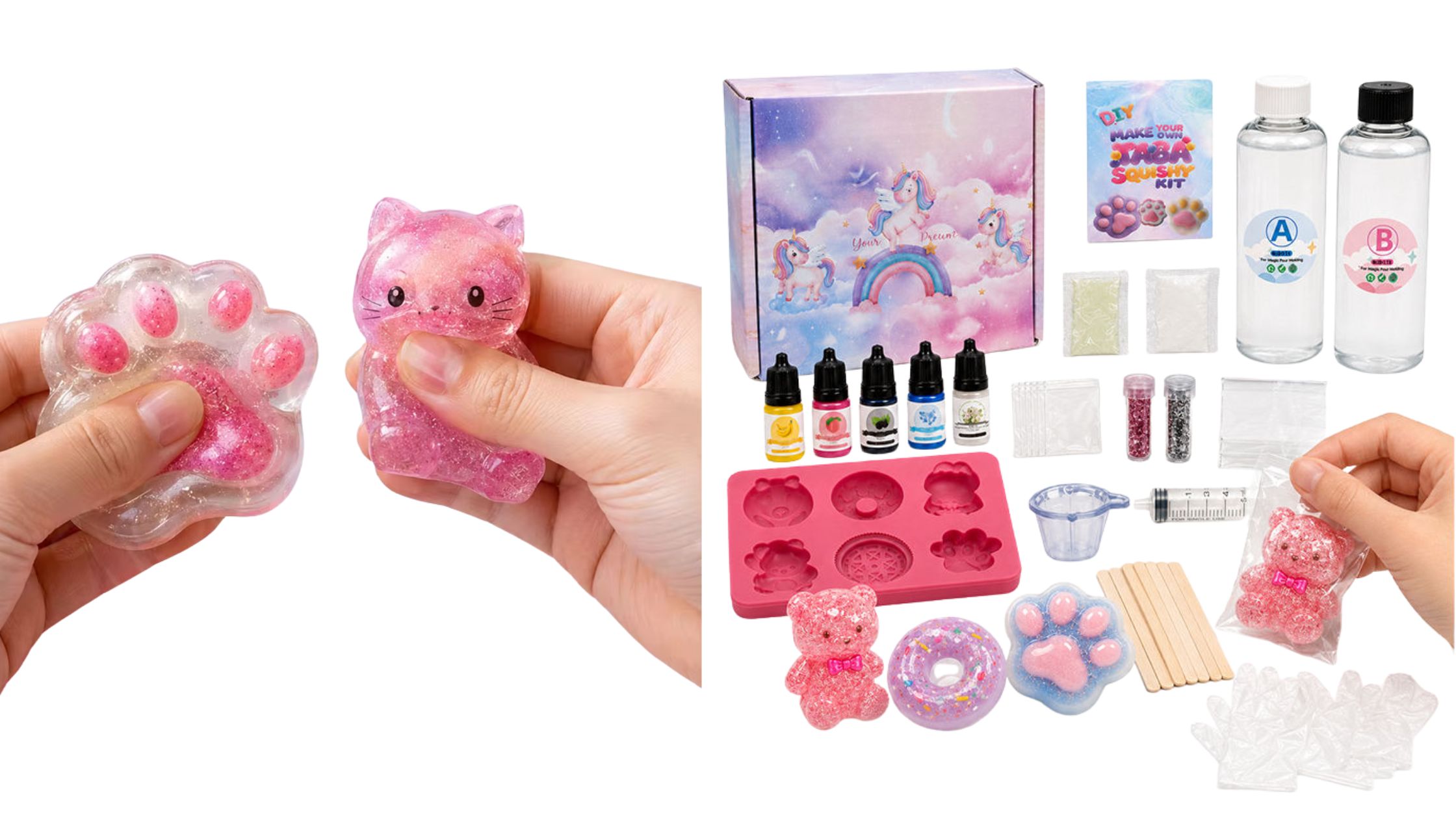
A squishy is a soft foam toy. You squeeze it, and it slowly comes back to shape — usually in three to five seconds. That slow bounce back is the whole point of the product.
Most squishies look like food: buns, strawberries, mochi. There are lots of animals too. Many are scented to smell like whatever they look like.
Squishies started in Japan as part of kawaii culture. They reached US shops in the spring of 2017 and spread fast on YouTube unboxing videos and ASMR clips. Collectors still call them *kawaii squishies*. You can see the shapes and materials in our overview of мягкие игрушки.
The word you will hear in 2026 is taba squishy — the sticky, wobbly style. TABASQUISHY makes theirs from solid food-grade silicone. Other brands use a softer rubber called TPR. We cover both in силиконовый мягкий и TPR toys.
1.1 Two mix-ups that cost buyers money
Squishmallows are not squishies. A Squishmallow is a soft plush stuffed with polyester, made by Kellytoy. A squishy is foam. Shoppers mix them up all the time, and so do listings. Put “squishmallow” on a foam kit and you pull in the wrong traffic and the wrong complaints.
You are selling the making, not the toy. Your box sells an activity and its result. That brings two sets of safety rules, more parts to count, and a refill business that comes free with it. More on that in Section 2.3.
2. Is This Category Worth Your Money? Here Are the Numbers
2.1 How big the squishy market is right now
Two research firms put the world market for fidget and stress-relief toys at about $9 billion in 2025. Mordor Intelligence says $9.07 billion in 2025 and $9.68 billion in 2026. Fortune Business Insights says $9.01 billion and $9.57 billion. When two firms land within 1% of each other, the demand is real — this is not a short-lived fad.
The bigger picture helps too. Toy sales in the US hit $30.3 billion in 2025, up 6% after two flat years. When shelves start moving again, shops refill them. That is when a new supplier gets a foot in the door.
2.2 Why TikTok keeps demand going
The fidget-toy hashtag on TikTok has passed 35 billion views. People buy these because they film well. A slow squeeze, a soft sound, a bright bun shape — it all looks good on a phone. To understand the channel, read what are fidget toys.
Two things follow from that, and both change how you plan. Demand can arrive faster than you can make it. And a shape can be dead two seasons later. Plan for speed, not for a five-year product.
2.3 What these kits actually sell for on Amazon
Tracking tools count about 133 live listings for “make your own squishy kit”, and the $10–20 price band holds 41% of them — the most crowded part of the category. For “squishy making set”, the $20–50 band holds 56%. Today’s best sellers sit around $22–28 and sell thousands a month. If Amazon is your channel, read toy sourcing for Amazon from China next.
Here is the part that should shape your order: this is a refill business wearing a toy costume. Elmer’s sells its kit with 80 characters to collect and 12 rare ones, then sells a refill pack beside it. Collecting plus refills means people buy again and again. A refill buyer is the cheapest customer you will ever win — it is the same idea that runs the blind box toy business.
3. The 5 Types of DIY Squishy Kit — and Who Makes Each One
Most buyers skip this part, and it is the part that decides whether sampling goes well. “DIY squishy kit” is not one product. It is five, and no single factory makes all of them well.
| Kit type | What is in the box | Age | Usual retail | Who really makes it | What goes wrong |
|---|---|---|---|---|---|
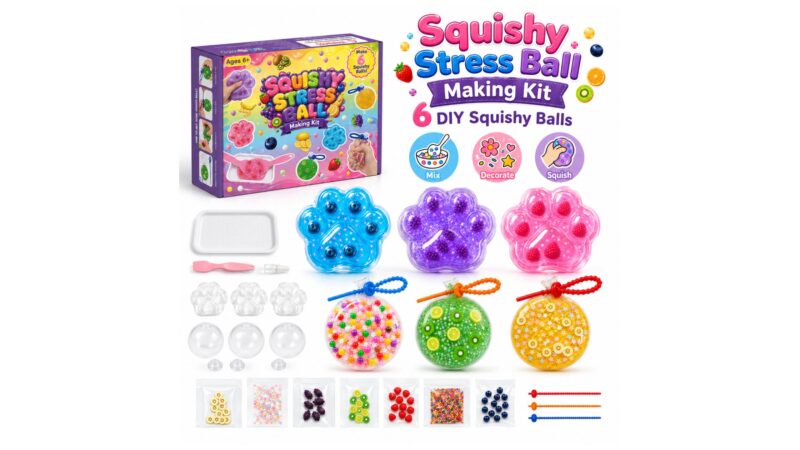
| Paint-your-own foam | 2–4 blank slow-rise foam shapes, puffy or fabric paint, brushes, glitter and small charms | Fine for the youngest | Low–mid | A foam moulder plus a paint supplier — see arts and crafts toys wholesale | The paint cracks off after a few squeezes |
| Two-part goop | Two liquids A and B, molds, cups, stir sticks. Sets in about an hour | 6+ | About $18 for four | A chemical packer plus a mold maker | Wrong mix, messy, and a smell you cannot hide |
| Two-part silicone | 16 oz of A/B silicone, silicone molds, color paste, gloves, flocking powder. Needs about 4 hours to set at 77°F | 14+ | About $26 | A silicone factory | The long set time, and an honest 14+ label that shrinks your market |
| Water gel (“aqua fairy”) | Gel liquid, a calcium bath, molds | 3+ | About $25 | A chemical packer | Leaking gel, and a wet, messy play pattern |
| Blank skins + pump | Clear TPR skins, a hand pump, an expander tool | 8+ | About $23 for 15 | A ТПР factory | Weak seams once inflated |
3.1 Why the box matters more than the toy
Read that table as a buyer. A kit with eight parts has eight things that can go wrong, and eight minimum order quantities. The foam maker does not make paint. The paint maker does not make molds. Somebody has to count it all and seal the box. That is exactly the job described in sourcing toys and DIY items from China.
Two things you can do about it. Get the full parts list in writing before you ask for a price — a quote for “a squishy kit” means nothing. And expect the printed box to set your real minimum: box printing usually starts at 500 to 1,000 pieces, however flexible the factory is on the foam.
4. Which Material Should You Choose: PU Foam, TPR or Silicone?
Once you have picked a kit type, you still have to pick the material. This one choice sets your cost, your product life, your test route and who will stock you.
4.1 What each material costs and how long it lasts
| PU foam | ТПР | Силикон | |
|---|---|---|---|
| How it feels | Very soft, 3–5 second slow rise | Stretchy, bounces back fast | Dense, smooth, feels expensive |
| Normal factory price (FOB) | $0.20–1.00, up to about $5 for jumbo | $0.30–1.20 | $1.20–3.50 |
| How long it lasts | 6–18 months. It flattens out and the paint flakes | 1–3 years, and it survives washing | Years. No peeling, and it can go in a dishwasher |
| Decoration | Surface paint only — and it wears | Color all the way through, best for printed logos | Color through, pressed-in or laser marks |
| Best shelf | Trend shops, collectibles, claw machines, subscription boxes | Promotions, schools, vending machines | Adult wellness, therapy, premium gifts |
Only PU foam gives you that true slow rise. TPR and silicone bounce back fast by their nature. So if the promise on your box is the slow “melting” return, PU is your only real choice — and that means budgeting cure time to keep the smell down (Section 4.3). If you would rather test the market with finished goods first, our wholesale squishy toys range is the fast way in.
4.2 Choose by where you sell, not by what you like
Do not pick a material because you like how it feels in your hand. Pick it for the shelf it will sit on.
- Selling on Amazon or other marketplaces? Use TPR. Returns and one-star reviews cost you far more than a few cents a unit, and TPR survives handling and washing.
- Selling in gift shops, at markets, or as party favors? PU foam is fine. Shoppers buy on look and feel, the price is low, and the toy does not need to last three years.
- Selling to schools or therapists? Use silicone, or a named high-grade TPR. These buyers ask for paperwork, keep the item for years, and pay more for something they can clean. That is who our sensory toys wholesale range is built for.
- Putting a logo on it for a promotion? Use TPR. It takes a clean pad print, and the promo industry already knows how to price it. See promotional toy sourcing.
One clear warning: stay away from cheap PVC. It costs about $0.25–0.90, but it carries the worst smell risk and the worst phthalate risk. One run of “smells like chemicals” reviews can kill a listing.
4.3 The smell test — do this before you approve anything
Smell is the number one reason these toys get returned and reviewed badly. It comes from three places: foam packed before it finished curing, cheap PVC, and a sealed bag sitting in a hot container for 35 days.
Do this on every sample, every time. Put the toy in a zip bag. Wait 48 hours. Open it and smell it. That is what your customer gets when they open the package. If it smells bad, no amount of nice packaging will save your reviews.
5. Will Your Shipment Pass? The Rules That Decide It
This is the part that decides whether your goods land or get destroyed at the port. It is also where most first-time importers lose money. Read our guide to toy certification before you ask anyone for a price.
5.1 This category has been pulled off shelves before
In 2018 the Danish environmental agency tested 12 squishy toys, and all 12 gave off harmful chemicals — including N,N-dimethylformamide, styrene and toluene. The government told shops to pull them and told buyers to throw them away. The EU safety alerts from that time, A12/1635/18 and A12/1627/18, name the same chemicals and say plainly that the products break the Toy Safety Directive.
The industry body argued back then that the risk was overstated. For you the argument does not matter. What matters is that this category has a record — and the buyer without a fresh test report is the buyer who pays for the recall.
This is not old news. In March 2026 the China Toy and Juvenile Products Association tested 126 batches of toys. Soft-gel stress toys came out worst of any type: about 77% broke the new national limits for formaldehyde, benzene, toluene, xylene and TVOC. Start with the labs in 10 best toy testing labs for CE, ASTM and EN71.
5.2 Formamide: the chemical number your foam must hit
The chemical regulators look for in foam today has a number you can put in a spec sheet. It is called formamide.
- EN71-15:2025 sets it at 200 mg/kg. Go over that and you must run a release test and stay under 20 μg/m³ over 28 days. It covers toys for children under 36 months and anything made to be mouthed.
- China’s GB 6675.1-2025 uses the same pair of numbers — 200 mg/kg and 20 μg/m³ — from 1 November 2026.
- The new EU toy law, (EU) 2025/2509, stretches the 200 mg/kg limit to all toys for under-14s from 1 August 2030.
- Taiwan’s CNS 4797 uses the same 200 mg/kg.
Write “formamide ≤200 mg/kg, or release ≤20 μg/m³” into your spec today. It costs nothing now, and it is the line that will decide your EU listing in 2030.
5.3 China’s new toy law starts November 1, 2026
The 2025 version of GB 6675 was published on 5 October 2025 and takes effect on 1 November 2026, replacing the 2014 rules. It runs on a “12+12” plan: 12 months for factories to switch over, then 12 more months to sell off old stock. Everything on the market must comply by 1 November 2027.
What changed, in plain terms:
- TVOC given off must stay under 0.5 mg/m³ — the first limit of its kind in any toy standard, and aimed straight at the “it smells strong” problem in this category.
- Formaldehyde given off must stay under 0.08 mg/m³, plus a 30 mg/kg limit on materials that children under 36 months can touch.
- Phthalates go from 6 controlled types to 10, all capped at 0.1%.
- Boron capped at 300 mg/kg for slime-type materials.
- “Squishies” and crystal slime are named in the rules directly.
Two things follow for you. A factory still quoting against the 2014 standard is telling you it has not caught up. And stock you buy in late 2027 that was made to the old rules has an expiry date.
5.4 The big trap: your kit is a toy AND an art set
Here is the mistake almost every first-time buyer makes. You test the foam, and you forget the paint.
In the US, the foam toy is a children’s product. You need third-party testing to ASTM F963 and a Children’s Product Certificate. You also need to meet CPSIA limits — 90 ppm lead in coatings, 100 ppm total lead in the base material — plus phthalate limits and a tracking label. Since mid-2026 that certificate has to be filed electronically; see CPSC eFiling и CPC / TIC direct validation.
But the paint, markers, glue and glitter in the same box are art supplies, and they run under a different law called LHAMA. Under it:
- A trained toxicologist must review every formula for long-term health harm before the product is sold.
- The pack must say “Conforms to ASTM D-4236.” It can go on the product, the kit box, an invoice or the shelf display.
- If there is a hazard, you need warning text and a US phone number, and you cannot sell it to children in grade 6 or below.
- US shops ask for the ACMI AP Seal — it means non-toxic. The CL Seal means “read the warnings,” and CL products must never go to grade 6 or younger.
So ask your supplier two questions, not one. “Do you have the ASTM F963 test report for the foam?” and “Do you have the ASTM D-4236 toxicologist review for the paint?” Most factories can answer the first. Very few can answer the second.
5.5 What Europe and the UK ask for
For Europe and the UK, expect EN71-1 (shape and physical safety), EN71-2 (how it burns) and EN71-3 (heavy metals). Then the newer parts: EN71-15 for formamide, EN71-16 for certain flame retardants at 5 mg/kg each, and EN71-17 for preservatives in water-based materials.
On top of that, ДОСТИГАТЬ brings phthalates at 0.1%, PAHs, nickel release and short-chain chlorinated paraffins, and any listed substance above 0.1% triggers SCIP reporting. You also need a CE declaration and your name and address on the pack as importer. You can apply for a toy test report at most accredited labs in China within two weeks.
One honest warning. The age label drives which rules apply, and writing “adult desk toy” will not save you if the product looks like a children’s toy. Regulators read the shape, the colors and the price — not your disclaimer.
6. What Will a Factory Charge You? MOQ, Molds and Time
Get these numbers before you email anyone. They help you tell a real quote from a guess.
| PU foam | Силикон | ТПР | |
|---|---|---|---|
| Normal minimum order | From 1,000 pcs | From 300 pcs | 3,000–5,000 pcs |
| Mold cost | From about $1,000 | From about $1,000 | From about $2,000 |
| Cutting the mold | 20–30 days | 20–30 days | 20–30 days |
| Making samples | 10–20 days | 10–20 days | 10–20 days |
| Mass production | About 30 days after you approve | About 30 days | About 30 days |
Treat these as a rough guide, not a promise. Hard shapes, more colors, custom fillings, retail packaging, testing and how busy the factory is will all move them.
6.1 Six things to send before you ask for a price
Send these in your first email and you skip two weeks of back-and-forth. Our guide on how to check a toy quotation list explains why each line moves the price.
1. Размер — target measurements, or a product to copy. 2. Quantity — the total, and how many per design or color. 3. Design files — real 2D drawings or a ready-to-use 3D file. 4. Material and feel — PU, TPR or silicone, and how the squeeze should feel. 5. Logo and packaging — print method, labels, retail box, polybag, display unit. 6. Your market, the age group, and the standards you must meet.
Buyers leave out that last line, and it is the line that changes the price.
6.2 Freight: squishies ship cheap, kits less so
Out of China, sea freight costs about $0.10–0.30 per kg, and air freight costs $4–8 per kg. That is a 20 to 40 times gap. Squishies pack tight, so a carton of foam costs far less to ship than the same carton of plush. Work the numbers with a freight forwarder in China before you commit.
One thing to remember about air freight. It charges on whichever is bigger: the weight, or the size weight (length × width × height ÷ 6000 in cm). A kit box with stiff molds is heavier and bulkier than a bag of foam, so the kit flies worse than the toy it makes.
On duty, most squishies sit under HS code 9503: the US charges 0% on most toys, the EU and UK 4.7%, Australia 5%. Add about 0.3–0.5% of the cargo value for insurance, plus a few hundred dollars for the broker and port fees.
7. 5 Checks Before You Say Yes to a Sample
Almost every disaster in this category shows up in the sample — if you know where to look. None of these need a lab. Five minutes and your own hands will do.
7.1 Check 1: put it in a bag for 48 hours
Already covered in 4.3, and worth saying again. Zip it in a bag, wait 48 hours, then smell it. Do it on the production sample, not just the pretty sales sample.
7.2 Check 2: write the bounce-back time in seconds
“Slow rise” means nothing to a factory worker. Write down the number of seconds. Three to five is the classic feel. Skip this and you will get a batch that snaps back at once, and every review will say the same thing.
7.3 Check 3: rub the paint hard
On painted foam, press hard and rub the surface with your thumb. Cheap paint lifts and cracks on the second squeeze. Puffy or fabric paint bends with the foam. Plain acrylic does not. And if your kit is paint-your-own, test the paint from the box on the foam from the box — not on paper.
7.4 Check 4: ask how long it cured
Foam bagged before it has finished curing will reach you smelling like a chemical works. Ask the factory how many days run between pouring and packing, and ask them to air the cartons. This one question separates factories that know this product from ones that just bought a mold.
7.5 Check 5: read the small parts and the instructions
Charms, glitter pots, tiny brushes and rare “collectible” pieces all pull the age label down. Confirm the age label, the choking warning, and that the instruction sheet is in the language of the country you sell in. One folded sheet printed in six languages costs less than six separate print runs — ask for it.
8. Where to Buy in China — and How to Spot a Middleman
8.1 The three places that make squishies
- Иу — home of PU foam squishies and small goods, and easily the best place to pull many small parts into one container. Got eight parts from six suppliers? Yiwu is where that gets solved. Our Yiwu market buying guide shows how such an order actually runs.
- Shantou / Chenghai — the plastics and injection hub, strongest on TPR squishies and gel-filled items at scale. See Shantou toy factories.
- Dongguan — silicone, and the tighter tolerances that come with it.
8.2 Five questions that expose a trading company
Ask these and you will know in two minutes who you are talking to.
1. “Who owns the mold?” A factory owns tooling. A trader rents it. 2. “Can you show me the foam pouring line?” Video is fine. Watch how they answer, not just what they show. 3. “Can you send the raw material spec and the test report in your own company name?” A report made out to someone else is not your report. 4. “How many days between pouring and packing?” See 7.4. 5. “Which part of the kit do you make yourself?” Anyone who says “all of it” is not telling you the truth.
More on vetting here: how to find the best toy manufacturers in China.
One red flag worth naming: a supplier who never asks about your market and your age group. A real factory knows those two answers change the material and the price.
8.3 Accept it: a kit is an assembly job
Nobody makes foam, paint, molds and printed boxes under one roof, so somebody has to kit them together. You have three options.
- Buy from a kit factory that already holds those relationships.
- Let your biggest supplier buy the rest in — and carry the quality risk yourself.
- Use a sourcing agent to pull it together and check it before the cartons close.
Most first-time importers end up at the third one, usually after trying the second.
9. What You Can Change — and What You Can’t
9.1 What you’re free to change
- Shape — your own mold, from about $1,000 and 20–30 days.
- Color and scent — cheap to change, and scent is a real reason people buy again.
- Fillings — beads, glitter, maltose gel. This is what turns a soft toy into a *crunchy* or a *squirty* one.
- Surface — flocking powder, glow-in-the-dark, two-color marbling.
- Logo — works well on TPR and silicone, badly on PU foam, where you can only surface paint it.
- Упаковка — retail box, header card, hangtag, instruction sheet, display unit. See custom toy packaging for what each one costs.
- Refill packs — the cheapest repeat sale you will ever build.
9.2 Want repeat orders? Build in a mystery format
The best-selling kit in the US does not sell a squishy. It sells 80 characters, 12 of them rare, in a blind box. That is why children buy it four times.
If you are building your own brand, ask your factory how many shapes it can tool in one program and whether it can hold a “rare” back. The mystery setup is a factory decision, not a marketing one.
9.3 The one line you cannot cross
Food shapes and animal shapes are safe to develop. Characters are not. If a shape belongs to someone else, get written permission before you cut a mold. A factory that hands you a famous character without asking for proof is handing you a problem, not a shortcut.
This category has a long history of knock-offs, and marketplaces delist first and ask questions later. The brands that get rich from characters — see the Labubu toy market — own the ones they sell.
10. Frequently Asked Questions
What is a DIY squishy kit?
A boxed set that lets the buyer make a squishy instead of just buying one: blank foam shapes with paint, two liquids with a mold, or a gel kit. It sells an activity and its result, which is why it behaves nothing like a finished squishy when it comes to testing and reorders.
What is the minimum order for a custom DIY squishy kit from China?
The foam usually starts at about 1,000 pieces, silicone at 300, and TPR at 3,000–5,000. But for a kit, your real minimum is the biggest minimum among the parts — and that is usually the printed box, which often starts at 500 to 1,000.
How much does a DIY squishy kit cost to make?
The squishy alone runs about $0.20–1.00 in PU foam, $0.30–1.20 in TPR, and $1.20–3.50 in silicone. The kit adds the mold, paint, brushes, decorations and printed box, so the box and the assembly usually cost more than the toy inside.
Are squishy toys safe?
They are safe when they are tested, and this category has a record you should know. In 2018 Denmark tested 12 squishies and all 12 gave off harmful chemicals. Today, ask for a fresh report on formamide, TVOC, formaldehyde and phthalates — a supplier who cannot produce one is not a supplier you want. See the labs in our toy testing guide.
What is the formamide limit for foam squishy toys?
200 mg/kg under EN71-15:2025, for foam in toys for children under 36 months and anything made to be mouthed. Go over it and you must pass a release test at 20 μg/m³ over 28 days. China sets the same pair from 1 November 2026, и the EU stretches it to all under-14 toys from 1 August 2030 under Regulation (EU) 2025/2509.
What certifications do I need to import squishy kits into the US?
Two sets of rules.
For the toy: third-party testing to ASTM F963 and a Children’s Product Certificate (here is how the Children’s Product Certificate works). Add CPSIA lead limits — 90 ppm in coatings, 100 ppm in the base material — plus phthalate limits and a tracking label.
For the paint, glue and markers: a toxicologist review and a “Conforms to ASTM D-4236” statement under LHAMA. Most buyers also ask for the ACMI AP Seal.
What certifications do I need for Europe and the UK?
EN71-1, EN71-2 and EN71-3, plus the newer EN71-15 for formamide in foam. Add ДОСТИГАТЬ limits on phthalates (0.1%), PAHs, nickel and short-chain chlorinated paraffins, plus SCIP duties. You also need a CE declaration and your name and address as importer on the pack.
What does “Conforms to ASTM D-4236” mean, and do I need it?
It means a toxicologist has checked the formula for long-term health harm, as the law requires. Yes, you need it for any paint, marker or glue in your kit. The CPSC enforces it, and marketplaces and school buyers ask for it by name.
PU foam or silicone — which is better for a squishy kit?
PU foam is the only material that gives a true slow rise, and it is the cheapest, so it wins for trend shops, collectibles and claw machines. Silicone costs two to three times more but lasts for years and feels premium, so it wins for adult and therapy buyers. Pick by your shelf, not by your hand.
Why do my squishy samples smell like chemicals?
Three usual reasons: the foam was packed before it finished curing, the factory used cheap PVC, or a sealed bag plus a 35-day sea trip concentrated the smell. Test it by sealing a sample in a zip bag for 48 hours before you approve anything.
Can I print my logo on a squishy?
Yes, and TPR takes it best — pad printing gives a clean, lasting logo. Silicone takes pressed-in or laser marks well. PU foam is the weak one: you can only surface paint it, and that wears. Put your logo on the box instead. This is the same process used across promotional toys.
Can I make a squishy kit with a licensed character?
Only with written permission from the owner. Food and animal shapes are yours to develop. A character owned by someone else needs a license before you cut a mold, and a factory that does not ask for proof is a risk to your listing.
How long does production take, and when should I order for Christmas?
Cutting the mold takes 20–30 days, samples 10–20 days, and the bulk run about 30 days after you approve. Call it 60 to 90 days door to door before shipping even starts. To be on a Christmas shelf, sign off your sample in early summer. Order in August and you are paying for air freight.
Do squishy kits ship better by sea or by air?
By sea, almost always — about $0.10–0.30 per kg against $4–8 per kg by air. Squishies pack tight, so they ship cheap per unit. Use air for samples, launches and emergency top-ups, and remember air charges on size weight, which hurts bulky kit boxes. See shipping from China to the US.
What HS code do squishy kits use?
Most squishies and fidget toys sit under HS 9503. Duty is 0% in the US for most toys, 4.7% in the EU and UK, and 5% in Australia. Check the code with your broker before you quote, because a wrong code risks seizure, not just a small fine. If you are new to all this, how to import from China covers the paperwork end to end.
Can I sell refill packs to get people buying again?
Yes, and you should. Refills are the cheapest repeat sale in this category. The market leader sells 80 collectible characters plus a separate refill pack, and the refill buyer has already been sold once. Ask your factory to tool the refill as a stock item, not a custom run.
Wrapping Up
Four things decide whether this category makes you money.
First, pick the type before you pick the supplier. Paint-your-own, goop, silicone, water gel and blank skins are five different supply chains. No single factory is good at all five.
Second, this category has a compliance record, not just a list of rules. Twelve out of twelve squishies failed in Denmark in 2018, and about 77% of soft-gel stress toys failed China’s own 2026 survey. Write formamide ≤200 mg/kg, TVOC ≤0.5 mg/m³ and the ASTM D-4236 review into your spec before you ask for a price. And remember: a kit is a toy *and* an art set, so you are buying two sets of paperwork.
Third, the box is the product. Your real minimum order is your printed carton. Your biggest quality risk is paint cracking off the foam. Your biggest review risk is smell. All three get solved by a written spec and a 48-hour bag test — not by a cheaper factory.
Fourth, build refills and mystery formats in from day one. A kit you can collect is a kit people buy four times. That is the difference between one good season and a product line.
Where we fit is the part that usually goes wrong: pulling eight parts from six suppliers into one checked carton.
We have worked out of Yiwu and Shantou since 2012. We supply toy importers, Amazon sellers and promotional distributors with squishies, fidget and sensory toys, activity kits and custom packaging — sourcing, sampling, lab-test booking, consolidation and pre-shipment checks in one flow.
New to importing? Start here. Send us your kit type, your age group, your market and your quantity. We will come back with a part-by-part quote, a testing plan for your country, and samples you can smell before you commit. Leave a comment or send us your brief.