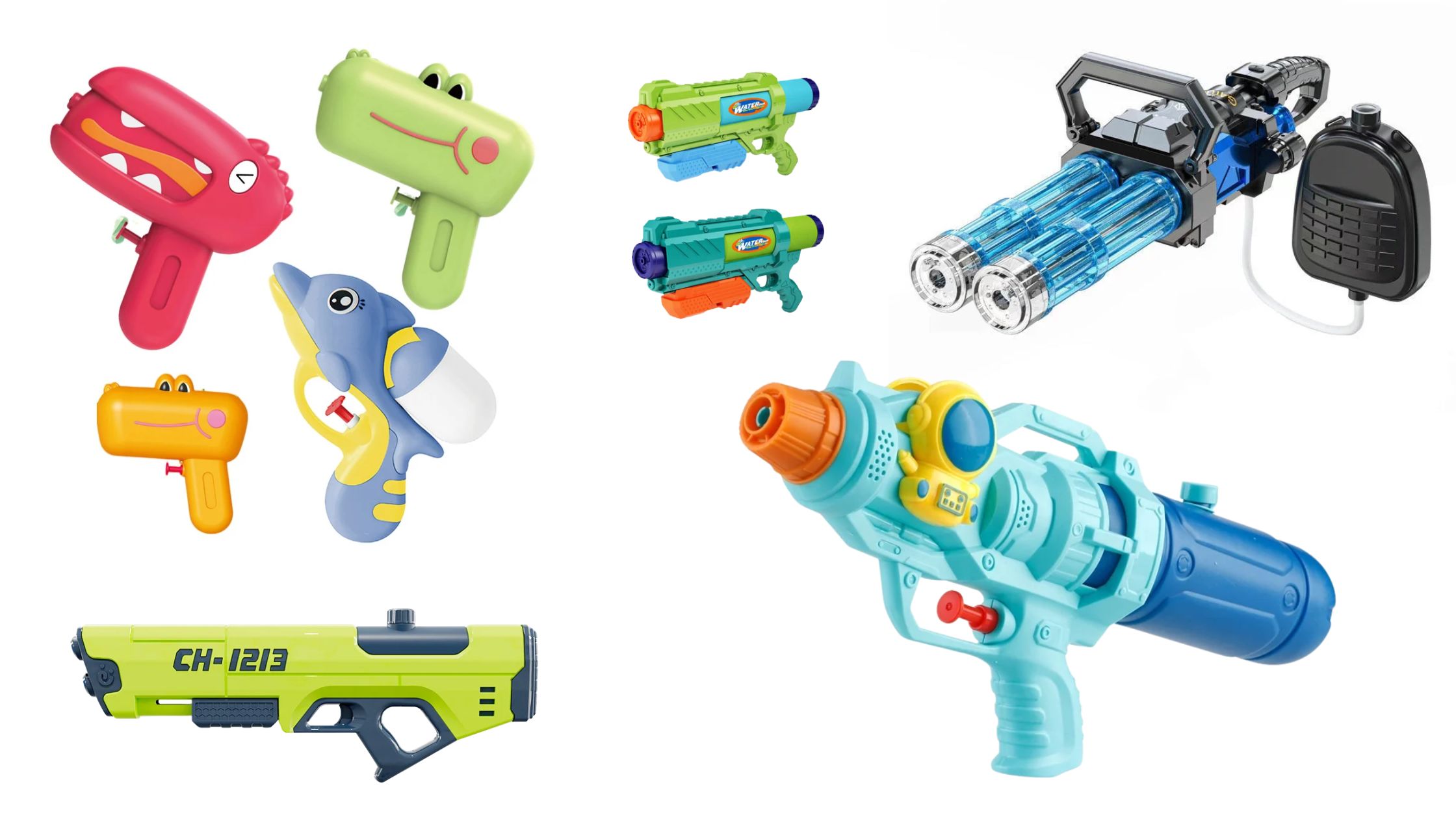
6 Types of Water Guns: Types and What Each Costs to Source
Most guides to the types of water guns sort them by size or by age group. Small pistol for a toddler, big backpack blaster for a teen. That is a nice list for a parent. It tells a buyer almost nothing.
Here is why. A water gun is a tank, a seal and a nozzle. Change the way it builds pressure and you change the factory, the mould, the test file and the price. The shape is decoration. So the useful question is not “which one looks cool”. It is “how does it push the water out?”
This guide sorts the types of water guns by their pressure system. Six groups, one table each, and the paperwork that comes with them. If you are building a summer range, this is the split that decides your margin.
Prices below are rough FOB guides at 1,000–3,000 pieces. They are not a quote. Your number depends on size, mould ownership and colour work.
For the bigger picture, our разные виды игрушек page lays out the whole toy range. This page covers how each water gun type is built and sourced.
The Types of Water Guns Split by How They Push Water, Not by Their Shape
Ask a factory for a “small water gun” and a “big water gun”. You will often get two quotes that differ by 5x. Same plastic, different pressure system. The pressure system is the product. The colour is the skin.
This matters for three reasons.
First, it sets your tooling. A squeeze gun is a two-part mould. A constant-pressure blaster has a latex bladder, an air chamber and a pump. Those are three different sub-suppliers.
Second, it sets your compliance file. A plain squirt gun is a normal toy. An electric one adds battery rules. A gel-ball blaster adds a water-bead rule that most suppliers still ignore.
Third, it sets your freight. A 30 cm backpack blaster ships mostly as air. You pay for the carton, not the kilo.
So the rest of this guide uses one axis: how the water gets pushed out. Everything else — colour, shape, brand — is skin.
The 6 Types of Water Guns at a Glance
| Group | Pressure system | Main material | Typical FOB | Tooling |
|---|---|---|---|---|
| 1. Squeeze & piston | None stored | ABS, PP | $0.30–1.50 | Mould only |
| 2. Pump-action air | Air in tank | ABS, PP, rubber seal | $1.00–4.00 | Low–mid |
| 3. Chamber & CPS | Separate air chamber | ABS, PP, latex bladder | $3.00–10.00 | Mid–high |
| 4. Motorized & electric | Battery pump | ABS, PP, electronics | $5.00–25.00 | Высокий |
| 5. Large-capacity & backpack | Any of above, big tank | ABS, PP, strap | $8.00–30.00 | Высокий |
| 6. Gel ball blaster | Air-fired gel beads | ABS, PP, gearbox | $8.00–40.00 | Высокий |
The spread is not a markup story. Group 1 uses almost no sub-parts. Group 4 and group 6 carry an electronics or a gearbox file that the others never touch. Group 5 ships badly because it is big and light.
Type 1: Squeeze and Piston Squirt Guns — The Cheapest to Source
This is the biggest group by volume for promo and party buyers, and the one most importers start with. A soft-chamber squirt gun or a piston pistol, no pump, no battery.
There are two ways it works, and the choice sets everything else.
Squeeze guns use a soft reservoir. You squeeze, water comes out; you release, it refills from the tank. Piston guns use a plunger that pushes water straight through the nozzle. No pre-pumping, no air. Both are pure injection moulding plus a rubber seal.
Tooling is a simple steel mould, usually 25 to 30 days. There is no bladder, no gearbox, no circuit. That is why a stock pistol can land at US$0.30–1.50 FOB in a polybag.
The trap is thin plastic on the seam. A cheap squeeze gun cracks at the weld after one summer. Decide before you approve the sample: do you want a 0.8 mm wall or a 1.2 mm wall? The second costs more in plastic but survives the return season.
For summer context, these sell next to our руководство по выбору пляжных игрушек range and the best beach toys list. Same shelf, different factory.
Type 2: Pump-Action Air-Pressure Guns — The Classic Super Soaker Style
This is the group most people picture when they say “water gun”. You pump a handle, it forces air into the water tank, and the trigger releases a pressurised stream.
The body is still injection moulded, but now you have a pump rod, a one-way valve and a pressure seal. That is one more sub-supplier and one more failure mode. If the valve is cheap, the gun hisses instead of shooting.
FOB runs US$1.00–4.00 at 300–800 ml. The cost is in the seal and the pump, not the plastic. A good gun holds pressure for a week on the shelf; a bad one leaks by the time it reaches the warehouse.
Our advice: buy the pump assembly from a factory that already makes it, not from a factory that makes toy bodies. A body factory can mould the shell. It usually cannot make a reliable valve, and the ones it buys in are the cheapest on the market.
If you want to see the summer catalogue these fit into, our summer outdoor toy catalog и летние игрушки для малышей pages show the season window.
Type 3: Separate-Chamber and CPS Blasters — The High-Pressure Class
This is where the “Super Soaker” name came from, and where the real performance sits. Instead of pressurising the whole tank, the gun pumps water into a separate air chamber or a rubber bladder (CPS). The stretched rubber pushes a constant stream, shot after shot, with almost no drop in range.
Two things drive the cost here. First, the latex bladder or the sealed air chamber — a different part from a normal toy. Second, the higher mould precision needed to hold pressure without leaking. FOB runs US$3.00–10.00 at 500 ml–1 L.
The compliance note: this is still a normal toy, so ASTM F963 and EN 71 apply like any other. But the bladder is a stressed rubber part, and a stressed rubber part is exactly what a good lab will pull-test. Ask for the pressure-cycling report, not just the basic toy test.
A word on the name. “Super Soaker” is a Hasbro trademark. You cannot put it on a box or a listing as a generic term. Use “water blaster” or “pressure water gun”. We come back to this below.
Type 4: Motorized and Electric Water Guns — Highest Return Risk
Battery-powered pumps give a continuous stream with no pumping. Great for teens and for promo events. Worst margin after returns.
Three things drive the cost: the motor and pump, the trigger circuit, and the battery compartment. A basic electric gun runs US$5 to US$10 FOB. Add a rechargeable pack, lights or a demo mode and you are at US$15 to US$25.
The compliance file is the real cost. A powered toy needs the toy standard plus a battery standard. In the US that means ASTM F963-23 and, if the battery is a replaceable coin or button cell, the battery compartment rules under 16 CFR 1263 (Reese’s Law). In the EU it means EN IEC 62115 plus EMC.
If this is your first water gun order, do not start here. Start with group 1 or 2, learn the seal and packing line, then move up. The electronics are where containers get rejected.
Type 5: Large-Capacity and Backpack Blasters — Pay for the Carton
Backpack and oversized blasters are not a new pressure system. They are groups 2–4 wearing a big tank and a strap. Capacity runs 1–3 litres and up.
The sourcing story is about volume, not weight. A 60 cm backpack blaster fills a carton that holds two units and weighs 4 kg. That carton is the product you are shipping. You pay for the cubic metre, not the kilo.
Two checks before you order:
- Carton maths. Get the carton dimensions and units per carton before you compare FOB. A cheaper unit in a bigger carton can cost more landed.
- Strap and cap quality. A weak shoulder strap or a leaky cap is a return, not a defect you can fix later.
FOB runs US$8.00–30.00 depending on the pressure system inside. Treat the tank as the main cost driver, not the gun.
Type 6: Gel Ball Blasters — A Different Product With Different Rules
Gel ball blasters, gellet guns or splatter-ball guns look like water guns but they are нет the same product. They do not shoot a water stream. They shoot small water-absorbing gel beads (gellets) out of an air-driven gearbox, like a low-power airsoft gun.
This matters more than any other point in this guide, so read it twice.
The gel bead is a water bead. Under US rules, a water bead is a liquid-absorbent polymer that expands when soaked — exactly what a gellet is. Since 12 March 2026, the US has a standalone federal standard for these: 16 CFR 1250.4. It applies to water bead toys and to any toy that contains water beads.
The rule has three parts, and each one kills a common product:
- Size. A bead that fits in the small-parts cylinder when dry must pass through a 5.0 mm funnel or sieve gauge once fully expanded. A bead that grows to 12 mm fails.
- Chemistry. No more than 325 micrograms of extractable acrylamide per 100 small beads, or per one large bead. Cheap polymer fails this regularly.
- Labels. The toy, the packaging and the container all need the warning. Multi-packs need every unit marked.
And the certificate has to name it. Your CPC must list “16 C.F.R. § 1250.4” as one of the rules certified.
On top of that, many markets treat gel blasters as imitation firearms, not as toys. Australia bans them. Parts of the UK and some US states restrict them. If a product is marketed to buyers 14 and older, it can fall outside children’s-product toy law — but then it meets a different, often stricter, set of rules. Do not assume a gel blaster is a toy. Ask the lab and the customs broker before you cut steel.
So what do you do? Three things:
- Treat gel balls as water beads under 16 CFR 1250.4, and get the acrylamide and expanded-size test before artwork approval.
- Check the imitation-firearm rules in every market you sell to.
- Keep “toy water gun” and “gel blaster” in separate product lines and separate test files.
Why Two Look-Alike Water Guns Cost 3x Apart
Two 25 cm blasters, same colour, same shape. One quotes US$1.80, the other US$5.40. Buyers assume one factory is cheating. Usually both are honest.
| Pump-action ABS | Pressure-chamber / CPS | |
|---|---|---|
| Pressure | Air in shared tank | Separate rubber bladder |
| Материал | ABS, PP | ABS plus latex bladder |
| Seal | One O-ring | Valve + bladder + O-ring |
| Tooling | Lower | Higher |
| Failure mode | Hiss, slow leak | Bladder fatigue |
| Best for | High-volume promo | Premium performance |
Three things explain the gap.
One: the pressure part. A shared-tank pump is a mould and a seal. A CPS bladder is a rubber component with its own supplier and its own shelf-life test.
Two: the wall thickness. A cheap gun gets a 0.8 mm wall and one glue pass. An expensive one gets a 1.2 mm wall, a reinforced seam and a pressure test. Hand work does not get cheaper with volume.
Three: the finish. A cheap gun is one colour, one spray. A good one is two colours, a pad-printed logo and a matte topcoat. That is the part the buyer sees and the part that decides reorders.
This is why the same drawing can produce a US$1.80 toy and a US$5.40 blaster. If you want the cheap one, accept the thinner wall. If you want the expensive one, pay for the seal and say so in the spec.
Which Types of Water Guns Need Toy Certification
Almost all of them, but not for the same reasons. A quick map:
| Рынок | Rule | What it means |
|---|---|---|
| НАС | ASTM F963-23 (16 CFR 1250) | Mandatory toy standard |
| НАС | КПК | Certificate signed by importer or maker |
| НАС | CPSIA | Lead 90 ppm in surface coating, 8 phthalates at 0.1% |
| НАС | 16 CFR 1263 | Battery compartments with coin/button cells |
| НАС | 16 CFR 1250.4 | Gel beads, effective 12 March 2026 |
| EU | EN 71-1 / 2 / 3 | Mechanical, flammability, migration |
| EU | CE marking | Self-declared, with a technical file |
| EU | EN IEC 62115 | Electric toys |
| Оба | Age grading | Usually 3+ or 6+; under-3 needs small-parts check |
Two dates matter. In the US, a children’s product is one aimed mainly at children 12 or younger. In the EU, a toy is for children under 14. A blaster marked 14+ can sit outside EU toy law — but then imitation-firearm and other rules may apply, as we saw with gel blasters.
Он CPC is signed by the importer, not the factory. The factory supplies test reports from an accepted lab. If a supplier offers to “give you a certificate”, ask who signs it.
Our guide to toy testing labs for CE and ASTM covers how to check a report before you pay a deposit.
Super Soaker Is a Trademark. Water Blaster Is Not.
This is the cheapest mistake to make and one of the most expensive to fix.
“Super Soaker” is a registered Hasbro trademark. The brand was invented by Lonnie Johnson, launched by Larami in 1989, and Hasbro took it over in 2002. The CPS pressure patent expired in 2016, so the *technology* is free to use. The *name* is not. Putting “Super Soaker” in a title, a listing or a box is a trademark risk even if your gun is your own design.
Use “water gun”, “water blaster” or “squirt gun” instead. Those are generic. They describe the product without touching a brand.
So what do you do? Three things:
- Keep “Super Soaker” out of the artwork, the listing and the box copy.
- Use generic category words in your titles and your ads.
- If a buyer sends you a reference image with a brand on it, ask for the licence before you produce it. A purchase order is not a licence.
How Much Do Water Guns Cost, and What Is the MOQ
Rough FOB bands at 1,000–3,000 pieces. Treat them as a planning tool, not a price list.
| Type | Size / format | FOB guide |
|---|---|---|
| Squeeze & piston | 100–300 ml, polybag | $0.30–1.50 |
| Pump-action air | 300–800 ml | $1.00–4.00 |
| Chamber & CPS | 500 ml–1 L | $3.00–10.00 |
| Motorized & electric | 500 ml–1.5 L | $5.00–25.00 |
| Large-capacity & backpack | 1–3 L+ | $8.00–30.00 |
| Gel ball blaster | Tactical look | $8.00–40.00 |
MOQ has three tiers, and the difference confuses almost every first-time buyer.
- 500–1,000 pieces per design. This is what a sourcing agent quotes, because the agent is buying from a factory that already owns the mould. You are picking from an existing range.
- 1,000–3,000 pieces. Custom colour and custom packaging on an existing mould. You pay for print plates, a colour match and a new box die.
- 3,000–5,000 pieces. A new mould. Simple single-cavity tooling often starts at 5,000 because the tooling has to be paid back inside the first run.
So when one supplier says 500 and another says 5,000, they are usually not competing. One is selling a stock design, the other is selling your design. Ask which one you are being quoted.
Most water-gun moulding capacity sits in Chenghai, Dongguan and Shenzhen. Our Фабрика игрушек Шаньтоу guide explains how that cluster is organised, and the top 21 toy manufacturers list is useful when you are shortlisting.
Tooling, if you go custom: US$800–3,000 per design for a simple single-cavity mould, more for a blaster with a bladder or a gearbox. Hand samples take 5–7 days; a new mould takes 25–30 days; mass production runs 15–45 days after sample approval. Plan 8 to 12 weeks from artwork to warehouse.
Season is the part most buyers miss. Water guns sell in the Northern Hemisphere summer. If you want stock on the shelf in May, you should be ordering from October to February. Miss that window and you either pay air freight or miss the season entirely.
On payment, the normal term is 30% T/T deposit and 70% against the bill of lading copy. Larger programmes can use a letter of credit at sight. For a first order, keep the deposit small and put the balance against a passed inspection.
Часто задаваемые вопросы
What are the main types of water guns?
By pressure system: squeeze and piston, pump-action air-pressure, separate-chamber and CPS, motorized and electric, large-capacity and backpack, and gel ball blasters. By shape is not a useful split, because the same mould can carry many shapes.
How many types of water guns are there?
Six useful sourcing groups, covered above. Sub-variants (pistol, rifle, backpack) are formats built on those six pressure systems, not separate types.
Which type is cheapest to start with?
A squeeze or piston squirt gun in the 100–300 ml range, packed in a polybag. Stock moulds, no pump, no battery. Our stock lines start around US$0.30–1.50 at 1,000 pieces.
Do water guns need toy certification?
Yes, as normal toys: ASTM F963-23 and CPC in the US, EN 71 and CE in the EU. Electric ones add battery rules. Gel ball blasters add the water-bead rule 16 CFR 1250.4.
Can I call my product a Super Soaker?
No. “Super Soaker” is a Hasbro trademark. Use “water gun” or “water blaster” in your titles, listings and packaging.
Are gel ball blasters the same as water guns?
No. They fire water-absorbing gel beads, not a water stream, and the beads are regulated as water beads under 16 CFR 1250.4. Many markets also treat them as imitation firearms. Keep them in a separate product line.
What is the HS code for a water gun?
9503, toys. Do not let a supplier declare it under 3926 as a plastic article. That is a classification error, and it changes your duty and your admissibility. Gel blasters may face a 9304 (imitation arms) classification in strict markets.
When should I place a water gun order?
От October to February for a Northern Hemisphere summer. The factories and the freight are busy from March, and air freight will eat your margin.
How much does a sample cost?
Around US$20–50 for a stock item, credited against the order. A custom coloured sample with new artwork costs more, because the print plate and the proof are one-off.
Pick the Pressure System Before You Pick the Color
Он types of water guns split six ways, and the split is about pressure, not shape. A squeeze pistol, a CPS blaster and a gel-ball gun are three different businesses with three different rule books.
Get the pressure system right and the rest gets simple. You will know your mould cost, your test file and your freight profile before you see a single sample. Get it wrong and you will spend a month comparing two quotes that were never for the same product.
Start with one question. How does it push the water out? Everything else — colour, shape, box art — is skin.
If you already have a reference sample or a component list, send it over. We will tell you which group it lands in, what the mould will cost, and which test report you need. Our China factory network covers injection, rubber and electronics under one order, so a mixed water-gun range does not need five suppliers. For the buying side, start with wholesale toys from China или full stock catalogue. If the range sits next to a school or nursery buyer, our оптовая продажа развивающих игрушек page covers the age-graded side, and the виды развивающих игрушек guide shows how the categories break down.
We handle sampling, factory checks, inspection and shipping as one job. The service page explains what is included and what is not. And if you want to understand the import side before you buy, our import toys from China to the USA guide and the how to order toy samples page cover the next steps. For private-label work, see our private label toys page, and for market context the China toys wholesale market overview is a good start.