How Are Toys Manufactured? The 7 Stages, and What Each One Costs
Most pages that explain how are toys manufactured give you four words: design, mould, assemble, ship. That answer is true. It is also useless if you are the one paying the deposit.
A buyer needs the same story told in days and dollars. How long does each step take? What does it cost? And at which step does a small slip turn into a container of stock you cannot sell? This page answers those three, stage by stage.
The 7 Stages at a Glance
| Stage | What the factory does | Calendar days | What it costs you |
|---|---|---|---|
| 1. Design and 3D | Draw, model, print a sample | 5–10 days | USD 200–800 per sample |
| 2. Tooling | Cut the mould | 20–35 days | USD 1,500–60,000 |
| 3. Forming | Mould or cut each part | 1–3 days | Machine time |
| 4. Painting and printing | Colour, eyes, logos | 7–15 days | Hand work |
| 5. Assembly | Join the parts | 3–7 days | Line labour |
| 6. Testing | Pull, drop, lab work | 7–15 days | USD 300–2,500 |
| 7. Packing and shipping | Box, load, sail | 5 + 25–40 days | Freight by CBM |
Two of those rows decide the whole order. Stage 2 sets your budget. Stage 4 sets your deadline. First-time buyers plan for neither, and both land as a surprise.
Prices and times below are rough 2026 factory ranges, not a quote. Use them to shape the conversation, not to sign anything.
1. How Does a Toy Design Become Something a Factory Can Build?
It starts with a drawing, sometimes just a photo. A modeller turns it into a 3D file. Then the factory prints a resin sample, paints it, and sends it to you.
This first sample is called a prototype or hand sample. It costs USD 200 to 800 and takes 5 to 10 days. It is the only step where changes are still cheap.
Here is the part most buyers miss. Once you approve the sample, an engineer breaks the model into parts. A figure with moving arms might split into six pieces. Each piece needs its own mould cavity. So the “look” you approve sets the tooling bill directly.
A smoother shape with fewer undercuts can cut tooling cost by a third. That decision is made here, at day 8, not later on the factory floor.
If you are building a blind box or a figure line, the art toy production process walks the same path in more detail. For product development from the idea stage, the toy development guide covers the earlier decisions.

2. What Does “Making a Mould” Actually Mean?
Tooling is the step where a block of steel becomes the shape of your toy. It is also the step that scares buyers most, because the quotes range from USD 1,500 to USD 60,000.
That range is not factories ripping you off. It is three different processes sitting under one word.
Why One Mould Costs USD 1,500 and Another Costs USD 60,000
Injection moulds are graded by the SPI system, set by the plastics industry. The class tells you how many parts the tool should make before it wears out.
| SPI class | Expected life | Typical build | Use case |
|---|---|---|---|
| Class 101 | 1,000,000+ shots | Hardened steel, ≥48 HRC | Global mass production |
| Class 102 | Up to 1,000,000 | Hardened cavities, standard parts | Established products |
| Class 103 | Up to 500,000 | P20 pre-hardened steel | Mid-volume, first orders |
| Class 104 | Under 100,000 | Aluminium or mild steel | Low volume runs |
| Class 105 | Under 500–1,000 | Aluminium or epoxy | Prototype only |
Steel grade is the other half of the price. P20 sits at 28–32 HRC and runs about 100,000 shots. Add nickel and you get 718, good for 300,000 to 500,000. H13 is hardened to 45–52 HRC and passes 800,000 to 1,000,000 shots. It costs 40% to 60% more than 718, and it is the only sane choice for glass-filled or abrasive resin.
Lead times move with the steel. Aluminium tooling lands in 2 to 6 weeks. Pre-hardened steel takes 6 to 12 weeks. Fully hardened steel runs 10 to 20 weeks. In the toy trade, where tools are smaller, most shops quote 20 to 35 working days.
Two things inflate the bill fast. A side action, called a slider, adds 15% to 30%. Two sliders push it past 40%. And a textured surface needs more draft angle than a polished one, or the part drags and scuffs on the way out.
The Three Mould Routes
Injection moulding melts plastic pellets and pushes them into a steel tool under high pressure. Water in the mould cools the part. Ejector pins push it out. One cycle runs 15 to 60 seconds, and cooling eats 50% to 70% of that. It gives sharp detail and a solid wall.
Rotocasting makes hollow shells. Liquid PVC goes into a copper mould. The mould is heated and spun on two axes. The PVC coats the walls, the extra is poured out, and what is left is a light, slightly soft shell. It uses less material and more hand work. Wall thickness varies, and fine detail is weaker. This is the route for blind boxes and soft vinyl figures. Hardness is set by formula, usually Shore A 60 to 90.
Die casting is the metal route. Molten zinc alloy, mostly Zamak 3 or Zamak 5, melts near 380°C. Hot chamber machines run 100 to 800 shots an hour, at 10 to 30 seconds a cycle. Cold chamber handles aluminium at 20 to 60 seconds a cycle. This is how diecast model cars get made, and the OEM diecast guide covers the custom side.
So “how much is a mould” has no answer until you say which one. Tell the factory your process, your annual volume, and your finish. Then the number means something.
3. How Is Each Part Actually Formed?
How are toys manufactured in each of those routes? Here is the short version, with the numbers that matter.
Four routes cover most of the toy shelf, and each one carries a different tooling bill and a different MOQ.
| Matériel | How it is formed | Rough tooling cost | Usual MOQ |
|---|---|---|---|
| ABS or PP plastic | Injection moulding | USD 15,000–60,000 | 500–1,000 |
| Soft PVC vinyl | Rotocasting | USD 1,500–8,000 | 500–1,000 |
| Zinc alloy | Die casting | USD 10,000–40,000 | 500–1,000 |
| Plush fabric | Cutting and sewing | No mould, pattern only | 300–500 |
| Wood | Cutting, sanding, finishing | No mould, jigs only | 100–500 |
| Paper and board | Printing and die cutting | Die tool USD 500–3,000 | 500–1,000 |
That table is the fastest way to read a quote. If someone offers you a custom plastic figure at a 300-piece MOQ, they are not running a new mould. They are painting an existing one.
Plastic parts come off injection machines. Small bricks might run 32 cavities at once. A factory making building blocks can turn out over a billion pieces a year on automated lines.
Soft hollow parts come from rotocasting. Each turn of the oven makes one shell.
Metal parts come from die casting, then get plated or painted.
Fabric parts get cut and sewn. Plush starts with a marker or a laser cutting the cloth. Operators sew the shell, then stuff it, then close the seam. Eyes and noses go on last. Custom plush production follows this route, and the plush knowledge page explains where seams fail.
Wood works differently again. It is cut, sanded and finished, and there is no steel mould behind it. That is why wooden toy lines carry no tooling floor.
Puzzles are their own case: printed board, then a die cut, then a box. The puzzle production page covers it.

4. Why Does Painting Take the Most Calendar Days?
Injection moulding sounds slow and is not. A part every 15 to 60 seconds is fast. Painting is the step that quietly eats your schedule.
A plain figure might get two coats. A detailed collectible gets five or six, hand sprayed. That is three times the labour. Worse, each coat has to dry before the next one goes on. Drying is measured in hours, and you cannot rush it.
So when a quote says “production 30 days”, a large part of that is paint waiting to dry. This is also the main source of the price gap between two look-alike toys.
Four methods do the work:
- Spray painting with masks, for base colours and large areas
- Pad printing, where a silicone pad lifts ink off an etched plate — used for eyes and logos
- Water decals for complex art
- UV printing for short runs and photo detail
Colour is matched to Pantone codes. Send the codes with your artwork. If you send only a picture, the factory will match it by eye, and the second batch will not be identical to the first.
Print method matters for your logo too. The logo printing guide covers what works on which surface.
5. How Are Toys Assembled?
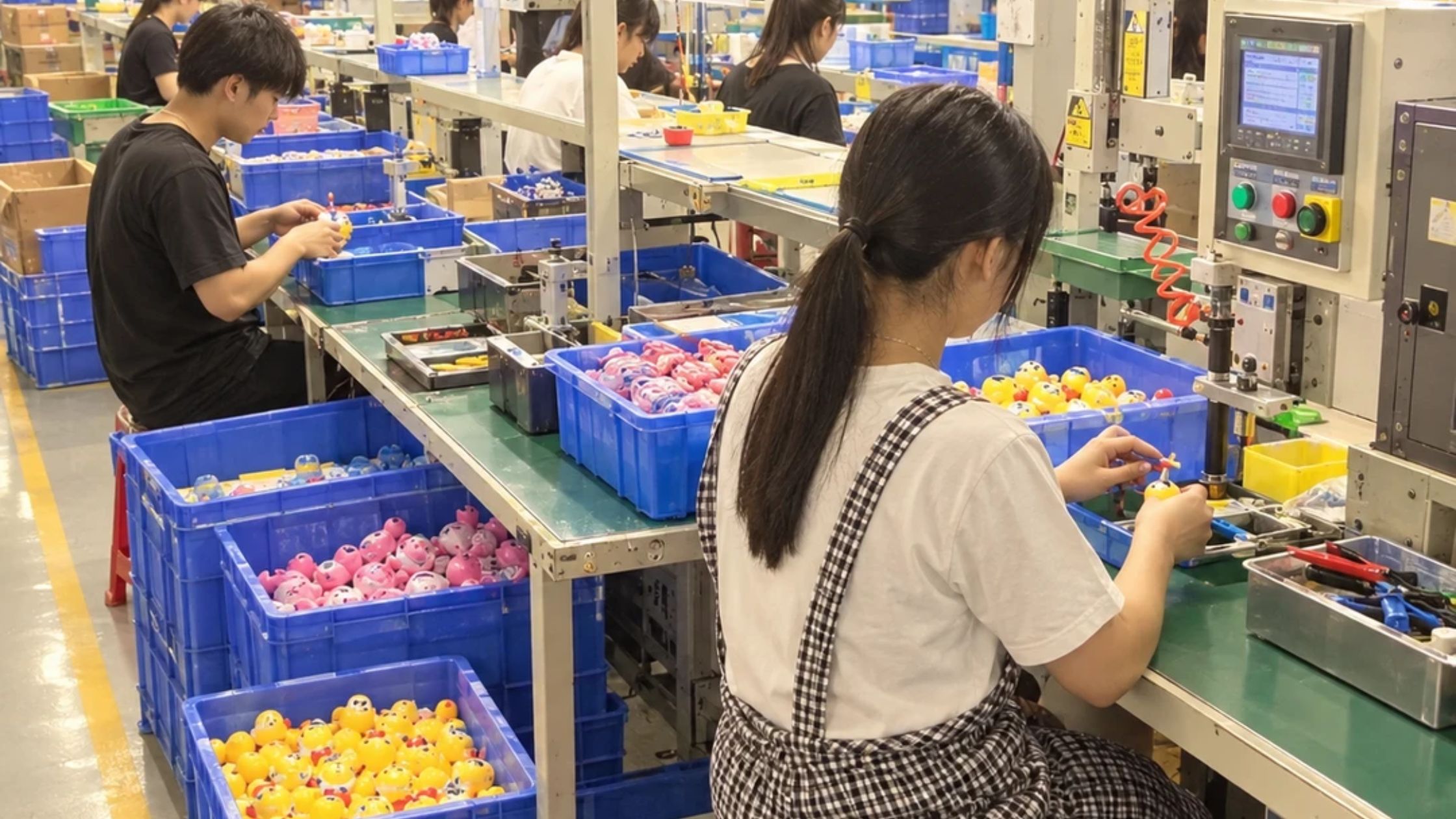
Parts meet on a line. Each station does one job: one clips an arm, one drops in a sound box, one closes the shell.
Three ways to join plastic:
- Ultrasonic welding melts the joint with sound, no glue
- Screws, easy to take apart, and they add a battery rule
- Snap fits, cheapest, but they loosen over time
Anything with a battery picks up EN 62115, and the battery door has to stay shut under force from any direction. If you are shipping powered items, check the battery shipping rules before you book the container.
Electronics push the job to a specialist. Electronic toys et Jouets radiocommandés need a factory that holds radio approval, not just a toy safety report.
6. What Tests Must a Toy Pass?
Testing is not a last step. It is baked in at the design stage, and finding that out late is expensive.
In the United States, the mandatory standard is ASTM F963-23. The CPSC approved it on 18 January 2024 and it took effect on 20 April 2024 (Federal Register 89 FR 3344). Toys made of expanding materials, including water beads, also fall under 16 CFR 1250.4, effective 12 March 2026.
In the European Union, the route is EN 71. For soft-filled toys there are two rules buyers get wrong. The seam test pulls at 70 N. And after that test, a 12 mm probe must not go in more than 6 mm. The European Commission also treats soft-filled toys made for cuddling as toys for children under 36 months, whatever the box says.
The physical tests are brutal on purpose:
| Test | What they do | Rough figure |
|---|---|---|
| Drop test | Drop the toy on a hard floor | About 85–93 cm, several drops |
| Tension test | Pull on eyes, limbs, seams | About 90 N, held 10 seconds |
| Torque test | Twist any part a child can grip | About 0.34–0.45 N·m |
| Small parts | Check if a bit fits the cylinder | 31.75 mm |
| Chemical | Test for lead and phthalates | EN 71-3 limits |
One report does not cover a range. Each material and each coating is its own line on the lab bill, which is why a five-colour figure costs more to test than a plain one. The toy certification guide covers the paperwork, and the testing lab list covers where to send samples.
Selling on Amazon? You also need a CPC certificate, and the CPSC eFiling rules now apply to imports.
7. How Are Toys Packed and Shipped?
Packing is a design job, not an afterthought. Common formats are a colour box, a window box, a blister card, or a PDQ tray that goes straight on a shelf.
Then comes the maths that catches everyone. Freight is charged by volume, not by weight. A light bulky toy can cost more to ship than to make. Cartons also get a drop test before they leave, because a crushed corner is a return.
Le freight forwarder page covers the booking side, the US shipping guide covers transit times, and the import duty guide covers what the tariff adds.
OEM, ODM or Ready Stock: Which Route Are You On?
Before you ask a factory anything, know which of these three you are doing. They have nothing in common on cost or timing.
| Route | What you can change | Tooling | Lead time | Good for |
|---|---|---|---|---|
| Ready stock | Nothing | None | 3–5 days to ship | Cash flow, small bets |
| ODM | Colour, logo, packing | Often none | 20–35 days | Testing a market |
| OEM | Everything | Full tooling | 90–120 days | A real product line |
The step most buyers skip is ODM. You get your own colour and box on a shape the factory already owns, with no mould bill. It is the cheapest way to find out whether a market exists before you spend USD 30,000 on steel.
Once the design is yours, you are in OEM territory, and the OEM block toy route shows what that looks like end to end. If you just need goods moving now, the wholesale catalogue is the stock side.
Where Do Orders Go Wrong?
Eight places, and they come up again and again on real orders.
1. Colour matched by eye instead of Pantone. Batch two never matches batch one. 2. Mass production started before the pre-production sample was signed. Every fix after that is a rework. 3. Testing booked after the goods were made. A fail then means a write-off, not a fix. 4. Steel grade not written into the contract. You get P20 and find out at shot 120,000. 5. Only the unit price compared, never the carton size. Freight eats the margin instead. 6. Colour changes not counted in the schedule. Each one adds flushing time and scrap. 7. Paint coats not specified. Two coats and six coats are a three-times labour gap. 8. Packaging never drop tested. Cartons arrive crushed and the returns start.
None of these are exotic. They are all cheap to prevent and expensive to fix.
How are toys manufactured well? By fixing the process, the steel grade and the paint schedule before anyone cuts metal. Everything after that is follow-up.
Who Actually Makes Your Toy? One Factory, or Three?
Almost nobody in the toy trade makes the whole thing under one roof.
Look at the numbers. Chenghai district in Shantou has roughly 64,200 toy businesses. Only about 18,500 of them actually produce. Around 21,500 are support units — painting, pad printing, assembly — and 27,300 are trade. Chenghai holds about 60% of the world market and shipped to over 170 countries in 2025, with output passing RMB 50 billion. Sources: CCTV, 2 November 2025; Nanfang Daily, 21 May 2026.
What that means for you: the factory you audit is often one station on a longer line. Your mould sits in one workshop, your paint goes on in a second, and your box is filled in a third.
The clusters split by material:
- Shantou Chenghai — plastic and electronic toys
- Dongguan — collectibles and blind boxes, close to 85% of China’s output
- Yunhe, Zhejiang — wooden toys, about 40% of the world market
- Yangzhou — plush, around 20% of the world market
- Yiwu — the trading hub, about 25% of world toy volume
Le Shantou factory guide and the Chenghai cluster map give the local detail. For a shortlist, the toy manufacturer list and the reliable manufacturers page are the ones we work from.
How Long Does It Take, Start to Finish?
For a first custom order, plan on 90 to 120 days door to door. Here is where it goes.
| Étape | Days | Note |
|---|---|---|
| Design and 3D model | 5–10 | Cheapest place to change your mind |
| Prototype sample | 5–10 | Painted and posted to you |
| Tooling | 20–35 | The long pole |
| First trial and fixes | 7–10 | Almost always needed |
| Pre-production sample | 5–7 | Sign this before mass run |
| Mass production | 25–40 | Paint drying is inside this |
| Lab testing | 7–15 | Can run alongside production |
| Fret maritime | 25–40 | Varies by port |
Reorders drop to 30 to 45 days, because the mould already exists. That gap is the real reason to keep a design alive rather than chase a new one every season.
Samples come in two kinds. Stock samples ship in 3 to 5 days and are usually free, you pay the courier. Custom samples take 7 to 12 days and run USD 35 to 80, often refunded against the order.
What Does It Cost? Where the Money Goes
Two separate bills, and buyers mix them up constantly.
Bill one, one-time tooling:
| Tool | Rough range | Life |
|---|---|---|
| Aluminium prototype mould | USD 3,000–15,000 | Under 100,000 shots |
| P20 steel, Class 103 | USD 15,000–50,000 | Up to 500,000 shots |
| Hardened steel, Class 101 | USD 25,000–100,000+ | 1,000,000+ shots |
| Rotocast copper mould | USD 1,500–8,000 | Shorter, varies by care |
Bill two, the unit price. That single FOB number is made of:
- Raw resin, cloth or wood
- Machine time per part
- Paint and printing labour — usually the biggest slice on a detailed toy
- Assembly labour
- Conditionnement
- Your share of the lab report
- Factory margin
MOQ is not a mood. A colour change means flushing the last resin out of the barrel, which takes 30 to 60 minutes and several kilos of scrap. Spread that scrap over enough units and it disappears. That calculation is your MOQ. Typical floors run 300 to 500 for plush et 500 to 1,000 for most plastic lines.
How you pay matters as much as what you pay. The trade standard is a 30% deposit to start, with the 70% balance against a copy of the bill of lading. That split protects you twice: the factory cannot walk away with nothing at risk, and you do not release the last 70% until the goods are actually on the water.
Tooling is billed differently, usually 50% up front and 50% on sample approval. Never pay 100% of tooling before you have held a sample from that mould.
Two more rules worth knowing. Samples and tooling are usually paid by T/T bank transfer, not card, because the amounts clear the fee threshold where cards get expensive. And for orders under about USD 1,000, a letter of credit is pointless — the bank fees will eat more than the order is worth.
Before you compare two quotes, read the quotation checklist and the toy price list. They show which lines are missing from a factory’s sheet.
How Are Toys Manufactured for Small Orders?
This is the question behind most first enquiries. So how are toys manufactured when you only want 300 pieces? Usually without a new mould at all.
Here is the honest split.
| Order size | What is realistic | Pourquoi |
|---|---|---|
| Under 300 pieces | Stock or ODM repaint | No factory opens a mould for this |
| 300–500 pieces | Plush, wood, printed goods | No steel mould, only patterns and die tools |
| 500–1,000 pieces | New injection or die cast tooling | Enough to spread set-up and scrap |
| 1,000+ | Full OEM, multi-cavity tooling | Unit price finally drops hard |
Two workarounds help below the floor. A shared, or “public”, mould is a shape the factory already owns; you pay for colour and packing only. And digital printing has made short-run boxes cheap, so you no longer need 5,000 printed cartons to look professional.
What does not work is asking a factory to cut your own mould and then ordering 200 pieces. The tooling never pays back, and the quote you get will either be padded or quietly use softer steel.
FAQ
How are toys manufactured in a factory, in the simplest terms? Draw it, cut a mould, form the parts, paint them, put them together, test them, box them. The whole path runs 90 to 120 days for a first custom order, and 30 to 45 for a reorder.
How are plastic toys made? Mostly by injection moulding. Plastic pellets are melted and pushed into a steel tool at high pressure. Cold water in the tool sets the part. Pins push it out. One cycle takes 15 to 60 seconds, and most of that is cooling.
How are toys manufactured without a mould? Three ways. Plush needs only a paper pattern. Wooden toys need cutting jigs, not a mould. Printed goods like puzzles and cards need a die cutting tool, which costs USD 500 to 3,000 instead of tens of thousands.
How are toys manufactured in small batches? Usually by ODM, not OEM. You take a shape the factory already has and change the colour, the logo and the box. MOQ drops to 300 or 500, and there is no tooling bill at all.
Are all toys made by injection moulding? No. Soft vinyl figures are rotocast into hollow shells. Model cars are die cast from zinc alloy. Plush is cut and sewn. Wooden toys are machined and sanded. Each route has a different mould cost, from about USD 1,500 to over USD 60,000.
Why is my tooling quote so different from another factory’s? Because they may be quoting different steel. P20 is softer and cheaper. H13 is hardened and costs 40% to 60% more, but lasts eight times longer. Ask for the steel grade and the SPI class in writing.
What takes the longest? Tooling, at 20 to 35 days. Second is painting, because each coat has to dry before the next one goes on. A six-coat figure takes far longer than a two-coat one, on the same line.
How much is a mould for a small toy? A simple single-cavity tool might start near USD 3,000 to 5,000. A multi-cavity hardened steel tool for a blind box line runs USD 25,000 and up. Complexity moves it more than size does.
Do I own the mould after I pay? You own it if the contract says so, which is the norm when you pay 100%. The factory usually keeps it on site for your production runs. Ask for a photo of the mould with your name plate on it.
Can I make changes after the sample is approved? Yes, but the cost jumps. A colour change is cheap. A shape change can mean cutting a new cavity, or a new mould, and another 20 to 35 days.
When should I test? Before mass production, on the pre-production sample, not on the finished batch. A failed test on 10,000 units is a write-off. The test report form is where that starts.
Is one test report enough for my whole range? Rarely. Reports are per material and per coating. Five colours on one figure can mean five chemical tests. The certificate guide shows how labs bill it.
How are toys manufactured if I only have a rough idea? That is normal. You send a sketch, a photo, or a similar product you like. A modeller builds the 3D file, and you get a printed sample to hold. Budget USD 200 to 800 for the sample and about 10 days. Many factories refund it against the order.
Where are most toys manufactured? China, and inside China it is very local. Chenghai in Shantou for plastic, Dongguan for collectibles, Yunhe for wood, Yangzhou for plush, Yiwu for trade. The Shantou sourcing page covers the biggest of them.
How do I know a factory is real, not a trader? Ask which stages it runs in house, and ask to see the mould room and the paint shop. Our factory vetting checklist is the one we use on site. If you are buying from a marketplace instead, read why not to buy direct on Alibaba first.
Next Step
Send us your drawing, a reference photo, or just the product type and the quantity you have in mind. You get back MOQ, tooling cost, FOB unit price, carton size and lead time in one sheet, with the stages above shown as dates.
We will also tell you which mould route your design needs, and what it will cost to test. That is usually the part that decides whether the order goes ahead.
Request a quote or email info@tonysourcing.com.