What Are Sensory Toys? A Practical Guide for Toy Buyers
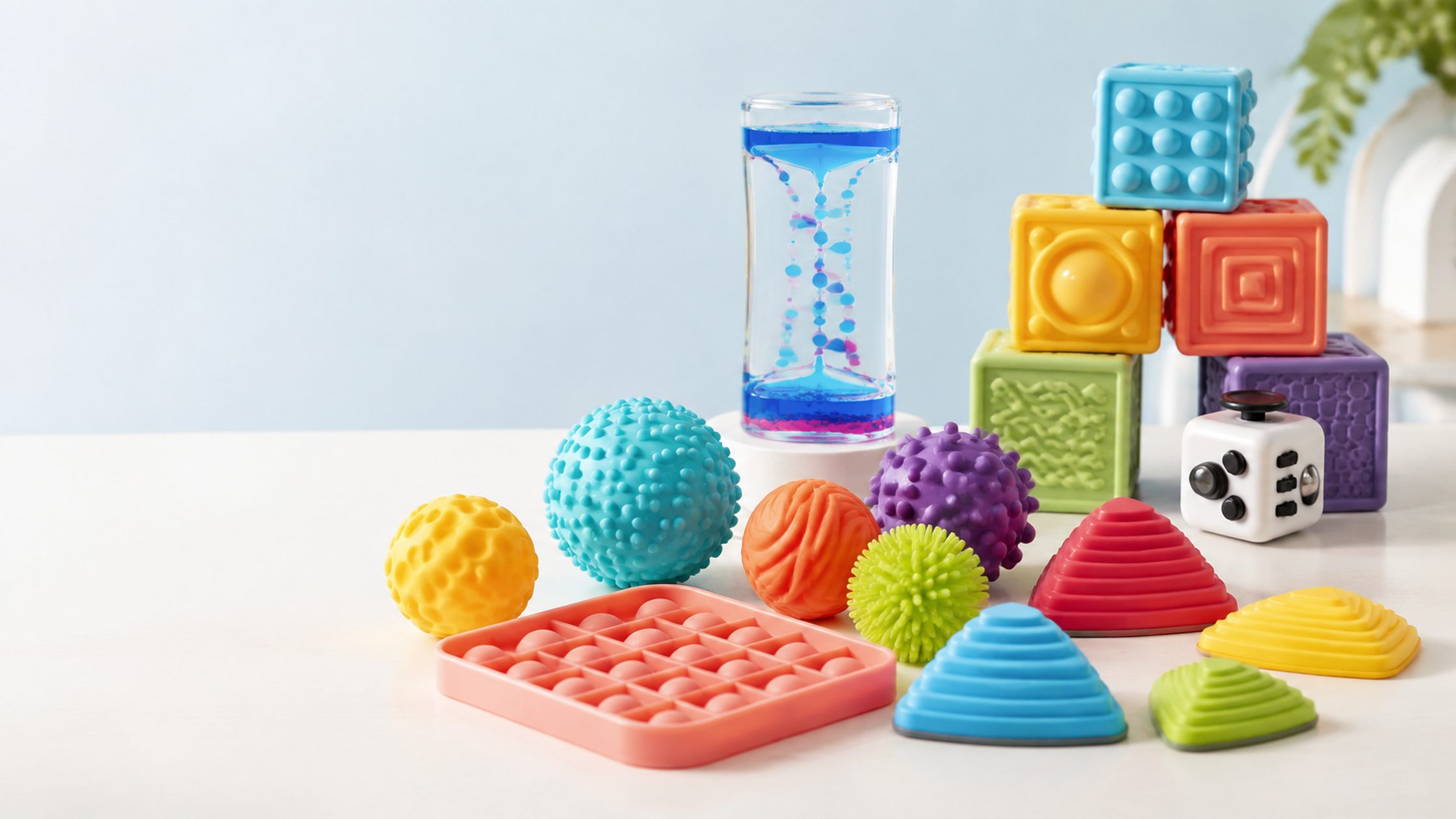
Sensory toys are play products designed to provide noticeable input through touch, sight, sound, movement, body position, or the mouth. The category includes everything from textured balls and pop tubes to balance boards. For buyers, the key is to define the play action—not rely on the word “sensory”—then verify age fit, safety, quality, and compliance.
What Makes a Toy a Sensory Toy?
A sensory toy gives the user a clear, repeatable experience through one or more sensory systems. A child may squeeze a textured ball, watch liquid move through a timer, hear beads fall through a rainmaker, or shift weight on a wobble board. The toy is defined by the input it provides and the action it invites.
This is a broad retail category rather than one standardized product type. Many ordinary playthings have sensory qualities: blocks provide touch and body-position feedback, rattles combine sound and movement, and modeling compound offers texture and resistance. Calling a product “sensory” is useful only when you can answer four questions:
- What does the child do with it?
- Which kind of input does it provide?
- How intense and controllable is that input?
- What age, environment, and level of supervision suit the product?
Sensory toys are also not automatically therapy products. Occupational therapy practitioners use individualized approaches when sensory processing affects participation in everyday activities. A mass-market toy should not be advertised as treating autism, ADHD, anxiety, or a sensory disorder unless the claim is legally permitted and supported by appropriate evidence. Describe observable features and play instead: “soft textured surface,” “quiet clicking action,” or “rocking movement.”
The Main Types of Sensory Toys
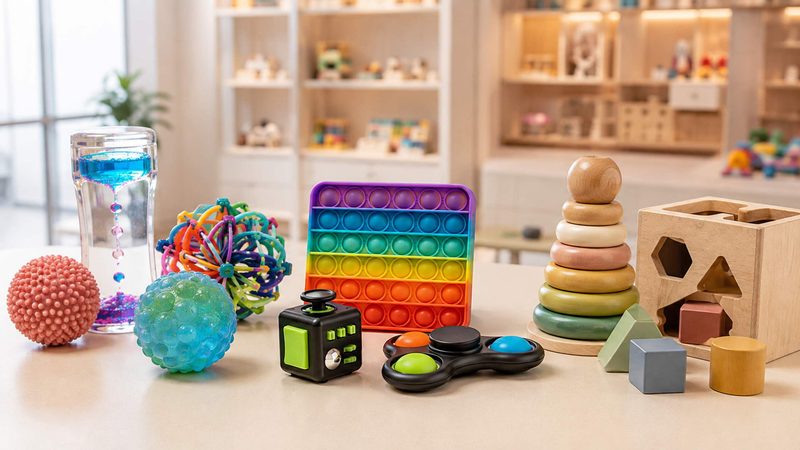
Classifying sensory toys by input is more useful than grouping them by trend or appearance. One product may belong to several groups, but the primary play action should remain clear.
| Sensory input | Common product examples | What the user does | Buyer priorities |
|---|---|---|---|
| Tactile | Textured balls, putty, sensory tiles, fabric books | Touches, presses, squeezes, rubs | Surface consistency, tear resistance, cleanability, leakage |
| Visual | Liquid timers, light-up panels, kaleidoscopes, spinning toys | Watches color, light, or repeated motion | Optical clarity, brightness, battery access, liquid sealing |
| Auditory | Rattles, rainmakers, musical toys, pop tubes | Shakes, taps, stretches, or presses | Sound level, sound consistency, loose parts, speaker quality |
| Proprioceptive | Resistance bands, body socks, squeeze toys, weighted products | Pushes, pulls, carries, or compresses | Load limits, seam strength, rebound, specialist review for weighted items |
| Vestibular | Wobble boards, rocking toys, stepping paths, swings | Balances, rocks, spins, or moves | Stability, anti-slip performance, fall zone, load rating, installation |
| Oral | Textured teethers and purpose-made chew products | Bites, mouths, or chews | Intended age, material documentation, bite durability, hygiene, shape |
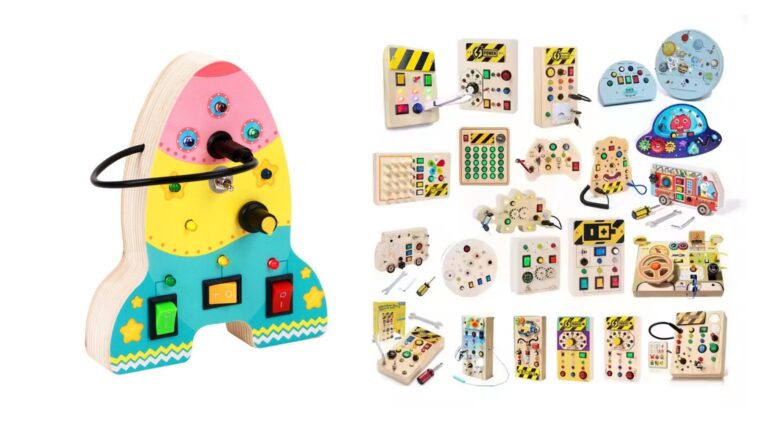
| Multisensory | Activity cubes, busy boards, sensory kits | Uses several actions and inputs | Component count, overstimulation, age consistency, missing parts |
Smell and taste can also be sensory inputs, but intentionally scented, flavored, cosmetic-like, or food-contact products may introduce additional chemical, allergen, hygiene, labeling, and regulatory questions. Unless your market and compliance plan are clear, these are not ideal entry products for a new sensory range.
Tactile and Squeeze Toys
Tactile products are the easiest part of the category for customers to understand: the surface or deformation is the experience. Stress balls, squishies, putty, textured blocks, poppers, and stretchy toys can work as impulse items, small gifts, classroom resources, or components in a larger kit.
The apparent simplicity hides several sourcing risks. A soft toy may split at a seam, release gel or foam, collect dirt, become sticky, develop odor, or attract dust. Putty and slime require control of formula, container seal, net content, microbial cleanliness, and shelf behavior. Ask suppliers for the exact material or formulation rather than accepting “non-toxic” as a specification.
For sampling, compare odor after opening, surface tack, color transfer, deformation recovery, seam strength, and leakage after repeated compression. Also test how the product behaves after heat and cold exposure appropriate to your shipping and storage route.
Visual and Light-Up Toys
Visual sensory toys use color, reflection, bubbles, falling liquid, projected patterns, or light sequences. Their movement is easy to demonstrate in short videos, making them suitable for e-commerce and gift channels. A strong visual product can also act as the hero item in a sensory kit.
The buyer must control more than appearance. Check whether transparent housings crack, caps can loosen, liquid escapes, LEDs flicker, and battery compartments remain secure. Ask for measured product dimensions and video of the exact sample in normal lighting; edited supplier footage can make weak effects appear brighter or smoother than they are.
Avoid promising that a visual pattern will calm every child. Some users enjoy bright or repetitive effects, while others may find them distracting or uncomfortable. A controllable on/off function and simple product description are more defensible than a universal “calming” claim.
Auditory Toys
Auditory sensory toys produce sound through shaking, tapping, squeezing, stretching, or electronic playback. Rainmakers, rattles, musical panels, crinkle fabrics, and pop tubes fit this group.
Sound character matters as much as volume. A harsh squeak, irregular rattle, or distorted speaker can turn a promising sample into a return risk. Compare units for loudness and tone, test repeated activation, and inspect whether internal beads or sound components can escape after foreseeable use.
For a classroom or quiet-fidget range, low-noise operation should be a measurable product requirement—not just a marketing label. For the U.S. market, sound-producing toys are among the product-specific areas addressed by ASTM F963, so the exact design and intended age must be included in the compliance review.
Proprioceptive and Resistance Products
Proprioception relates to information from muscles and joints about force and body position. Toys that involve squeezing, pulling, pushing, stretching, climbing, or carrying may provide this type of input. Small hand products include resistance putty and squeeze toys; larger examples include body socks, tunnels, crash pads, and some weighted items.
These products should be separated into two sourcing tiers. Handheld resistance toys can often be managed like other conventional toys. Load-bearing, wearable, enclosed, or weighted products need closer attention to sizing, seams, ventilation, entrapment, use instructions, contraindications, and adult supervision. A generic factory sample is not enough for a product that bears body weight or applies pressure.
Weighted products deserve particular caution. Do not convert an arbitrary product weight into a therapeutic recommendation. Define the user, use position, duration, supervision, construction, and destination-market requirements with a relevant professional and test laboratory before production.
Vestibular and Movement Toys
Vestibular products involve balance, acceleration, rocking, spinning, or changes in head position. Balance boards, stepping stones, rocking toys, scooter boards, and indoor swings can create a higher-value segment, but they also carry more serious mechanical and fall risks than small tabletop toys.
For buyers, performance claims should become testable specifications: maximum user mass, product dimensions, base geometry, anti-slip material, allowable deflection, fastener design, and intended surface. Inspect stability at the edges, grip on different floors, pinch points, sharp edges, and damage after repeated loading.
Installation changes the risk profile. If a swing requires ceiling hardware, the complete system—not only the fabric seat—needs a clear compatibility and installation plan. Retail packaging must not suggest use conditions that the supplied hardware or instructions cannot support.
Oral Sensory and Mouthing Products
Products intended to be chewed or placed in the mouth require a different standard of material, durability, hygiene, and labeling than handheld fidgets. Teethers, chewable pendants, and textured oral products should never be selected by shape and color alone.
Specify the intended age, whether the product is a toy or another regulated product category in your market, the exact material and colorants, the bite-use scenario, cleaning method, dimensions, cords or breakaway features, and expected replacement conditions. Test for pieces that can detach, surface damage, tearing, and inaccessible areas that trap moisture.
A supplier’s phrase “food-grade silicone” does not replace a relevant test report. The report must cover the exact material, colors, construction, intended use, and current destination-market requirements.
Sensory Toys, Fidget Toys, and Montessori Toys: What Is the Difference?
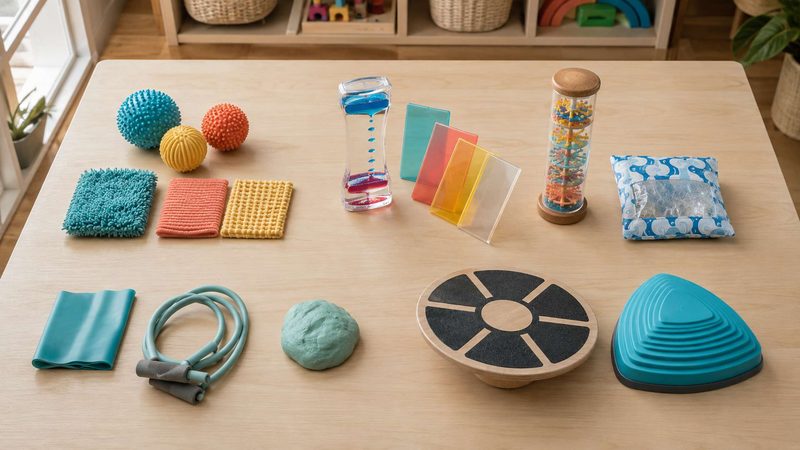
These labels overlap, but they are not interchangeable.
| Category | Main organizing idea | Typical examples | Commercial implication |
|---|---|---|---|
| Sensory toy | Provides noticeable sensory input | Textured balls, liquid timers, rainmakers, wobble boards | Broad range; specify input and use scenario |
| Brinquedo antiestresse | Allows small, repetitive hand movement | Spinners, cubes, poppers, sliders | Portable and demonstrable; durability and noise matter |
| Montessori-style toy | Supports purposeful, hands-on, often self-correcting activity | Object sorters, practical-life boards, simple puzzles | Method claims should match the actual activity, not visual style |
| Therapeutic equipment | Selected or used toward an individualized clinical goal | Some swings, weighted tools, specialist oral products | Requires professional and regulatory caution beyond ordinary retail copy |
A popper can be both a sensory toy and a fidget toy. A wooden shape sorter has tactile qualities but is normally sold by its sorting activity. A therapy clinic may use an ordinary toy as part of an individualized plan, but that does not make every unit a medical or therapeutic product.
This distinction affects keywords, packaging, channel placement, and claims. If you sell a general toy, lead with the play mechanism. If you target specialist education or therapy channels, involve qualified reviewers before using clinical terminology.
What Benefits Can You Responsibly Claim?
Sensory toys can invite exploration, repeated cause-and-effect play, manipulation, movement, and participation with other people. Those are observable play opportunities. Depending on the design, a product may also give children a way to practice grasping, pressing, balancing, matching, or taking turns.
What a buyer should not do is turn those features into guaranteed outcomes. “Cures anxiety,” “treats autism,” “improves ADHD,” and “guarantees focus” are medical or performance claims that ordinary supplier evidence usually cannot support. Even softer claims such as “calming” should be contextual and qualified because sensory preferences are individual.
Safer retail language connects feature to action:
- “Ten textured surfaces to touch and compare” is clearer than “improves sensory processing.”
- “Quiet buttons and switches for hands-on play” is more defensible than “keeps every child focused.”
- “Rocking base encourages active balance play” is preferable to a therapeutic balance claim without evidence.
This approach protects trust and also improves merchandising: customers can see what the product does before deciding whether it suits their needs.

How to Build a Commercial Sensory Toy Range
Do not begin by buying a large mixed assortment labeled “sensory.” Build the range around a customer, use setting, and price ladder.
Match the Range to the Sales Channel
- Value retail and party channels: compact tactile fidgets, poppers, textured balls, and simple tubes can provide visual variety at low shelf space. Prioritize robust construction and efficient multipacks.
- Toy stores and educational retailers: combine tactile, visual, auditory, and simple movement products so staff can explain the differences. Clear age grading and demonstration value matter.
- E-commerce and social commerce: visual timers, transforming fidgets, and cause-and-effect products show well on video. Packaging must survive parcel delivery, and claims must remain supportable on the listing.
- Schools and classroom suppliers: favor quiet, washable, individually manageable items. Avoid loose fillers, leakage-prone products, and complicated clean-up unless the setting explicitly requests them.
- Specialist sensory retailers: deeper specifications, replacement guidance, material documentation, and professional review are more important than a broad catalog.
Create a Balanced Product Ladder
A practical opening range might include:
- An entry-price tactile or quiet fidget item.
- A mid-price multisensory activity toy.
- A visually distinctive hero SKU for demonstration.
- A larger movement product only if your channel can handle its safety, freight, and after-sales needs.
Kits can raise perceived value, but every component must suit the same advertised age group. A kit inherits the risk of its weakest item: one small magnet, burstable gel toy, long cord, or unsuitable oral product can change the compliance and complaint profile of the entire set.

Safety and Compliance Risks Buyers Must Control
“Sensory” is a merchandising description, not a safety certification. The applicable rules depend on the exact product, age grade, materials, mechanism, and destination market.
Water Beads
Water beads are a high-risk choice, especially anywhere babies or young children may be present. Dry beads can be tiny and difficult to recover after spilling; after ingestion, they can expand and cause serious internal injury. The U.S. Consumer Product Safety Commission’s new federal water-bead toy standard took effect in March 2026 and includes expansion, acrylamide, and warning requirements. CPSC still urges consumers to keep water beads away from young children and advises childcare centers, camps, and schools to avoid them.
For a new general-purpose sensory range, the simplest risk decision is to exclude loose water beads. If your business chooses to sell a covered product, obtain current product-specific regulatory advice and laboratory testing rather than relying on an older generic toy report.
Small Parts, Magnets, and Batteries
Sensory toys often use beads, buttons, charms, magnets, and lights. Those features can create choking, ingestion, and chemical or electrical hazards. High-powered magnets are especially serious because two swallowed magnets can attract through intestinal tissue. Battery-powered visual and sound products need secure compartments; button or coin cells must not become accessible during foreseeable use.
Check the finished product after use and abuse testing, not only before. A component that begins too large to be a small part may crack or detach. Include spare batteries, tools, and removable accessories in the risk assessment and packaging review.
Liquids, Gels, Putty, Slime, and Fillers
Ask for the formulation, material safety information where relevant, fill quantity, preservative approach, and batch control. Test seams, closures, cleanliness, evaporation, odor, staining, and performance after storage. A report for the outer plastic shell does not cover the liquid or gel inside it.
Cords, Straps, Wearables, and Load-Bearing Products
Chew necklaces, body socks, swings, resistance products, and weighted items need design-specific evaluation. Consider entanglement, strangulation, breakaway behavior, ventilation, seam failure, attachment points, pinch hazards, maximum user mass, and foreseeable misuse. Warnings cannot compensate for a poor construction.
Market-Specific Responsibilities
For the United States, toys designed or intended primarily for children 12 and under generally require third-party testing by a CPSC-accepted laboratory and a Children’s Product Certificate covering applicable federal requirements. ASTM F963-23 is the mandatory toy standard for products manufactured after April 20, 2024. Applicable sections vary with the product; sound-producing toys, liquids and gels, small objects, cords, batteries, magnets, and other features may trigger different requirements.
In the European Union, toys must satisfy the applicable toy-safety framework, undergo safety and conformity assessment, carry CE marking, and have the required technical documentation and traceability. Regulation (EU) 2025/2509 entered into force on January 1, 2026, but generally applies from August 1, 2030; Directive 2009/48/EC remains the main framework during the transition. Buyers planning products with a long life cycle should prepare for the Regulation’s digital product passport and strengthened chemical provisions.
Do not ask a supplier simply, “Do you have EN71 or ASTM?” Send the exact SKU, intended age, market, materials, functions, accessories, packaging, and claims to a competent laboratory. Then verify that the report’s product photos, model number, materials, colors, and tested standard match the production order.
A Practical Supplier and Sample Checklist
Before requesting quotations, give every supplier the same product brief. It should include:
- primary sensory action and intended use;
- intended age and destination market;
- dimensions, weight, material, hardness or resistance where relevant;
- sound, light, liquid, magnet, battery, cord, or load-bearing features;
- color assortment and acceptable color variation;
- unit packaging, instructions, warnings, barcode, and carton requirements;
- logo, mold, artwork, and private-label needs;
- required test standards and document list;
- order quantity, delivery target, and Incoterm.
Then evaluate samples with tests related to the actual play pattern:
| Product feature | Sample checks |
|---|---|
| Squeeze or stretch | Repeated cycles, seam failure, rebound, odor, tack, color transfer |
| Liquid or gel filled | Leakage, cap security, drop exposure, heat/cold storage, fill consistency |
| Clicking or moving parts | Cycle life, jamming, noise variation, pinch points, detached parts |
| Light or sound | Output consistency, switch life, battery security, heat, auto-off behavior |
| Chew or mouth contact | Material identity, bite damage, detached pieces, cleaning, moisture traps |
| Balance or load bearing | Stability, anti-slip grip, repeated load, fasteners, edges, instructions |
| Fabric or weighted | Seam strength, fill migration, leakage, ventilation, wash behavior |
Keep a signed specification sheet and sealed approval sample. During pre-shipment inspection, use the same acceptance criteria and test method. “Same as sample” is too vague if the sample does not record material, fill, component, color, packaging, and performance details.
Common Sourcing Mistakes
- Buying the label instead of the function. “Sensory toy” is too broad for a comparable quotation. State the input, action, materials, dimensions, and performance.
- Treating all sensory input as calming. Response varies by user and context. Offer clear features and controllability rather than universal outcomes.
- Using one age grade for a mixed kit. Grade the complete set around its most restrictive component and actual play pattern.
- Accepting generic “non-toxic” or “food-grade” statements. Request exact material identification and product-specific evidence.
- Ignoring cleaning and storage. Sticky surfaces, fabric seams, liquid chambers, and textured cavities can become hygiene or return problems.
- Approving appearance without endurance testing. Many defects appear only after repeated squeezing, pulling, biting, rocking, or dropping.
- Copying medical claims from marketplace listings. Supplier copy is not clinical evidence and may expose your listing to regulatory or platform action.
- Comparing unit prices without packaging and freight. Large balance products and bulky kits can lose their margin through volumetric shipping and parcel damage.
Conclusion: Define the Sensory Action Before You Source
Sensory toys are not one mechanism or one customer need. They are products that offer identifiable input through touch, sight, sound, movement, body position, or oral interaction. The strongest buying brief therefore starts with the action and user, then specifies age, material, intensity, construction, packaging, testing, and market.
Start with low-complexity tactile and visual products, add differentiated items only after sample testing, and treat oral, weighted, liquid-filled, magnetic, battery-powered, and load-bearing products as higher-control categories. If you need to compare brinquedos antiestresse por atacado, brinquedos educativos, or a custom sensory range from China, TonySourcing’s toy sourcing service can coordinate supplier comparison, samples, packaging, inspection, and shipping. Send your target market, sales channel, age group, quantity, and preferred sensory actions to build a comparable sourcing brief.
Frequently Asked Questions
Are sensory toys only for autistic children?
No. Sensory toys can be used in ordinary play by many children and adults. Some autistic people have particular sensory preferences, but product suitability is individual. Avoid marketing a general toy as autism treatment or implying that one product works for everyone.
Are all fidget toys sensory toys?
Most fidget toys provide tactile, visual, auditory, or movement feedback, so they can fit within the broader sensory category. However, fidget toys are mainly organized around small repetitive actions, while sensory toys also include large movement, resistance, visual, auditory, and oral products.
Which sensory toys are easiest for a first wholesale order?
Simple, sealed, non-electronic tactile products are usually easier to inspect and ship than liquid-filled, magnetic, battery-powered, oral, weighted, or load-bearing products. The exact choice should still match your age group, channel, and destination-market requirements.
Can different sensory toys be sold as one kit?
Yes, but the complete kit must have a coherent use case and age grade. Evaluate every component, the combined packaging, instructions, small parts, materials, and required tests. A single high-risk item can determine the compliance burden for the whole kit.
What information is needed for an accurate wholesale quotation?
Provide reference images or a concept, the intended sensory action, age grade, destination market, dimensions, material, functions, color assortment, packaging, branding, test requirements, quantity, target delivery date, and Incoterm. Ask suppliers to separate tooling, samples, testing, packaging, and freight where applicable.