Jigsaw Puzzle Brands for Business: Buy, License or Build Your Own
There are already enough lists of jigsaw puzzle brands. This is not another one.
This page answers the question a business buyer actually has. What is a brand worth to you, and which of the three ways to use one can you afford?
The short answer: a brand is not a factory. It is a price tag with a distribution network and an art licence behind it. Once you see those three parts separately, the decision gets much easier — and much cheaper.
1. What Does a Jigsaw Puzzle Brand Actually Sell You?
Three things, and only one of them is the puzzle. If you need the parts list first, our guide to what a jigsaw puzzle is covers the board, the die and the box.
First, a shelf price. A 1,000-piece cardboard puzzle costs about US$0.90 to US$3.50 to make in China. The same spec sells wholesale for US$4 to US$8 under a known brand, and retails at US$15 to US$25. The pieces are the same. The price is not.
Second, an art licence. Every printed puzzle carries an image, and someone had to clear the rights to it. A brand has already done that work, and that is a large part of what you are paying for.
Third, a returns record. A brand with a clean fit and a sharp print has fewer complaints. That matters more online than on a shelf, because a bad review follows the listing, not the batch.
The numbers behind that premium are not small. Ravensburger, founded in 1883 and still family owned, sells more than 20 million puzzles a year. Trade estimates put its puzzle turnover at about US$200 million, with roughly 24% of the global puzzle market. The whole market is expected to pass US$5 billion by 2028.
That is the scale you are competing with if you build your own line. It is also the reason a brand line is worth benchmarking before you do.
What the brand does not give you is freedom. A distribution agreement normally sets a price floor, a territory and a ban on marketplaces. You buy the demand, and you accept the rules that come with it. If you want to see what the open market looks like by comparison, our jigsaw puzzle wholesale range shows the same formats at factory prices.
2. Which Jigsaw Puzzle Brands Are Worth Benchmarking?
Not the ones with the best reputation. The ones closest to your channel.
| Brand | Home base | Shelf position | Known for | What to benchmark from it |
|---|---|---|---|---|
| Ravensburger | Germany | Premium | Linen finish, tight fit, huge catalogue | Print quality and box weight |
| Clementoni | Italy | Mid to premium | Children’s and family ranges | Age grading and box clarity |
| Jumbo | Netherlands | Mid to premium | Wasgij mystery series | Concept puzzles that sell on the idea |
| Educa Borras | Spain | Mid | Blue board, fine art images | Board grade for adult puzzles |
| Gibsons | UK | Mid to premium | British scenes, round boxes | Gift packaging |
| Trefl | Poland | Mid | High volume, broad licence range | Price control at scale |
| Buffalo Games | NÓS | Mid | US art, strong mass channel | Art selection for the US shelf |
| Cobble Hill | Canada | Mid | Family and children’s lines | Random cut and piece variety |
| Pintoo | Taiwan, China | Premium | Plastic pieces, no glue needed | The plastic alternative |
Keep two of these in view, not nine. One premium, one at your price point. A benchmark you cannot reach is not a benchmark, it is a wish.
Read the last column as a shopping list for your spec sheet. If you benchmark Ravensburger, you are buying print quality and a heavy box. If you benchmark Buffalo Games, you are buying art that works on a US shelf. Those are different briefs, and they cost different amounts.
Where the brands actually sit in each market is a distribution question, not a design one. Our guide to finding jigsaw puzzle wholesale suppliers covers the channel side.
If you want the long-form brand profiles, our list of marcas de quebra-cabeças covers eight in detail. Jigsaw puzzle manufacturer brands covers nine more from the production side. This page stays on the commercial decision.
3. What Are the Three Ways to Use a Brand?
Only three exist, and they are priced very differently.
| Route | What you get | What it costs | Minimum realistic volume | Who it suits |
|---|---|---|---|---|
| Stock a brand | Finished goods at brand wholesale | 40–55% off retail, plus shipping | One pallet and an approved account | Distributors with a retail base |
| License the brand or art | The right to print a name or image | 5–15% royalty, plus a minimum guarantee | Set by the licensor, often 5,000+ | Factories and established brands |
| Build your own | Your own name on the box | Tooling, art, testing, stock | 300–1,000 units | Most importers |
Route one is closed more often than buyers expect. Brands sell through appointed distributors by territory, and the appointment usually comes with a minimum purchase, a price floor and a ban on marketplaces. That is not a negotiating position. It is the channel model.
Route two is the most misunderstood. A licence does not give you a factory. It gives you a right, a royalty bill and an approval process. If the property is a film or character licence, expect an upfront guarantee. You pay it before you sell a single unit. Add two to four rounds of sample approval.
A licence also rarely comes alone. Most licensors want a category, a territory and a term, and they keep the right to approve your artwork, your box and sometimes your retail price. Budget four to seven months before the first container.
Route three is the only one that scales from zero. You pay for tooling and art once, then keep the margin. The catch is that all the work the brand did for you — art, fit, packaging, compliance — is now yours.
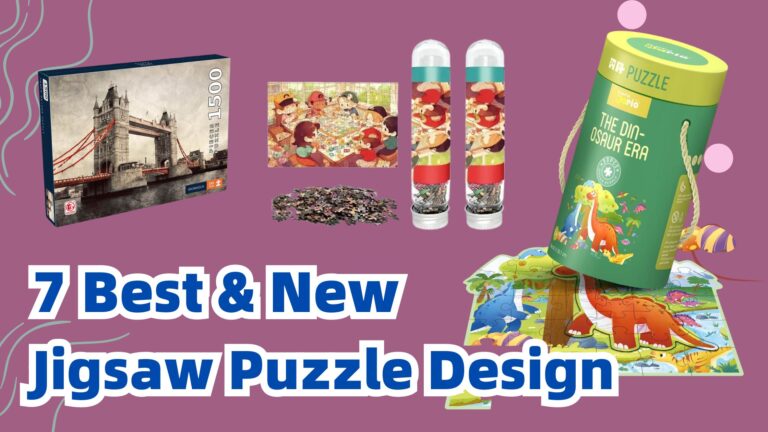
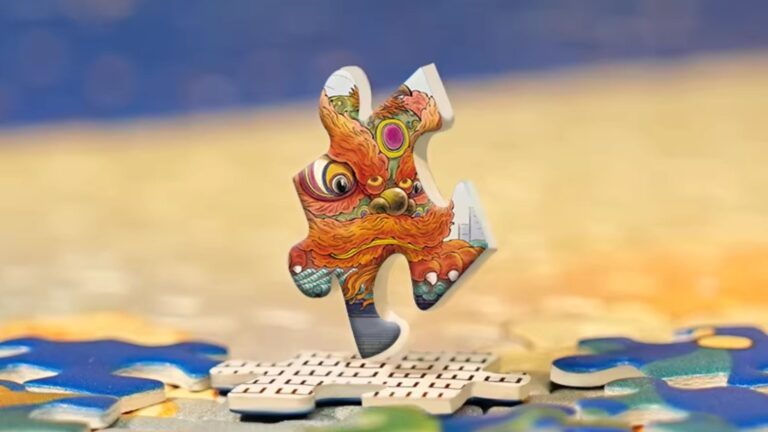
Start with a format the factory already runs. A standard 1,000-piece die exists in most plants, so your first order pays for print and board, not a new tool. Change the image, the box and the finish before you change the cut. Our notes on new jigsaw puzzle designs show how far that gets you.
4. Are Chinese Jigsaw Puzzle Brands Easier to Work With?
Often, yes. And that is exactly why you should be careful.
A Chinese puzzle brand sits close to the factory. That shows up in three practical ways. Most Chinese jigsaw puzzle brands will also print your artwork on an existing die and quote in days.
- MOQ is lower. A European brand may want 5,000 units per design. A Chinese brand may open at 500 to 1,000.
- Private label is normal. Many will print your artwork on their existing die and put your name on the box.
- Reply time is shorter. Catalogues arrive in English, and samples move in days rather than weeks.
| What you get | Chinese jigsaw puzzle brand | European brand |
|---|---|---|
| Design and supply | Yes, often with your branding | Yes, under their name only |
| Retail recognition in the US or EU | Low to medium | High |
| MOQ flexibility | 500–1,000 | 5,000 and up |
| Exclusivity for your market | Possible, but ask in writing | Rare |
The missing piece is demand. A Chinese brand gives you a product and a supply chain. It does not give you a shelf price that a retailer already trusts. You are buying design and capacity, not recognition.
Ask one question before you commit: will you sell this design to my competitor in the same country? If the answer is vague, you are renting a design, not owning one. The same logic runs through the China toy wholesale factory map.
5. Where Does the Art Come From? Four Licences, Four Costs
This is where most puzzle projects fail, and it has nothing to do with the factory. Jigsaw puzzle brands compete on art as much as on board, and the licence is where the cost hides.
| Image source | What you need | Typical cost | Risk if you skip it |
|---|---|---|---|
| Your own photo or design | Nothing, but keep the file and the date | Free | Low, if you really shot it |
| Public domain artwork | A clean file and a rights check | Free to low | Medium. The museum may still claim rights |
| Living artist or photographer | A licence from the artist or agency | 5–15% of wholesale, often with an advance | High. Claims start here |
| Film, character or sports IP | A merchandising licence | Advance plus minimum guarantee plus approvals | Very high. Customs seizure and recall |
The factory will print whatever file you send. That is the whole problem. A printer in Ningbo has no way to know whether your image is licensed, and no reason to ask. The claim lands on the importer of record, which is you.
6. Can You Print a Museum Image for Free?
Usually yes, but not for the reason most buyers think.
There are two separate rights in a painting: the painting, e the photograph of the painting. They expire independently, and the second one is where people get caught.
- In the United States, a faithful photographic reproduction of a public domain painting gets no copyright of its own. That is the rule from *Bridgeman Art Library v. Corel* (1999).
- In the European Union, Article 14 of Directive (EU) 2019/790 says the same thing: once the artwork’s copyright expires, a straight reproduction of it does not create a new right.
- In the UK, the Court of Appeal confirmed the position in *THJ v Sheridan* in 2023.
So the law is on your side. The practical problem is a contract. Many museums still assert rights over their photography, and the file they hand you often comes with terms of use. Copyright and contract are different levers, and the second one still binds you if you accept their file.
The clean route is an open-access collection. The Art Institute of Chicago has released more than 50,000 images under CC0. The Met, the Rijksmuseum and the National Gallery of Art run similar programmes. Open access frees the photograph. It never frees a painting that is still in copyright.
One more trap. A painting being old does not mean the subject is safe. A modern photograph of a modern building, a living person’s face, or a trademarked product in the scene carries its own rights.
Before you send a file to a factory, run three checks. Where did the file come from? Keep the source URL and the download date. What does the source say about commercial use? Read the terms, not the caption. Is the subject itself clear? A public domain painting of a branded product is still a branded product.
This is also where jigsaw puzzle brands earn their margin, and where new importers lose theirs. The brand pays a rights manager. The importer pays a lawyer, or a destroyed container.
7. What Does a Branded Puzzle Cost Against Your Own?
Here is the same 1,000-piece puzzle, priced three ways. It is also how jigsaw puzzle brands decide what belongs in a range. Every figure is a rough guide, not a promise.
| Line | Brand line | Private label, 1,000 units | Note |
|---|---|---|---|
| FOB | US$2.50–4.50 | US$0.90–3.50 | Same board, different print control |
| Freight and duty | US$0.60–1.20 | US$0.60–1.20 | Per unit, mixed container |
| Landed cost | US$3.20–5.60 | US$1.60–4.60 | Before art and tooling |
| Art licence | Included | US$0–1.50 | Depends on the source in section 4 |
| Tooling, first order only | None | US$800–2,500 | One die, one cut |
| Wholesale price | US$5.00–8.00 | US$3.50–6.00 | Your invoice to the retailer |
| Retail price | US$15.00–25.00 | US$12.00–20.00 | Set by the channel |
The gap is not the puzzle. It is the US$1 to US$2 per unit the brand spends on art, print control and packaging. A retailer also pays more for a name it recognises.
That is also the honest limit of a private label. You will not match a premium brand’s shelf price in year one. You can match its fit and its print, and you can beat its margin.
Volume moves the first column more than anything else. Moving from 1,000 to 3,000 units usually takes 8–15% off the FOB, because the die cost and the set-up time spread further. Moving from 1,000 to 500 adds it back. Ask for a price at three volumes in one email, and you will see the real curve.
For the board grades and cut types behind these numbers, see types of jigsaw puzzles. For the production steps, see how jigsaw puzzles are made.
8. What Does a Corporate Gift Puzzle Cost?
This is the fastest business use of a puzzle brand, and it needs no brand at all. You need a logo, a box and a deadline. It is also the one segment where jigsaw puzzle brands rarely compete on price.
| Format | Pieces | Typical MOQ | FOB per unit | Production time |
|---|---|---|---|---|
| A5 promo puzzle | 120–300 | 500 | US$0.55–1.20 | 15–20 days |
| A4 gift puzzle | 500 | 500 | US$0.90–2.00 | 18–25 days |
| Standard retail box | 1,000 | 500–1,000 | US$1.20–3.20 | 20–30 days |
| Shaped or wooden | 200–500 | 300 | US$1.85–4.20 | 25–35 days |
Three things decide the quote more than anything else. Box type — a rigid gift box can cost more than the puzzle. Print quality — a logo needs sharp edges, and cheap stock fuzzes them. Deadline — a corporate order has a fixed event date, and factories price urgency.
Ask for a pre-production sample and keep it. On a logo puzzle, the sample is the only way to check that the brand colour survived the print. Stock samples are often free with you paying the courier. Custom samples usually carry a fee of around US$100, credited against the order.
Payment is normally 30% deposit, 70% before the bill of lading, with LC at sight for larger orders. Fix the Incoterm in writing at the same time. Then check the carton spec: a standard 1,000-piece carton runs about 10 units at 52 × 39 × 28 cm and 10.5 kg. That number sets your container maths and your freight quote.
On a corporate order, work backwards from the event date. Air freight can save two weeks and cost three times as much. For a 500-unit run, that trade is often worth it. For 5,000 units, it never is. The full shipping sequence sits in how to import toys from China.
9. How Do You Check a Factory Before You Print?
Five questions, before you send artwork.
1. Which die will cut this, and how many cuts has it made? A worn die gives loose fits and returns. 2. What board grade, in millimetres? Under 1.8 mm, a large image warps in transit. 3. Can you show a printed sample on my file, not a catalogue image? Colour shifts hide in catalogue shots. 4. Which lab did the last test, and for which SKU? A report for a similar item is not a report. A toy testing lab can confirm the scope you need. 5. Who owns the die? If you paid for it, it should be yours, so a second factory can quote later.
If the puzzle is aimed at children, the compliance file changes with the age grade. In the EU, the piece count can also move the product out of toy law entirely. That line sits in types of jigsaw puzzles, and the shipping side is in how to import toys from China.
10. FAQ: Jigsaw Puzzle Brands for Business
Can I buy Ravensburger or Clementoni wholesale? Only through an appointed distributor for your territory. Both brands use controlled channels, and a new importer without a retail base is rarely appointed.
Which jigsaw puzzle brands can a small buyer actually stock? The mid-tier and regional brands are more open than the premium ones. Start with the brand that already sells in your channel, and ask for its distributor list rather than its head office.
Do I need a licence to print a famous painting? Not if the artist’s copyright has expired and the file is a straight reproduction. Check the museum’s terms anyway, and prefer an open-access image.
Can I print a Disney or Marvel puzzle if I find the art online? No. Character art needs a merchandising licence, with an advance, a guarantee and approval rounds. Unlicensed character puzzles are the most common seizure in this category.
What royalty should I expect on an art licence? Usually 5–15% of net wholesale. Well-known artists and entertainment properties also ask for an upfront advance against that royalty.
Is a private label cheaper than stocking a brand? At 1,000 units, yes, by roughly US$2 to US$3 per unit. At 200 units, no. Tooling and art are fixed costs, and they need volume to disappear.
How long does a custom puzzle order take? About 15 to 20 days for a small promo run, and 20 to 35 days for a retail box with new tooling. Add two weeks for a sample round and sea freight on top.
Considerações finais
Jigsaw puzzle brands sell three things: a shelf price, a cleared art file and a returns record. Each one is a shortcut, and each one is priced.
For a distributor with a retail base, that shortcut is worth the margin. For an importer starting at 1,000 units, it usually is not. Build the box yourself, benchmark two brands, clear your art properly, and keep the difference.
If you want a quote against a brand you already stock, send three things through the sourcing inquiry page: the benchmark product, your target shelf price and your market. We will come back with a shortlist, factory quotes and the test list you need. For the factory side, start with fabricantes de quebra-cabeças, then compare wider with fabricantes de brinquedos na China or the China toy wholesale map.