How to Import Toys from China: A Complete Guide for Importers, Wholesalers and Amazon Sellers
Most guides about importing toys from China stop at “find a supplier.” The hard part comes after: which market actually fits your order, the minimum you will really face, which safety standard applies in the country you sell in, and what the toy costs by the time it reaches your warehouse. This guide walks the whole route — with numbers you can check.
Video Guide
Why Import Toys from China
China is not the cheapest place to make toys any more, and pretending otherwise is how importers get hurt. It is, however, still the only place where the entire chain sits within a short radius.
Specialised clusters instead of one giant factory. Yiwu gives you enormous variety and the ability to fill a container with twenty different categories. Shantou and Chenghai are the manufacturing base for plastic and RC toys. Yangzhou and Baigou specialise in plush. Yunhe is where the wooden and educational toy industry sits. Your sourcing location changes depending on what you are buying — that is the point.
Supply chain depth. Mould making, injection, printing, electronics assembly, sewing and packaging suppliers operate within a few hours of each other. Development cycles that take months elsewhere take weeks here, because a tooling change does not require shipping anything across a border.
The caveat. A low unit price is one line on a much longer invoice. Importers who budget against the FOB price alone are the ones surprised at destination — usually by freight, packaging or tariffs, and sometimes by a certificate they did not know they needed.
Why Import Toys from China
China is not the cheapest place to make toys any more, and pretending otherwise is how importers get hurt. It is, however, still the only place where the entire chain sits within a short radius.
Specialised clusters instead of one giant factory. Yiwu gives you enormous variety and the ability to fill a container with twenty different categories. Shantou and Chenghai are the manufacturing base for plastic and RC toys. Yangzhou and Baigou specialise in plush. Yunhe is where the wooden and educational toy industry sits. Your sourcing location changes depending on what you are buying — that is the point.
The main categories most buyers start with: RC and electronic toys, educational and STEM toys, custom plush toys, baby and preschool lines, and pretend-play ranges. Each has its own cluster, its own tooling economics and its own compliance pitfalls.
Supply chain depth. Mould making, injection, printing, electronics assembly, sewing and packaging suppliers operate within a few hours of each other. Development cycles that take months elsewhere take weeks here, because a tooling change does not require shipping anything across a border.
The caveat. A low unit price is one line on a much longer invoice. Importers who budget against the FOB price alone are the ones surprised at destination — usually by freight, packaging or tariffs, and sometimes by a certificate they did not know they needed.
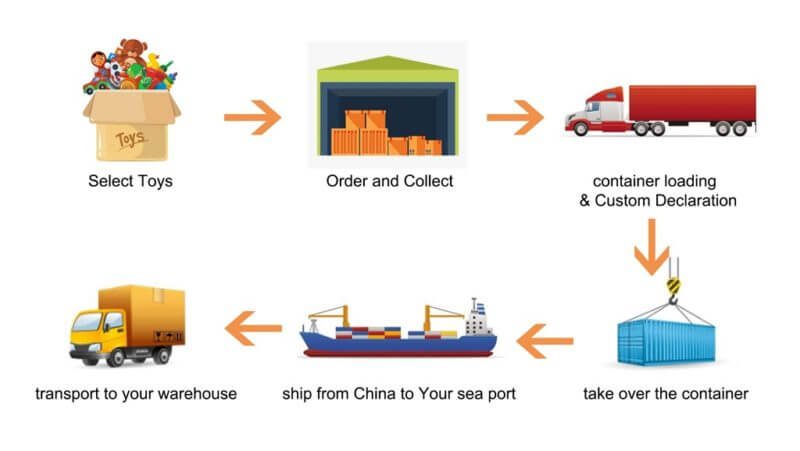
The Four Stages of a Toy Import
Every toy import runs through the same four stages, in this order:
Decide where to source. Wholesale market or manufacturing cluster — they behave differently.
Agree minimums and pricing. MOQ, tooling, packaging, payment terms.
Sort compliance for your destination. Testing, certificates, labelling, importer records.
Move the goods. Inspection, freight, customs clearance, landed cost.
From enquiry to delivered goods — the four stages every toy import runs through.
Most first imports go wrong at stage 3 or stage 4, not stage 1. Buyers spend three weeks comparing suppliers and about three days finding out what their own country requires.
Stage 1 — Where to Source: China’s 8 Toy Markets at a Glance
There is no single “best” market. The right answer depends on your order size, whether you need custom work, and which categories you are buying.
Рынок
Type
Best for
Typical MOQ
Choose it when
Иу (International Trade City, District 1)
Wholesale market
Mixed SKUs, small containers, first-time importers
Frequently by the carton on stock items; rises once you add custom packaging
You need many categories in one container
Shantou / Chenghai
Manufacturing cluster
OEM projects, brands, plastic and RC toys
The highest of the eight on custom work
You are developing your own product
Linyi (Yongxing)
Wholesale market
Regional and general merchandise buyers
Low, carton level
You serve inland or regional distribution
Yangzhou
Plush cluster
Custom plush and stuffed toys
Moderate on custom plush
Plush construction and customisation matter
Baigou
Plush wholesale
Price-sensitive plush buyers
Lower than Yangzhou on simpler constructions
Unit price is the deciding factor
Юньхэ
Wooden cluster
Wooden and educational toys
Moderate
You sell wooden or STEM lines
Zhengzhou
Wholesale market
General and regional wholesale
Carton level
You consolidate Central China supply
Гуанчжоу
Wholesale + showrooms
Buyers combining sourcing with the Canton Fair
Varies by supplier
Your trip already includes Guangzhou
Market vs manufacturing cluster
A wholesale market is a concentration of traders and factory sales offices. You get variety and low minimums, but you are often not talking to the factory that will make your goods. A manufacturing cluster is where production actually happens. You get engineering support and factory-direct pricing, but higher minimums and a longer development cycle.
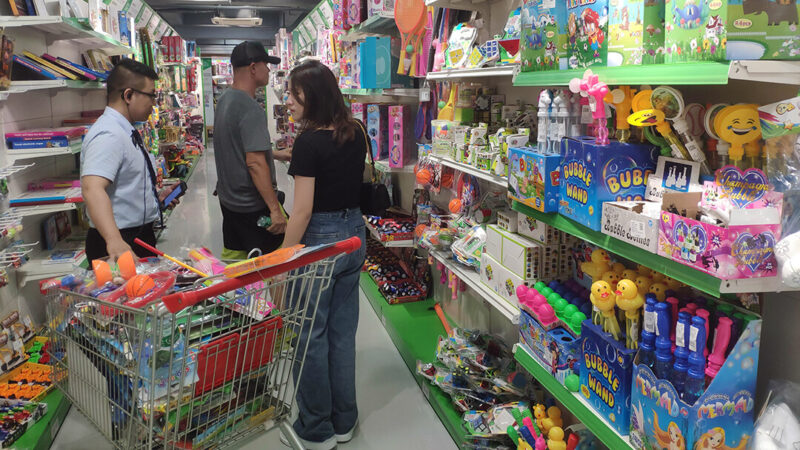
Yiwu: thousands of booths under one roof — a wholesale market, not a factory.Chenghai, Shantou: actual production, where OEM projects get built.
Neither is better. Yiwu wins on mixed containers; Shantou wins on making something new.
Full comparison of all eight markets, including what each one is weak at: China’s Top 8 Toy Wholesale Markets. We also maintain dedicated guides for buying in Рынок Иу and for the Shantou Chenghai toy cluster.
Stage 2 — MOQ: What Minimums to Expect
Minimum order quantity is not a number the factory invents to be difficult. It exists because of real setup costs: machine changeover, colour matching, printing plates, material purchase minimums and production scheduling. When you understand which of those your order triggers, MOQ becomes negotiable.
Market / cluster
Stock MOQ
Custom or OEM MOQ
What pushes the number up
Иу
Frequently by the carton — sometimes a few cartons per SKU
Rises once you add custom packaging or private label; commonly 500–1,000+
Custom colour, logo application, printed packaging, splitting across too many SKUs
Shantou / Chenghai
Limited stock programmes
Commonly 1,000–3,000+ per SKU for OEM; higher when new tooling is required
New moulds, new tooling, multi-colour printing
Linyi (Yongxing)
Low, carton level
Depends on the factory
Depth of customisation
Yangzhou (plush)
Some stock programmes
Commonly 500–1,000 for custom plush
Embroidery, custom fabric, hangtags, printed care labels
MOQ bands are typical ranges for custom-manufactured goods from China, not quotes. The fastest route to a real number is to send quantity, artwork and packaging requirements together — suppliers price the whole job, not the unit.
Four ways to get the minimum down
Start from an existing product. Existing tooling removes the single biggest barrier to a lower minimum.
Reduce the number of versions. If your MOQ is per colour or per design, five designs means five times the commitment. Launch with two.
Simplify the packaging. Custom printed boxes often carry their own minimum, sometimes higher than the product’s.
Offer to pay setup separately. Some factories will reduce the unit minimum if the setup charge is covered as its own line item.
Stage 3 — Compliance: What Your Destination Market Requires
This is the stage that stops shipments. Standards are not interchangeable, and “the factory has certificates” almost never means the certificates your market requires.
Место назначения
Core standard
What you must hold
Lab testing
Marking & labelling
United States
CPSIA and ASTM F963 (the edition CPSC has incorporated into its mandatory rule — check which version is in force)
КПК — Children’s Product Certificate, naming each applicable rule
Third-party testing by a CPSC-accepted accredited laboratory; retest when material, design or factory changes
Permanent tracking label on both product and packaging: maker name, production location and date, batch identifier. Age grading and hazard warnings where applicable
European Union
Toy Safety Directive 2009/48/EC with EN 71-1, -2 and -3 (plus EN 62115 for electric toys); also REACH Annex XVII and the General Product Safety Regulation
EU Declaration of Conformity plus CE marking; technical documentation retained
Accredited laboratory testing to EN 71; reports kept in the technical file
CE mark; importer name and postal address on the toy or its packaging; warnings in the language of each destination market
United Kingdom
UK Toy (Safety) Regulations plus EN 71 / BS EN 71
UK Declaration of Conformity и UKCA marking (check the current arrangements for CE acceptance)
Accredited laboratory testing to EN 71
UKCA or CE as applicable; UK importer name and address; English warnings
Canada
Canada Consumer Product Safety Act and the Toys Regulations
No certificate is issued, but compliance is mandatory and records must be kept
Testing against the Toys Regulations is strongly recommended
Bilingual labelling and warnings — English and French
Australia / New Zealand
AS/NZS 8124 series, aligned with ISO 8124
Supplier declaration; no pre-market approval
Testing to AS/NZS 8124
Age grading and small-parts warnings
Applies across most markets
Age grading, and the small-parts rule for anything intended for children under three.
Magnets, batteries and electronics carry their own additional requirements beyond the base toy standard.
Cords and strings on toys for young children have length limits.
Phthalates and heavy-metal migration limits on accessible materials.
A CPC is not a certificate you download. It is a written statement based on testing done by a CPSC-accepted laboratory, and it has to be re-based whenever the material, the design or the factory changes. Buyers who treat it as a one-time document are the ones who get caught at the port.
Scenario: 5,000 custom plush toys, 40 cm, each in a printed gift box. Supplier in Yiwu, shipped Ningbo to Los Angeles.
Line item
Basis
Amount
Unit FOB price
5,000 × $3.20
$16,000
Custom printed box
5,000 × $0.45
$2,250
Tooling and sample setup (one-off)
—
$900
Inland trucking and export clearance
Yiwu to Ningbo
$300
Ocean freight, LCL
9.2 CBM × $92
$846
Marine insurance
0.35% of goods value
$64
Customs value (CIF)
—
$19,160
Duty on toys
0% on the relevant Chapter 95 subheading
$0
Additional tariff on China-origin goods
7.5% × $19,160
$1,437
Merchandise processing fee
0.3464% (check current minimum and maximum)
$66
Harbor maintenance fee
0.125%
$24
Customs brokerage and ISF filing
—
$250
Port handling, THC and drayage
Los Angeles
$620
Domestic truck to warehouse
—
$380
Total landed cost
—
$23,137
Landed cost per unit
$23,137 ÷ 5,000
$4.63
The number that matters: a $3.20 toy costs $4.63 landed — 45% more than the price on the quote. If you build your retail margin on the FOB price, this is where it disappears.
Where the extra $1.43 goes
Amount
Share of the additional cost
Упаковка
$2,250
31.5%
Freight and inland logistics
$2,210
31.0%
Tariffs
$1,437
20.1%
Tooling, brokerage and fees
$1,240
17.4%
The same order into Rotterdam
Import VAT counted as cost
Import VAT reclaimed
Landed total
$25,209
$21,212
Per unit
$5.04
$4.24
Assumes 0% duty on the relevant subheading and import VAT at 21%. That VAT line is the single biggest difference between shipping to Europe and shipping to the US — and the one most first-time importers forget to model. Whether it is genuinely a cost depends on your VAT registration.
Freight rates move weekly and tariff rates change with policy. Figures above are illustrative as of October 2026 — verify current rates with your freight forwarder and broker before you budget.
Six levers that actually move landed cost
Consolidate to FCL. LCL is charged per cubic metre. Past roughly 15 CBM, a 20 ft container is usually cheaper than paying by volume.
Right-size the packaging. Shaving a few centimetres off a carton can drop you an entire CBM bracket on a larger order.
Confirm the HS subheading before you ship. Duty is 0% on most toys, but not every subheading, and misclassification costs more than the duty itself.
Ask whether a legitimate design change affects classification. Sometimes it does, sometimes it does not — ask before you assume.
Ship away from the peaks. Rates climb sharply before Chinese New Year and before peak retail season.
Register for VAT in Europe if you import regularly. Otherwise you are financing 21% you could reclaim.
Shipping & Logistics: Sea, Air or Rail
Toys are bulky. Freight is often priced on volume rather than weight, which is one reason quoted per-unit shipping sometimes looks disproportionate for plush, inflatables or large plastic items.
Mode
Typical transit
Cost level
Best for
Sea, FCL (full container)
Slowest but most predictable per unit
Lowest per unit at volume
Established demand, inventory you can plan
Sea, LCL (shared container)
Slightly slower than FCL
Higher per CBM
First orders, testing demand
Авиагрузоперевозки
Fastest
Highest by a wide margin
Small, light, urgent, or high-value items
Rail (China–Europe)
Between sea and air
Between sea and air
Europe-bound goods when air is too costly and sea too slow
The route decision should follow your calendar, not the quote. Working backwards from the date stock must be on the shelf is usually what determines the mode. On handling duties and clearance at destination, see our step-by-step import guide.
Quality Control Before Shipment
Inspection is not about distrusting the factory. It is the only point where finding a problem still costs nothing.
A standard pre-shipment inspection checks, at minimum:
Quantity and assortment against the packing list
Упаковка — carton strength, inner packing, whether it survives a short drop
Print adhesion — logos and warnings rubbed with solvent or tape as appropriate
Функция — every moving part, every electronic function, batteries fitted correctly
Safety-critical features — small parts pull test, sharp points and edges, cord lengths
Labelling — age grading, warnings, tracking labels, importer details, all present and correct
Most inspection programmes use a sampling standard such as ISO 2859-1, generally at inspection level II, with different acceptance limits for critical, major and minor defects. Your inspector should tell you which limits they are working to — if they cannot, that is a problem.
Inspect before you release the balance payment. Once the final payment has gone out, your leverage is gone with it. This is worth more than any discount you negotiate.
Three Ways to Work With Us
Different buyers need very different things. Most fall into one of three groups.
1. The traveller — you plan to visit China
Showrooms let you shortlist thousands of SKUs before you set foot in a factory.
If you are coming to Yiwu or Shantou, we arrange the itinerary, accompany you to markets and factories, handle translation and sample selection, and help you close the order on site. Seeing the goods in person settles questions that photographs never will.
2. The online buyer — you cannot travel
We work from catalogues, video and samples. Browse our toys catalogue, shortlist what you want, and we will come back with quotations and product videos. This suits wholesalers and retailers who already know what they want to buy.
We publish new toy lines regularly — subscribe on YouTube to see recent additions.
3. The developer — Amazon sellers and private label
You need something that does not already exist, or an existing product improved. Send the brief; we find the factory, manage sampling and mockups, arrange testing and deliver the production run. See our notes for sourcing toys to sell on Amazon.
TonySourcing is a toy sourcing agent headquartered in Yiwu and Shantou. We are not a trading company buying and reselling to you — you work directly with the factory, and we are paid for the work we do on your side of the table.
Commission of 5–8% based on your order value.
We can quote a full FOB price that includes factory cost, inland delivery and our service, so you see one number rather than three.
Factory pricing typically lands below what traders quote, because the markup layer is not there.
What that buys: verified manufacturers rather than listings, several comparable quotes, sampling coordination, inspection before shipment, consolidation from multiple suppliers, and someone accountable when something goes sideways. See what other buyers say on our client reviews page.
Common Mistakes First-Time Importers Make
Budgeting against the FOB price. Landed cost runs 30–50% above it for most toy orders. Work it out before you commit to a retail price, not after.
Checking compliance after production. Testing is cheaper before you make 5,000 units than after they are packed.
Accepting “we have certificates.” Ask specifically which standard, which edition, which laboratory, and whether the report names your product.
Releasing the final payment before inspection. Once it is paid, every problem becomes a negotiation.
Splitting the order across too many SKUs. Every version carries its own minimum, and inventory risk multiplies faster than variety pays back.
Ordering against hope rather than calendar. Work backwards from the date stock has to be live, including production, freight and clearance.
Часто задаваемые вопросы
What is the minimum order to import toys from China?
It depends on the market and on whether you are buying stock or commissioning something custom. Wholesalers in Yiwu often sell by the carton on stock items, while OEM work in Shantou usually starts far higher. Always ask for the MOQ per version, not just the order total.
How much does it cost to import toys from China?
Budget well above the FOB price. In the worked example above, a $3.20 FOB unit landed at $4.63 — packaging, freight and tariffs together added 45%.
How long does it take to import toys from China?
Count every stage: sampling, tooling if it is needed, production, inspection and freight. Sea freight alone typically runs several weeks, and custom items need sample approval before the production run even starts.
Do I need a CPC to import toys into the US?
Yes, for children’s products. The Children’s Product Certificate must be based on testing by a CPSC-accepted laboratory and must name each applicable rule. It has to be re-based when the material, design or factory changes. See our detailed note on US toy CPC requirements.
What is the difference between EN 71 and ASTM F963?
ASTM F963 is the US toy safety standard referenced by CPSC rules. EN 71 is the European standard set used to demonstrate conformity with the EU Toy Safety Directive. They address similar hazards with different test methods and limits, and the EU route additionally requires a Declaration of Conformity and CE marking.
Can I import toys from China without a sourcing agent?
Yes, but you take on supplier verification, negotiation, inspection and consolidation yourself. An agent earns the fee mainly on the mistakes you avoid, not on the unit price they negotiate.
How do I calculate landed cost for a toy shipment?
Start from FOB. Add packaging, inland transport, ocean or air freight, insurance, duty, any additional tariffs, brokerage and port fees. Divide by unit count. The worked example above shows every line.
What HS code applies to toys?
Most toys fall in Chapter 95, but the subheading matters for duty rate and for any additional tariff lists. Confirm the subheading with your broker before you ship, not after.
Can I mix toys from different suppliers in one container?
Yes — consolidation is one of the main reasons buyers use an agent. Plan it early, because the container ships at the speed of the slowest supplier.
What happens if my shipment fails inspection?
You rework, re-inspect and delay. This is why pre-shipment inspection before the balance payment is released is worth more than any discount you can negotiate.
Start Your Toy Import
TonySourcing has helped more than 200 global buyers source toys from China since 2012 — from a first mixed container out of Иу to full OEM programmes in Shantou.
Send us your product brief — categories, target quantity, destination market and target date — and we will come back with suitable markets, realistic minimums, compliance requirements for your destination, and a landed cost estimate. Request a quote или contact us directly.