Types of Wooden Toys: What Buyers Get Wrong About Them
Most pages about types of wooden toys split them by function, by age, or by material. That is fine if you are shopping for a toddler.
It is close to useless if you are placing an order.
Here is the gap. A buyer looks at a wooden stacking ring and sees a “sensory toy”. A factory looks at the same ring and sees a turned part on a lathe, in beech, with a water-based coat. The buyer’s word decides the keyword. The factory’s word decides the price. Most lists of types of wooden toys never mention this.
This page covers both. First the eight product types people search for. Then the four things that actually set your quote: how the part is made, which wood, which finish, and which age band.
Five Ways to Sort Types of Wooden Toys
A single toy sits on all five axes at once. Change one axis and the price moves.
| Axis | What it answers | Who cares |
|---|---|---|
| Play function | What the child does with it | Retail buyer, listing copy |
| Age band | Which test route applies | Compliance, and your test bill |
| Build method | How the part is cut or turned | Factory, and your MOQ |
| Wood species | How stable and how heavy | Cost, and damage claims |
| Finish | How the surface is sealed | Chemical testing, and returns |
Sort only by the first axis and you get a nice article. Sort by all five and you get a quote you can check.
The 8 Types of Wooden Toys, and What Each One Costs
Prices below are FOB China, small to mid volume, 2026. They are a rough guide, not a promise. Carton data comes from published supplier spec sheets.
| Type | Typical age | FOB per unit | Usual MOQ | Carton | Units per carton |
|---|---|---|---|---|---|
| Building blocks and sets | 1+ | USD 1.50–5.00 | 1,000 | 48.5×33×49.5 cm | 18 |
| Puzzles and sorters | 1–6 | USD 0.60–2.50 | 500–1,000 | 34×20×20 cm | 12–24 |
| Sensory and teething | 0–3 | USD 0.80–3.00 | 1,000 | Varies by shape | 24–48 |
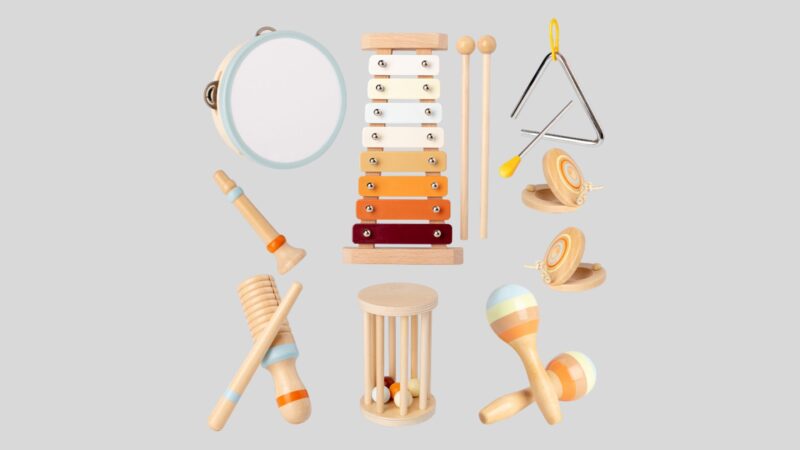
| Music toys | 2+ | USD 2.90–4.90 | 500–1,000 | 42.5×36.5×33 cm | 20 |
| Pretend play (kitchen, tools, food) | 3+ | USD 30–65 | 100–500 | Flat pack, 1–2 per carton | 1–2 |
| Pull-along and push-along | 1–3 | USD 3–8 | 500 | 47.7×22.5×38 cm | 10 |
| Ride-ons and balance bikes | 2–5 | USD 13–25 | 400–1,000 | 56×16×31.5 cm | 1 |
| Games and 3D puzzles | 5+ | USD 2–6 | 500–1,000 | Varies | 12–24 |
Four of these rows deserve a sentence each.
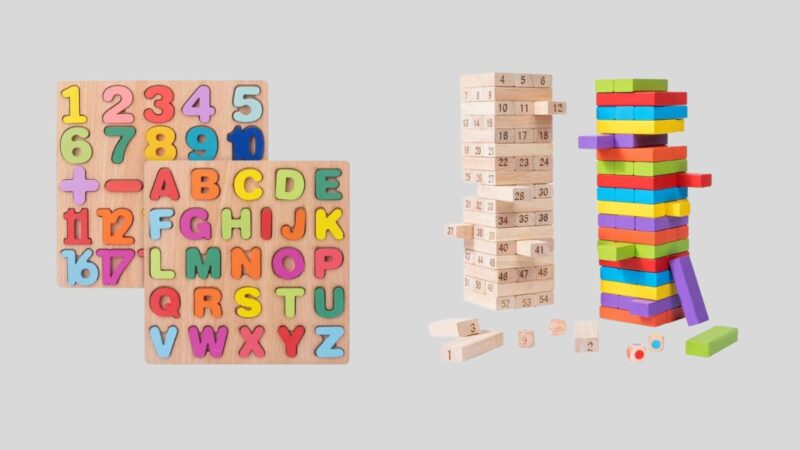
Building blocks are the volume product. A block set is small, light, and sells in every market. That is also why the price band is so wide: a 30-piece pine set and a 50-piece beech set are both “wooden blocks” and differ by 3×. Blocks are the easiest entry for a first order, and the hardest category to stand out in. Start with the building blocks wholesale side if you want stock shapes. If you want the educational angle, read what counts as an educational toy before you write the listing.
Puzzles and sorters have the lowest unit price and the highest design leverage. A laser-cut plywood puzzle has almost no tooling. You can test five designs for the cost of one plastic mould. Frame puzzles for toddlers and layered puzzles for older children are different products. Their carton sizes differ too, so check the cut style before you compare quotes. The jigsaw puzzle types breakdown covers the cut side.
Pretend play is where the money is, and where the freight hurts. A deluxe play kitchen runs USD 62–64 FOB. A dollhouse runs USD 30–50. Both ship flat-packed in a carton bigger than a balance bike’s, and both need a 3+ label plus edge and hinge testing.
Ride-ons are the worst freight per unit in the whole category. One bike per carton, at 0.028 CBM, means 1,000 bikes fill 28 CBM. The same 1,000 units of wooden xylophone fill 2.6 CBM. Hold that thought until the freight table below.
The Build Method Behind Each Type of Wooden Toy
This is the part the usual lists of types of wooden toys leave out.
Wooden toys have no steel mould. There is no cavity to cut, no shot weight to amortise, no 200,000-cycle tool life to pay off. The “tool” is a cutting file, a jig, or a profile knife. That one fact explains almost everything else about this category.
| Build | How it is made | Tooling | Best for | Cost shape |
|---|---|---|---|---|
| Turned | Round part spun against a shaped knife | Profile knife, cheap | Rings, beads, skittles, rattle bodies | Cheap at volume, limited to round shapes |
| CNC routed solid | Router cuts a shape from a board | Program plus fixture | Blocks, animals, puzzle bases | Medium, and shape changes are cheap |
| Laser-cut plywood | Flat sheet cut and layered | Cutting file only | Puzzles, stackers, inserts | Lowest tooling, more material waste |
| Finger-jointed panel | Short offcuts glued into a board | Jig only | Painted bodies, play food | Cheapest material |
| Flat-pack panel | Cut, drilled, edge-banded, buyer assembles | Cutting file plus drill jig | Kitchens, dollhouses, easels | High unit value, high volume |
Three consequences follow, and all three surprise first-time buyers.
First, low MOQ is real. A 500-piece order is not a favour. It is a normal run for a laser-cut puzzle. Do not let a supplier tell you 500 is impossible, and do not assume a low MOQ means low quality.
Second, price falls slowly with volume. In plastic, doubling the order can cut 30% because the mould spread shrinks. In wood, the cost is material, labour, and finishing. Doubling the order might save 8%. If a supplier offers 25% off at 10,000 pieces, ask what changed.
Third, the cost is in the sanding and the paint, not the wood. A block set has maybe 15 minutes of finishing per set. That labour is the same at 500 units and at 50,000. It does not amortise.
Which Wood Goes Into These Types of Wooden Toys
Species is the second biggest lever after labour. Density is quoted at 12% moisture content.
| Species | Density (kg/m³) | Cost | Where you see it | Watch out for |
|---|---|---|---|---|
| Pine | 420–510 | Lowest | Budget blocks, painted parts | Dents easily, knots, resin bleed |
| Rubberwood | 580–640 | Low | Painted blocks, puzzles, bodies | Needs proper kiln drying or it moulds in transit |
| Birch plywood | 620–700 (panel) | Mid | Puzzles, flat parts | Glue class decides the formaldehyde result |
| Beech | 710–730 | Mid-high | Rings, rattles, instruments | Heavier freight, higher price |
| MDF | 600–800 | Low | Painted panels, play kitchens | Swells when wet, formaldehyde |
| Maple and oak | 700–770 | High | Premium blocks | Weight and cost |
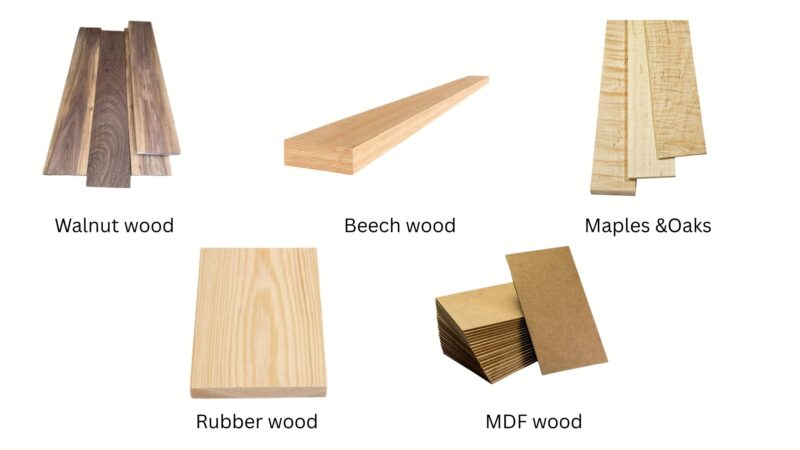
| Walnut | 650–670 | Very high | Decorative premium lines | Price, and colour variation between boards |
Rubberwood is the workhorse, and it is not a downgrade. It comes from Hevea trees after the latex years end. It is a plantation crop, dense enough to hold an edge, and cheap. The catch is moisture. Rubberwood carries sugar, and sugar plus 14% moisture plus a four-week ocean leg equals mould. Ask for 8–12% and ask for the kiln record.
MDF and plywood are not cheating. Half the play kitchens on the market are panel products with solid wood handles and legs. What matters is the glue. In the US, composite wood must meet TSCA Title VI: 0.05 ppm for hardwood plywood, 0.11 ppm for MDF, 0.13 ppm for thin MDF. In the EU, the panel is normally specified to E1. Those are two different numbers from two different rules, and a supplier who says “E0, very safe” has not answered either question.
One correction worth making. Plenty of articles warn that walnut toys carry a nut allergy risk. Walnut wood is not the nut. The allergy literature is about the kernel and about workshop dust. A sealed block puts neither in a child’s mouth. The real reason to think twice about walnut is price and how much the grain colour varies from board to board.
The Finish Is Where the Safety Risk Sits
Finish is the smallest line on the quote and the biggest line on a recall notice.
| Finish | What it is | Cost | The catch |
|---|---|---|---|
| Water-based acrylic | Pigment in an acrylic resin, water carrier | Mid | Pigment migration, so it needs EN 71-3 |
| Water-based lacquer | Clear or tinted film former | Mid | The film can chip, and a chip is a small part |
| Milk paint | Casein, lime, and pigment | High | Casein is a milk protein, so declare it |
| Unfinished or oiled | Sanded only, or linseed and beeswax | Lowest | No coating test, but no stain protection either |
| UV-cured | Cured under a UV lamp on a fast line | High setup | Clean, but only if the cure is complete |
Two things buyers get wrong here.
The AP Seal is not a toy certificate. The AP (Approved Product) Seal comes from the Art & Creative Materials Institute. It certifies an art material against ASTM D-4236 and the US labelling law. It says nothing about a coated toy block. If a supplier offers “AP certified paint” as proof of toy safety, ask for the EN 71-3 report instead.
Europe and the US measure different things. EN 71-3 measures how much of an element leaches out of the coating. For scraped-off coating, the EU limit for lead is 23 mg/kg and for cadmium 17 mg/kg. The US rule at 16 CFR 1303 measures how much lead is in the dry film: 90 ppm, total. A coating can pass the migration test and still fail the total-content test. That is why one report from one lab does not cover both markets.
The CE and EN71 certification process and the CPC route for Amazon are separate jobs. Budget for both if you sell in both markets, and pick the lab with the toy testing lab comparison rather than the cheapest quote.
The Age Band Changes the Test Bill, Not the Toy
The same stacking ring can be sold as a 0–3 teether or as a 3+ stacking toy. The toy does not change. The paperwork does.
| Age band | What it triggers | Effect on cost |
|---|---|---|
| 0–3 | Small parts test, plus the strictest chemical limits | Highest. Every part must survive the cylinder |
| 3–6 | No small parts test, standard EN 71-1/2/3 | Baseline |
| 6–14 | Same standards, looser play assumptions | Close to baseline |
| 14+ | Outside toy law in the EU and outside “children’s product” in the US | Lowest, and no CE toy marking |
Note the two US numbers, because they trip people up. A children’s product means 12 and under. A “toy” under ASTM F963 means under 14. The same object can be a children’s product and not a toy, or the reverse.
If your product is a teether, it will be in a mouth. Read the baby toy price guide before you fix the FOB. The test bill per SKU on a 0–3 item often decides whether you make 40% or 25%.
One Container Is Not Worth the Same in Every Type
This is the table that changes how people buy. Five real carton specs across types of wooden toys, all in the same 68 CBM of usable space in a 40HQ.
| Item | Units per carton | Carton size | CBM per carton | CBM per 1,000 units | Units per 40HQ |
|---|---|---|---|---|---|
| Wooden xylophone | 20 | 42.5×36.5×33 cm | 0.051 | 2.6 | 26,500 |
| Pull-along animal | 10 | 47.7×22.5×38 cm | 0.041 | 4.1 | 16,600 |
| Block set | 18 | 48.5×33×49.5 cm | 0.079 | 4.4 | 15,400 |
| Bead maze | 24 | 69.5×46.5×66.5 cm | 0.215 | 9.0 | 7,500 |
| Balance bike | 1 | 56×16×31.5 cm | 0.028 | 28.2 | 2,400 |
The per-unit spread is 11×. A xylophone takes 0.0026 CBM. A balance bike takes 0.028 CBM. Twelve xylophones fit in the space of one bike.
Now put money on it. A 40HQ of xylophones at USD 2.93 is about USD 78,000 of goods. A 40HQ of balance bikes at USD 15 is about USD 36,000. You need two containers of bikes to match one container of xylophones. The freight per dollar of goods is more than double.
And that bike carton is already partly knocked down. An 83 cm bike in a 56 cm carton means the front fork and handlebar ship loose. Ship it assembled and the carton is roughly 85×36×56 cm, or 0.17 CBM. That is six times the volume for the same unit.
This is why an experienced buyer asks two questions before the price: can it ship flat, and can two units go in one carton? Chasing a 5% FOB cut while ignoring a 6× freight jump is the most common mistake in this category. The freight and consolidation service page covers how groupage handles mixed cartons. The PPWR packaging rules decide what the outer box can be made of.
What to Put in the RFQ
Send these eight lines and you will get comparable quotes back.
| Line | What to write | Why it matters |
|---|---|---|
| 1 | Product type and age band | Sets the test route and the label |
| 2 | Species, or panel type and grade | 30% of the cost, and the formaldehyde answer |
| 3 | Finish and target market standard | Decides which lab report you need |
| 4 | Unit size, carton quantity, carton dimensions | The only way to compare freight |
| 5 | MOQ per colour and per SKU | Colour changes reset the paint batch |
| 6 | Incoterm and named port | FOB Ningbo and FOB Shantou are not the same number |
| 7 | Sample cost, lead time, refundable or not | Filters out traders in one step |
| 8 | Test report: which lab, which standard, how old | An old report is not a report |
Two lines do most of the work. Line 4 exposes suppliers who quote a price without knowing their own carton. Line 8 exposes suppliers who forward someone else’s PDF.
Where These Toys Are Actually Made
Production of all these types of wooden toys clusters in a few places in China. The cluster tells you what the factory is good at. Zhejiang (Yunhe and Lishui) is the centre for wooden puzzles, board games, and small painted parts. Shandong and Fujian handle larger panel goods and painted furniture-style items. Shantou is the volume hub for mixed toy orders, and its toy cluster is worth understanding before you book a trip. The Shantou sourcing guide covers how small mixed orders are grouped before they ship.
If you are choosing between factories rather than between types of wooden toys, the factory vetting checklist is the faster read.
Four Things Buyers Get Wrong
“Solid wood” usually means solid parts. A play kitchen listed as solid wood is normally a plywood or MDF carcass with solid wood handles, legs, and knobs. Ask which parts are solid and which are panel. A supplier who cannot answer in one line is guessing.
A low FOB is not a low landed cost. A USD 0.30 saving on a pine block disappears the first time a carton arrives with a split panel. You pay freight both ways on the replacement.
“Eco-friendly paint” is not a standard. It is a mood. Ask for the EN 71-3 report number and the date. Then ask which of the three migration categories the coating was tested under.
Wooden toys are not automatically covered by the EU deforestation rules. The EUDR applies by customs code, not by material. Wooden toys sit in CN 9503, and 9503 is not in Annex I. That does not stop a European buyer sending you a timber questionnaire. Answer it anyway, because losing an order over a rule that does not apply is still losing the order.
One forward-looking note. Regulation (EU) 2025/2509 is already in force, and it applies in full from 1 August 2030. It brings a digital product passport and tighter chemical limits. Any tooling or artwork decision you make now should assume that passport exists by the time the product is mature in the market.
FAQ
What are the main types of wooden toys? Eight product types cover most of the trade: blocks, puzzles and sorters, sensory and teething, music, pretend play, pull-along, ride-ons, and games. Every one of those types of wooden toys then splits by build method, species, finish, and age band.
Which type is easiest for a first order? Laser-cut plywood puzzles or a standard block set. Both have low tooling, a 500–1,000 MOQ, and a small carton. Avoid play kitchens and ride-ons on a first order, because the freight per unit is high and the damage rate is higher.
Is solid wood better than MDF? Not automatically. Solid wood handles impact better and repairs more cleanly. MDF holds a painted edge and a flat panel better, and costs less. The real question is where the toy will be used. A wet bathroom and a playroom need different answers.
Why is the MOQ lower than for plastic toys? Because there is no mould. A plastic toy needs a steel cavity that costs thousands before the first unit exists. A wooden toy needs a cutting file. The cost that normally forces a high MOQ is simply not there.
Do wooden toys need EN 71? Yes, if they are toys for children under 14 and sold in the EU. EN 71-1 covers physical and mechanical safety, EN 71-2 flammability, and EN 71-3 migration of elements. The paint report matters most, and it must name the coating category.
What moisture content should I specify? 8% to 12%, measured at the time of packing, with the test method named in the spec. Below 8% the part gets brittle in a dry container. Above 12% you risk mould on a long ocean leg, especially in rubberwood.
How long does production take? 25 to 40 days after sample approval and deposit for a stock design with your logo. A new design adds 10 to 20 days for sampling and artwork. Custom packaging adds another week if the box printer is busy.
How do I compare two quotes that look different? Convert both to a landed cost per unit. Add freight from CBM, add duty from the tariff code, add the test cost divided by your order quantity. The import duty guide covers the tariff side. The step by step import process covers the rest.
Do you supply these types of wooden toys? Yes. The wooden toys wholesale range covers stock designs and private label, and the Montessori wooden range covers the classroom side. For a mixed order across several types, an educational toys wholesale basket usually consolidates better than three separate suppliers.
Next Step
Pick the one type you want to test. Send us the age band, the species, and the carton size you can live with. We will come back with a factory shortlist, a carton plan, and a landed cost per unit.
That is more useful than another list of types of wooden toys. It is the same list, with the numbers attached.
Contact the sourcing team or email info@tonysourcing.com.