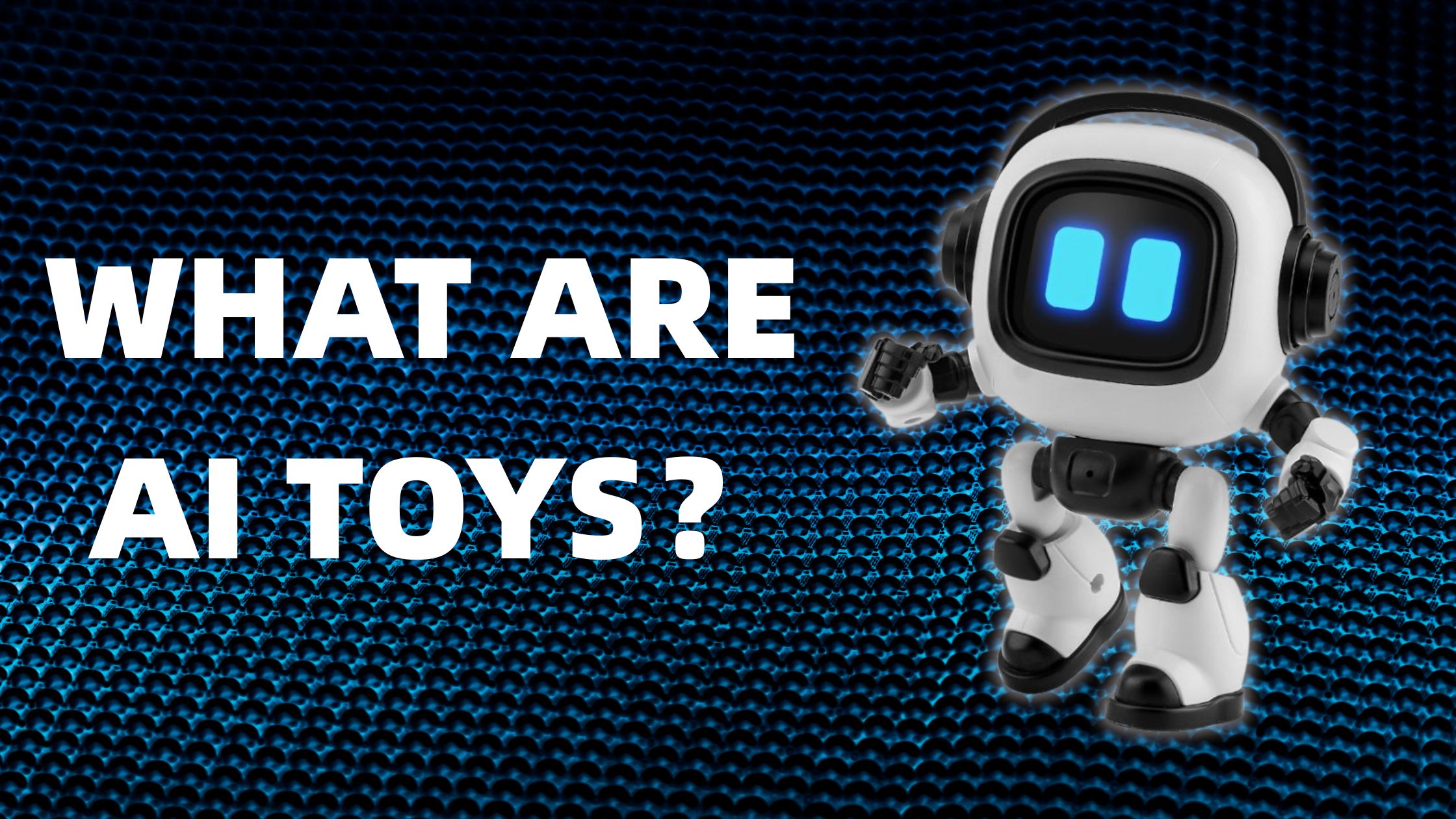
What Are AI Toys? Four Products in One Box, and Only One Gets Tested
Ask ten factories what are AI toys and you get ten answers. Most of them describe the box, not the product. That is the problem this page fixes.
Here is the short version. An AI toy takes an input the factory did not write, and gives back an answer the factory did not record.
That is it. Everything else is decoration.
The rest of this page turns that sentence into money. It tells you what to test, what to pay, and what to write on your purchase order.
1. What Are AI Toys? One Sentence and a Three-Question Test
A toy that dances when you press a button is not an AI toy. A toy that plays one of forty recorded songs when you press a button is not an AI toy either. Both are electronic toys, and both can be excellent products.
An AI toy does something else. It listens, works out what was said, and builds a reply that did not exist before.
You do not need a lab to check this. You need three questions, and you need to ask them in the sample room.
| Test | What you do | It is a real AI toy if | It is not if |
|---|---|---|---|
| 1. The off-script question | Ask something no marketing team would plan for | It answers, in its own words | It says a fixed line, or goes quiet |
| 2. The follow-up | Refer back to what you said a minute ago | It remembers the thread | It starts over every time |
| 3. The Wi-Fi pull | Turn the router off, then ask again | It tells you, or it still answers | It fails silently and looks broken |
Run all three. A toy that passes one is a toy with a microphone. A toy that passes three is an AI toy. A toy that passes none is an electronic toy with an AI sticker.
That last row is not a small group. In Shenzhen’s Huaqiangbei electronics market, the going rate to make an ordinary plush toy talk is about ¥200 and half an hour of work (TMTPost, October 2026). The result says “AI” on the hangtag.
If you want the wider category map first, our guide to interactive toys covers where these products sit on a shelf. This page stays on the narrower question: what makes one of them an AI toy.
AI Toy, Connected Toy, Smart Toy: Three Different Words
These get used as if they mean the same thing. They do not.
- AI toy describes *how it answers*.
- Connected toy describes *how it connects*.
- Smart toy describes nothing at all. It is a shelf label.
A toy can be connected without being intelligent. A toy can run a small model on the device and never touch the internet. “Smart” on the box is not evidence of either.
So when a supplier tells you a product is an AI toy, the useful follow-up is not “really?”. It is: what runs on the device, and what runs in the cloud?
One boundary is worth drawing. An AI toy is not the same claim as a STEM toy. A STEM claim is about what the child does; an AI claim is about what the machine does. A build-it-yourself coding robot can be both, and often is. If the STEM side is what you are selling, read what is a STEM toy and our STEM educational toy wholesale guide first — the box copy and the test plan are different.
2. Why Do the Market Numbers Disagree by 30 Times?
Four research firms published a 2025 figure for this market. Here is what they said.
| Who | What they counted | 2025 global figure |
|---|---|---|
| APO Research | AI toys | US$8.12 billion |
| SNS Insider | Smart AI toys | US$18.52 billion |
| Statista (via trade press) | AI toys, broadest scope | US$31.2 billion |
| PW Consulting | AI robot toys only | US$0.98 billion |
Same year. Same words. A 32x gap between the top and the bottom.
You see the same blur on price. Our toy price list and Yiwu toy price and MOQ pages both show ranges rather than single numbers, for the same reason: until you fix the specification, there is no single number to quote.
China’s own numbers disagree in the same way. The Ministry of Industry and Information Technology put the 2025 China AI toy market at about ¥29 billion, rising to about ¥34.2 billion in 2026. The Shenzhen Toy Industry Association and JD.com told MIT Technology Review the same market could pass ¥100 billion by 2030. Another research house put 2030 at ¥85 billion.
Why the mess? Because of the question on this page. There is no agreed answer to what are AI toys, so every analyst counts a different shelf.
If the analysts cannot agree, your customer will not either. Your product page has to say what yours does, in plain words, before someone else says it for you.
3. What Is Inside the Box? Follow the Money
This is the part most buyers get wrong, and it costs them real money in negotiation.
Take a ¥99 AI plush cat sold in China. A teardown by TMTPost in October 2026 traced where the money goes. Here is the bill of materials.
| Part | Cost | Who said it |
|---|---|---|
| Connect-and-control chip | Under US$1 (5 mm square, 22nm or 40nm, made in mainland China) | Tang Zhenzhong, CEO of Zhuhai Taixin Semiconductor |
| Wi-Fi / Bluetooth module | ¥8–12 per unit; Espressif’s ESP32 family holds 45% of the global AI toy module market at roughly 40% gross margin | Hua’an Securities supply-chain research, July 2026 |
| Communication module | About ¥14 | Same research |
| Battery, speaker, stuffing, touch sensor | ¥30–40 combined | Same research |
| Total hardware BOM | Under ¥80 | Same research |
| The AI itself, pay-per-call | ¥0.001 per call (iFlytek Spark Kids). Fifty calls a day for a year is about ¥18 | iFlytek pricing |
| The AI itself, one-off licence | About ¥10, capped under ¥20 per device (Baidu AI Cloud) | Baidu AI Cloud |
Now read that table again.
The AI is the cheapest line on the sheet. By call volume, it is 1–2% of the retail price. Even at the most expensive one-off licence, it caps out near 10%.
So what is the other ~¥70 buying? Not a smarter toy. It is buying the right to run AI at all: a chip that can connect, a module that can carry voice, and a battery big enough to hold a conversation.
Here is the practical use. When you sit down to negotiate, the lever that moves is the hardware and the tooling. The model fee is already near zero. Do not spend your negotiating energy on the cheapest line item.
For a sense of what the hardware side normally costs before any AI is added, our baby toy wholesale price guide breaks down where factory quotes come from.
4. An AI Toy Is Four Products in One Box. Only One Gets Tested
This is the section that changes your compliance budget.
A normal plush toy is one product. An AI toy is four, stacked in the same box. Each layer has its own rulebook, its own test, and its own certificate.
| Layer | What it really is | United States | European Union |
|---|---|---|---|
| 1. A toy | Choking, sharp edges, fire, lead | ASTM F963-23, mandatory under 16 CFR 1250 since 20 April 2024 (89 FR 3344), plus CPSIA | EN71; from 1 August 2030 the new Toy Safety Regulation (EU) 2025/2509 replaces 2009/48/EC |
| 2. A radio device | It has Wi-Fi or Bluetooth inside | FCC equipment authorisation | RED 2014/53/EU, plus EMC |
| 3. A battery device | It has a rechargeable cell and a charging circuit | Battery access and abuse testing, tightened in F963-23; UL 62115 for electrics | Battery Regulation (EU) 2023/1542; EN62115 |
| 4. A data device | It has a microphone and a child’s voice | COPPA | GDPR, plus the EU AI Act |
Our toy certification page sets out how these stack on a normal toy. The CE, EN71, ASTM and CPSIA certificate guide goes deeper on what each one actually proves.
Layers one to three are familiar. Most importers already budget for them.
Layer four is where orders die.
The Toy Layer Still Applies First
This is worth saying plainly, because suppliers sometimes argue otherwise. The new EU Toy Safety Regulation covers products for children under 14 “regardless of whether they have other additional functions.” An AI toy does not stop being a toy because it can talk.
The EU regulation also replaces the old declaration of conformity with a Digital Product Passport. It entered into force on 1 January 2026 and applies in full from 1 August 2030. If you are planning a product now, plan the passport now.
The Data Layer: What Changed Recently
Two things changed, and both landed on buyers.
In the US, a child’s voice is now personal information. The FTC’s 2025 amendments to the COPPA Rule were published on 22 April 2025, took effect on 23 June 2025, and required full compliance from 22 April 2026. Three points matter for an AI toy:
- Voiceprints are now personal information, alongside face templates and fingerprints.
- Sharing with a third party needs its own verifiable parental consent. The rule says plainly that AI training is not “integral” to the service, so it does not ride along with the main consent.
- You need a written security programme and a written retention policy. You cannot keep children’s data forever.
Civil penalties currently run at US$53,088 per violation.
In the EU, the toy has to admit it is an AI. Article 50 of the EU AI Act has applied since 2 August 2026. Any system that talks to people must let them know they are talking to a machine. The Commission’s guidance puts companion AI, virtual characters and interactive AI agents squarely in scope, and says that where children may be exposed, their cognitive characteristics must be factored into the assessment. A lifelike robot pet has to say so.
Fines reach €15 million or 3% of worldwide turnover.
One piece of good news, and do not over-read it. The EU AI Act’s heavy high-risk duties for products under Annex I were pushed to 2 August 2028 by the Digital Omnibus, Regulation (EU) 2026/1744, in force 27 July 2026. The Omnibus also narrowed what counts as a safety component: AI that only helps, optimises or automates, and whose failure would not risk health or safety, is not a safety component. Most AI toys are therefore not high-risk today. But that is a judgement about your product, not a blanket rule. Get it checked.
The Gap Nobody Has Closed
Here is the uncomfortable part for an importer.
In the United States there is still no federal safety standard for the hazards created by the AI inside a toy. The existing rules cover choking, fire and chemicals. The CPSC has told Congress it does not have authority over non-physical harm such as mental or emotional injury.
That gap is closing, slowly:
- S.5171, the Children’s Artificial Intelligence Toy Safety Act of 2026, was introduced on 29 July 2026 by Senators Duckworth and Murkowski. The Senate Commerce Committee reported it favourably on 5 August 2026. It is not yet law.
- Maryland has already enacted child-safety, data-privacy and labelling requirements for AI-enabled toys.
- In December 2025, U.S. PIRG Education Fund testing found some AI toys discussing sexually explicit content and telling children where to find knives, pills and matches in the home.
- The FTC has opened an inquiry into AI companion chatbots and children.
Read that list as a buyer, not a lawyer. Where there is no standard, the importer and the brand carry the risk. Nobody else is holding it.
5. What Do the Four Layers Cost You in Testing?
Here is the part that shows up on your invoice.
A 2026 cost breakdown from testing house RTS gives typical per-model ranges for a Children’s Product Certificate:
| Product type | Typical testing cost per model |
|---|---|
| Plastic toy, no battery | US$1,800–3,500 |
| Plush fabric toy | US$2,200–4,200 |
| Battery-driven toy (+ phthalates, UL 62115 electrics, battery access) | US$3,500–7,000 |
Every AI toy lands in the third row. Adding a battery and a circuit roughly doubles your test bill before you touch the AI.
Then add the filings. Since 8 July 2026, US importers must submit certificate data electronically to CPSC and CBP before goods enter commerce. That is the eFiling rule, and it applies to regulated consumer products including de minimis shipments. Goods routed through a Foreign Trade Zone get until 8 January 2027. Our CPSC eFiling page walks through the data fields.
If you sell through Amazon, add the marketplace layer on top. The US Amazon toy CPC guide and the page on Amazon compliance for kids’ items cover what the platform asks for beyond the law.
eFiling creates no new testing duty. It does mean your certificate data has to be clean, consistent and ready *before* the ship docks. That is a paperwork deadline, and paperwork deadlines stop containers.
6. Five Questions to Put in Your RFQ
Do not ask “is it AI?”. Ask these instead. Put them in writing, and make the factory answer in writing.
| # | Ask this | Why it matters |
|---|---|---|
| 1 | Does it generate a new reply, or pick one from a fixed library? | Decides whether you are buying an AI toy or a recording |
| 2 | What runs on the device, and what runs in the cloud? What still works with no Wi-Fi? | Decides the offline experience and your return rate |
| 3 | Who holds the child’s voice data, where is it stored, and how long is it kept? | Decides your COPPA and GDPR exposure |
| 4 | How long will the servers run, and what happens when they stop? | A dead server turns a talking toy into rubbish |
| 5 | What happens when the subscription lapses? | Decides whether the product still works next year |
Question four sounds paranoid. It is not. FoloToy’s published security-update policy, effective 18 March 2026, commits to updates only until 31 December 2030. That is a good, honest policy — and it is still an end date. Ask for yours in writing.
Also worth knowing: no company in this category has published daily active user figures. One practitioner admitted to Caixin that usage is high for the first two weeks, and by week three some users stop switching the toy on. Plan your reorder around that, not around the demo.
7. What Does It Cost to Make One, and What Is the MOQ?
Numbers below are a rough guide, not a promise. They come from factory listings and industry write-ups in 2026. Your final figures depend on the feature stack, the tooling and the size of the run.
| Item | Typical range |
|---|---|
| MOQ, existing tooling (公模) | 1,000–2,000 pcs |
| MOQ, your own tooling (私模) | 3,000–5,000 pcs, because mould cost is spread over the run |
| MOQ, low-end or stock platform | Some factories start at 200–500 pcs |
| Lead time, stock platform with your logo | About 1 week |
| Lead time, appearance changes | 10–15 days |
| Lead time, standard configuration | 25–35 days |
| Lead time, brand-new tooling | 45–60 days |
| Development, standard feature set | 30–45 days |
| Development, new mould + deep AI work + app | 60–90 days |
Certification you should expect a serious factory to hold or obtain:
- US: FCC, ASTM F963, CPSIA
- EU: CE covering RED and EMC, EN71, EN62115, RoHS, REACH
Ask which of these the factory already holds. A factory that already holds them can save you both money and weeks. A factory that cannot name them will cost you both. Our list of toy testing labs for CE, ASTM and EN71 is a place to start if you need to commission testing yourself.
On payment, the usual shape is a deposit before production and the balance against the bill of lading, by T/T. Samples are normally charged and then credited back against a bulk order. Carton specs matter more here than for a normal plush: a talking toy is heavier, and batteries change how your freight is classified. Confirm three things before you book: carton size, carton weight, and battery paperwork. Lithium cells change how a shipment is classified. Our shipping from China to the US guide covers that. The freight forwarder page covers who to hand it to.
For the custom side, custom plush toy manufacturing is the closest analogue to an AI plush build, and custom toy packaging matters more than usual here, because the box has to carry the AI disclosure.
8. What Actually Kills an AI Toy Order? (Not the Model)
Here is the pattern that keeps repeating, and it is not a model problem.
Returns are brutal. E-commerce return rates for AI plush run at 30–40%, and live-stream sales have hit 80%. Tech Planet puts the category norm above 50%, and reports one influencer with over ten million followers selling more than 10,000 units in a single session and getting six in ten back.
And some brands hold it to 8%. Ten times better. What separates them is not a better model. It is app onboarding, a Wi-Fi setup guide that works, follow-up customer service, and a membership that keeps content fresh. Unglamorous work, and it is the whole game.
The product itself often is not ready. Consumer councils in Yunnan, Guizhou and Guangxi ran a comparative test on 15 AI toys, using 75% as the pass line. Seven failed on voice-interaction success rate. Their wording: the toys “frequently gave irrelevant answers or played deaf.”
Ask parents what annoys them and you get the same list. A March 2026 consumer survey by iiMedia Research found the top three complaints were short battery life, safety worries, and slow or missed responses — each around a fifth of respondents. The lowest satisfaction scores were for value for money and how often content gets updated.
Notice what is not on that list. Nobody is complaining about which large language model is inside.
So the specification you write should not lead with the model. Lead with battery hours, wake-word success rate in a noisy room, response time, and how often the content library refreshes. Those four decide whether the toy survives week three.
9. Where AI Toys Are Actually Made
The supply chain splits by layer, and it is worth knowing which layer you are buying.
Shantou Chenghai — the body. Around 6 million toys a day leave Chenghai, and close to half of China’s plastic toys come from there. The “one-kilometre chain” is real: plastic pellet to finished product inside 50 km. Manufacturing cost runs maybe 30–40% below overseas equivalents. We cover the district in Chenghai, capital of toys and the Chenghai International Toys & Gifts Fair.
The flip side is that Chenghai’s factories are the weakest negotiator on the chain. OEM gross margins there are commonly under 10%. One Dongguan contract manufacturer took a million-unit order for an Amazon smart bear and cleared ¥2.30 per unit. Cheap, yes. Fragile, also yes — a factory at that margin has very little room to absorb a problem.
Shenzhen — the brain. Modules, chips and cloud platforms. Espressif, Tuya and Fibocom sit here. Fibocom sells a bundled Cat.1 module plus model package, with 2025 shipments expected above 8 million units.
Dongguan and Huizhou — the plush. The soft body, the sewing, the embroidery.
Yiwu — small-batch and gift channels. Best for testing demand before you commit to tooling.
If this is your first import, import toys from China covers the process end to end, and China’s top toy wholesale markets maps where each cluster sits.
One more number, with a warning attached. Business registry data cited by MIT Technology Review put more than 1,500 AI-toy companies in China as of October 2025. Registry data does not mean 1,500 capable factories. Most are not active, and plenty are not really toy makers. Treat it as noise, not a supplier list.
If you are building a shortlist rather than browsing a marketplace, start with how to find the best toy manufacturers in China and how to import toys from Shantou. Our comparison of Alibaba versus direct toy factories explains why the factory route usually wins once electronics are involved.
10. Frequently Asked Questions
What are AI toys, in one sentence? An AI toy is a physical toy that takes an input the factory did not write and returns an answer the factory did not record. If every reply was recorded in advance, it is an electronic toy.
Is a talking doll an AI toy? Usually not. If it plays one of a fixed set of recorded phrases when you press a button or say a keyword, it is an electronic toy with voice control. Ask an off-script question: a real AI toy answers, a recording dodges. See what are electronic toys for the wider category, and custom baby toys if you want the simplest version of the same build.
What are AI toys used for, and who buys them? Three jobs, mostly: companionship, language and homework help, and open-ended play. Educational buyers usually want the second, and should compare against science toy wholesale ranges before paying an AI premium for content a cheaper product already covers.
Are AI toys safe, and is there a standard for the AI itself? The physical side is well covered: ASTM F963-23 in the US, EN71 in the EU. The AI side is not. There is no US federal safety standard for non-physical harm from an AI inside a toy, and the CPSC has told Congress it lacks authority over mental or emotional harm. Maryland has legislated; a federal bill passed committee in August 2026 but is not law.
What certifications does an AI toy need? At minimum: toy safety (ASTM F963 + CPSIA for the US, EN71 for the EU), radio (FCC or RED), electrical and battery (UL 62115 / EN62115), and chemical (RoHS, REACH). Then the data layer: COPPA in the US, GDPR plus AI Act transparency in the EU. The toy certification page lists these in the order you will need them.
Do AI toys work without Wi-Fi? Some do, some go silent, and some fail in a way that looks broken. This is the single most useful question on your sample checklist, because it drives your return rate.
What is the MOQ for a custom AI toy? Commonly 1,000–2,000 pieces on existing tooling and 3,000–5,000 on your own mould. Some factories quote 200–500 for simple projects. Treat all of it as a rough guide, and compare it against the Yiwu toy price and MOQ benchmarks.
Can I put my own character and voice on it? Yes, and that is the main reason to do OEM here. You can usually specify the character design, the voice persona, the language set, the safety filters and the story library. Confirm in writing who owns the content and the voice data. The mechanics are close to OEM toy manufacturing and to creating your own block toy, with one extra contract: the voice and content rights.
How is an AI toy order paid for, and shipped? Payment is normally a deposit before production and the balance against the bill of lading, by T/T. On shipping, budget for more than a normal plush: the battery adds weight, and lithium cells need their own paperwork and sometimes a different freight class. Get the carton spec confirmed before you book space.
How long is the lead time? About a week for stock with your logo, 25–35 days for a standard configuration, and 45–60 days if new tooling is involved. Deep custom work with an app runs 60–90 days. If you are planning a Q4 shelf, our novelty toys for 2026 roundup shows what else is competing for the same factory slots.
11. What to Do Next
Three things, in order.
First, get the definition in writing. Before you pay for tooling, make the factory state what runs on the device, what runs in the cloud, and what happens with no signal. One page. It prevents most disputes. If you only remember one line from this page, remember that what are AI toys is a question you answer on paper, not on a hangtag.
Second, budget for four products, not one. Test the toy, the radio, the battery and the data. If your quote only covers the first, your certificate will not clear customs.
Third, test week three, not minute one. Battery hours, wake rate in a noisy room, response time, content refresh. Those decide whether the product comes back to you in a box. Our notes on toy product development cover where these checks belong in a project plan.
Sourcing AI toys means checking four layers before you pay for tooling. Our team works across Chenghai, Shenzhen and Dongguan. We can put the whole stack under one order: electronics, plush, certification and packing. That is the model behind our all-in-one supply service for toy wholesalers. It is also how we handle custom products for Amazon and Shopify sellers.
Talk to TonySourcing about your AI toy project.